Le jour des funérailles - Scène du Maroc
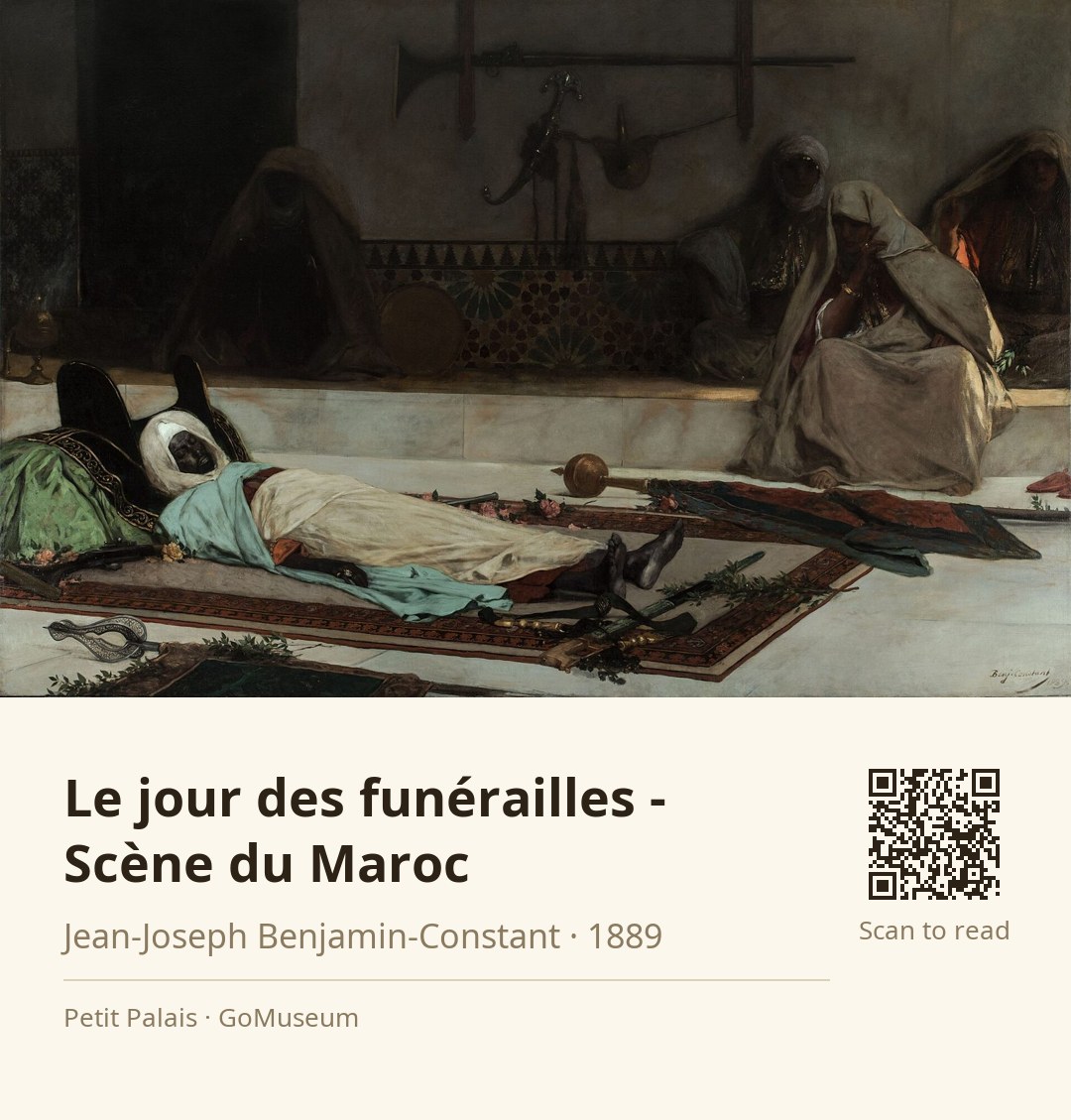
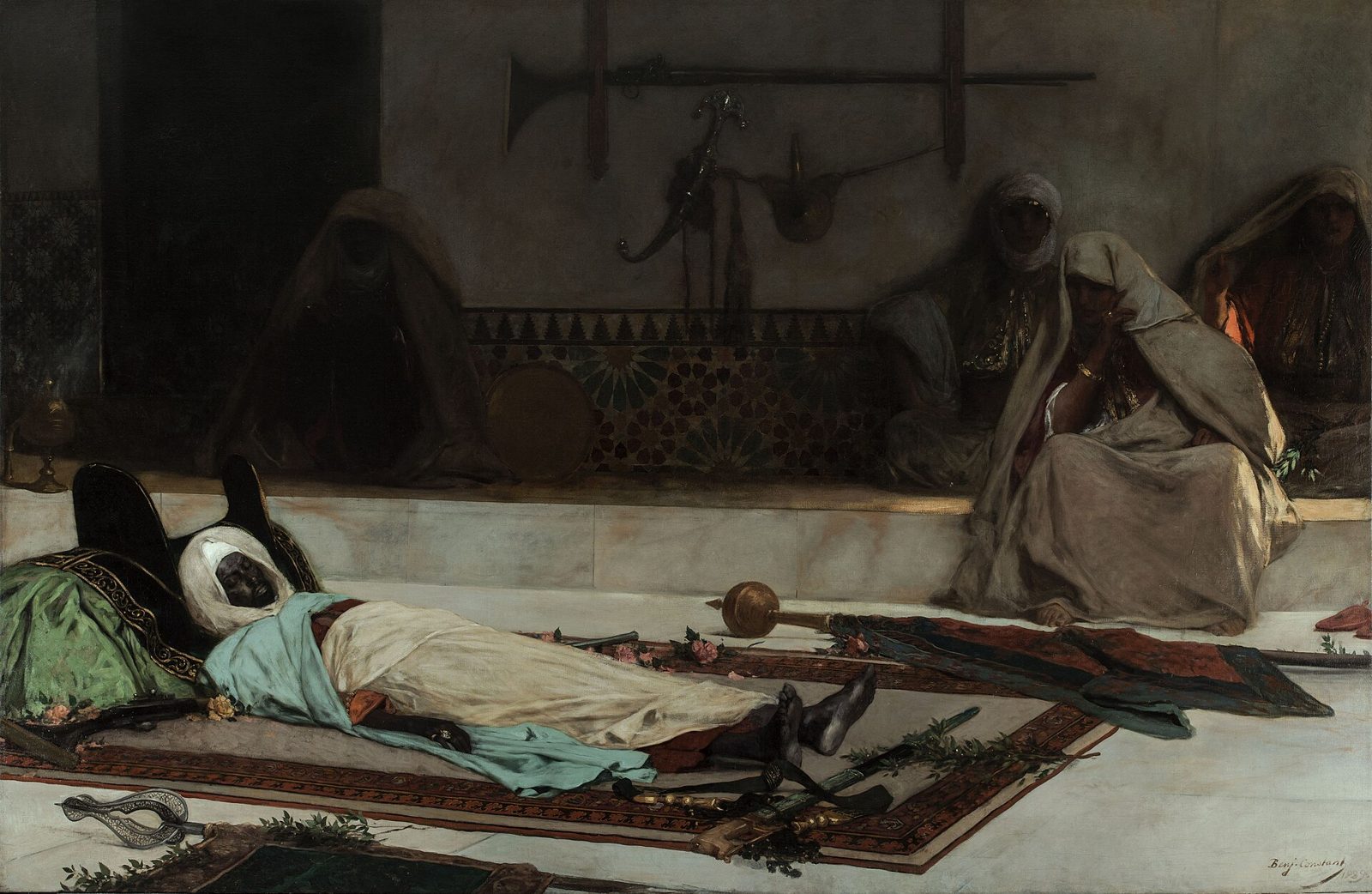
🎧 This work has audio narration — listen in the appThe central figure in "Le jour des funérailles - Scène du Maroc" lies solemnly on a richly adorned carpet, enveloped in white and pale blue garments, with a dark face partially veiled. Surrounding him are swords and a musical instrument, hinting at the cultural significance of this moment. The muted color palette, dominated by dark tones in the background, contrasts with the vibrant hues of the foreground, enhancing the sense of stillness and reverence that permeates the scene.
This painting captures a wake in a Moroccan interior, reflecting the artist’s fascination with Orientalism, a theme prevalent in his work. The body rests on a carpet strewn with roses and olive branches, symbolizing both mourning and respect. Behind him, four women, illuminated by the warm light of the setting sun, watch over the deceased, their presence underscoring the communal aspect of grief. The geometric designs of the patterned wall and the incense burner add layers of cultural context, evoking the rich traditions surrounding death in Moroccan society.
Created in 1889, this piece marked the end of Benjamin-Constant’s orientalist phase. It was later modified by the artist, who replaced a background window with a black veil, further emphasizing the somber mood.
Jean-Joseph Benjamin-Constant, born on June 10, 1845, in Paris, was a prominent French painter and etcher celebrated for his Orientalist themes and exquisite portraits. He studied at the École des Beaux-Arts in Toulouse under Alexandre Cabanel, and a transformative trip to Morocco in 1872 deepened his fascination with Orientalism, leading to notable works like "Last Rebels" and "Justice in the Harem." His large canvas, "The Entrance of Mahomet II into Constantinople," garnered acclaim and a medal in 1876.
After 1880, Benjamin-Constant shifted his focus to mural decorations and portraiture, becoming a favored artist among the British aristocracy. His significant works include murals in the Hôtel de Ville in Paris and portraits of notable figures like Queen Victoria and Pope Leo XIII. He was a respected educator at Académie Julian, influencing artists such as Henry Ossawa Tanner.
A member of the Académie des Beaux-Arts and a commander of the Legion of Honor, Benjamin-Constant's legacy endures through his contributions to Orientalism and portrait painting, marking him as a significant figure in late 19th-century art history. He passed away on May 26, 1902, in Paris.
Created in 1889, 'Le jour des funérailles - Scène du Maroc' was the last of Jean-Joseph Benjamin-Constant’s orientalist works. This painting emerged after a significant period in the artist's life, marked by his travels in Morocco over two decades earlier. Despite its rich narrative and visual appeal, the painting did not sell at the Salon and failed to garner any awards. In a later revision, Benjamin-Constant replaced a window in the background with a black veil, deepening the painting's somber tone. The artwork was donated to the Petit Palais in Paris by his widow, Catherine-Jeanne Constant, in 1905, and initially titled 'La Mort de l’Emir.' Over the years, it has been featured in various exhibitions, including a notable one in 2015 at the Montreal Museum of Fine Arts, showcasing the artist's influence on Orientalism during the Third Republic in France.
This painting is a striking example of Benjamin-Constant's mastery of oil on canvas, measuring an impressive 278 by 428 centimeters. The artist's brushwork is both deliberate and fluid, creating a sense of movement within the stillness of the scene. The muted color palette, dominated by dark tones in the background, contrasts sharply with the vibrant hues of the foreground, drawing your attention to the central figure. The warm light of the setting sun bathes the women in golden tones, enhancing their emotional presence. The geometric patterns on the walls, inspired by the Alhambra, not only provide cultural context but also guide the viewer's eye throughout the composition. Each element, from the richly decorated carpet to the carefully arranged objects, contributes to a layered narrative of mourning and respect, inviting you to feel the weight of the moment.
Despite its artistic merit, the painting did not sell at the Salon and failed to receive any awards.
The painting has been featured in various exhibitions, including a significant one in 2015 at the Montreal Museum of Fine Arts.
Benjamin-Constant was recognized as a member of the institute in 1893 and was made a commander of the Legion of Honor.