 Image: Sailko
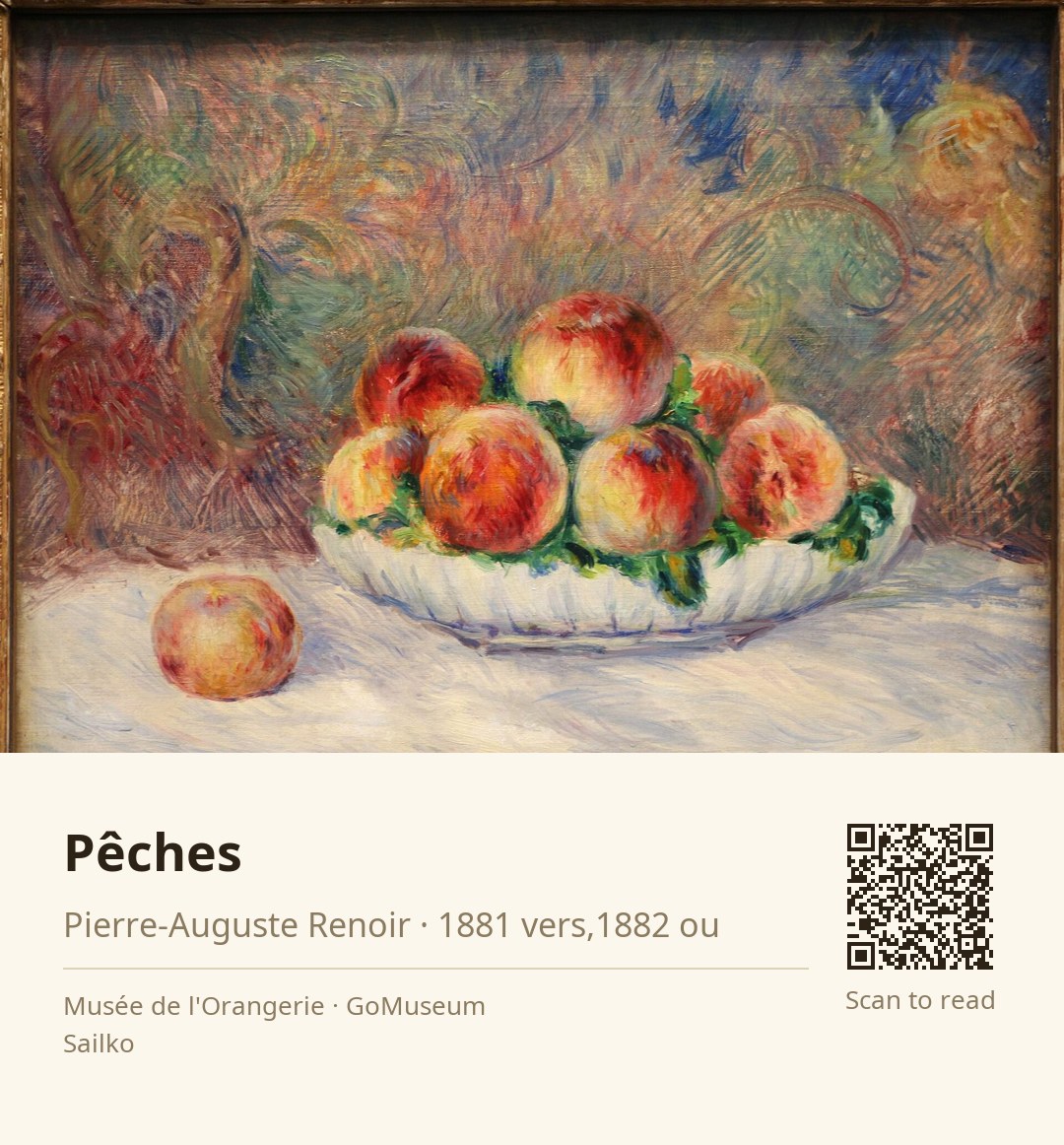
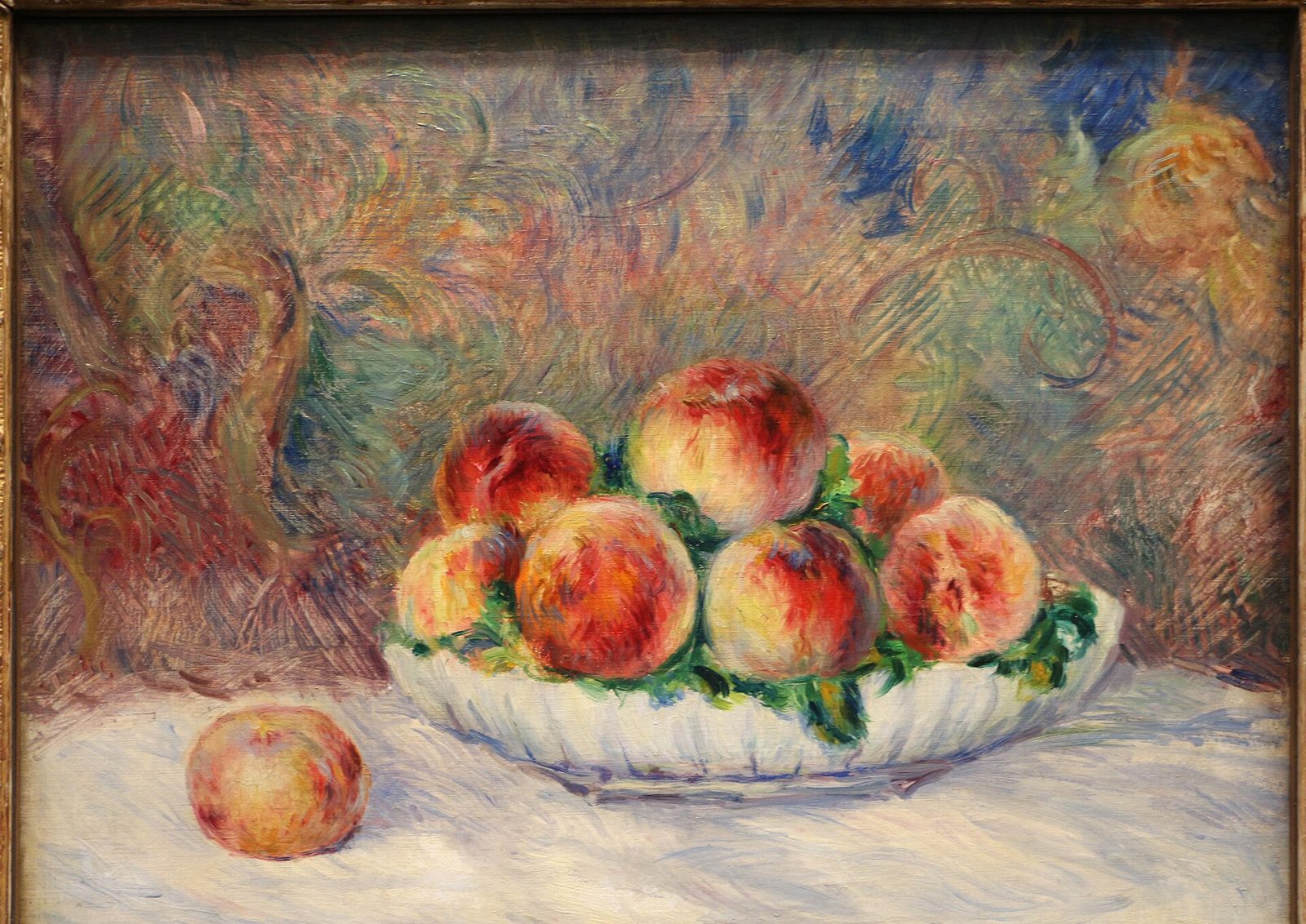
Eight peaches, and one of them sits all by itself at the lower left, as if it wandered off the pile. The rest are heaped in a shallow white dish, their skins a blend of red, orange, yellow and cream, with green leaves tucked between them and spilling over the rim. Look at how the dish's fluted edge catches a faint blue shadow, and how the cloth beneath is built not from smooth folds but from broad, loose strokes of white, lavender and blue, so the whole table seems to hum with fresh color. Behind it all, the background is a dense weave of short, feathery strokes in rust, green, pink and blue, with a darker mass at the left that may be a vessel, though the paint never settles on what it is. The surface is thick throughout, the marks of the brush left plainly standing.
What the material gives us about the painter is his road to this point. Pierre-Auguste Renoir was born in Limoges in 1841, the son of a tailor, and his family moved to Paris when he was a small boy.
This still life is held in the museum under inventory number RF 1963-16, and its later history passed through the hands of the dealer Ambroise Vollard before reaching Paul Guillaume and then the collection of Madame Jean Walter. It was shown in Paris in 1942, at the Galerie Charpentier exhibition on flowers and fruit since Romanticism, and again in 1946 in the exhibition devoted to still life. Its date is given as around 1881 or 1882, a period when Renoir was rethinking his palette and his way of building form.
Pierre-Auguste Renoir, born on February 25, 1841, in Limoges, France, emerged as a pivotal figure in the Impressionist movement. His early life in a modest family led him to Paris, where he honed his artistic skills amidst the masterpieces of the Louvre. Initially apprenticed in a porcelain factory, Renoir's passion for painting flourished, particularly after studying under Charles Gleyre, where he befriended fellow artists like Monet and Sisley.
Renoir's work celebrated feminine beauty and vibrant social scenes, exemplified in iconic pieces like "Dance at Le Moulin de la Galette." Despite facing criticism early on, he gained recognition, especially after participating in the first Impressionist exhibition in 1874. His style evolved over the years, transitioning towards realism influenced by classical masters like Raphael.
Throughout his life, Renoir balanced personal struggles, including health issues, with a prolific output, reportedly creating around four thousand works. He became a beloved figure in art history, known for his warm palette and expressive brushwork. Renoir passed away on December 3, 1919, leaving a legacy that continues to inspire artists and art lovers alike.
The material says that by the end of the 1870s, particularly after the success of Mme Charpentier and her Children at the Salon of 1879, Renoir had become a successful and fashionable painter.