Portrait of Théodore Duret
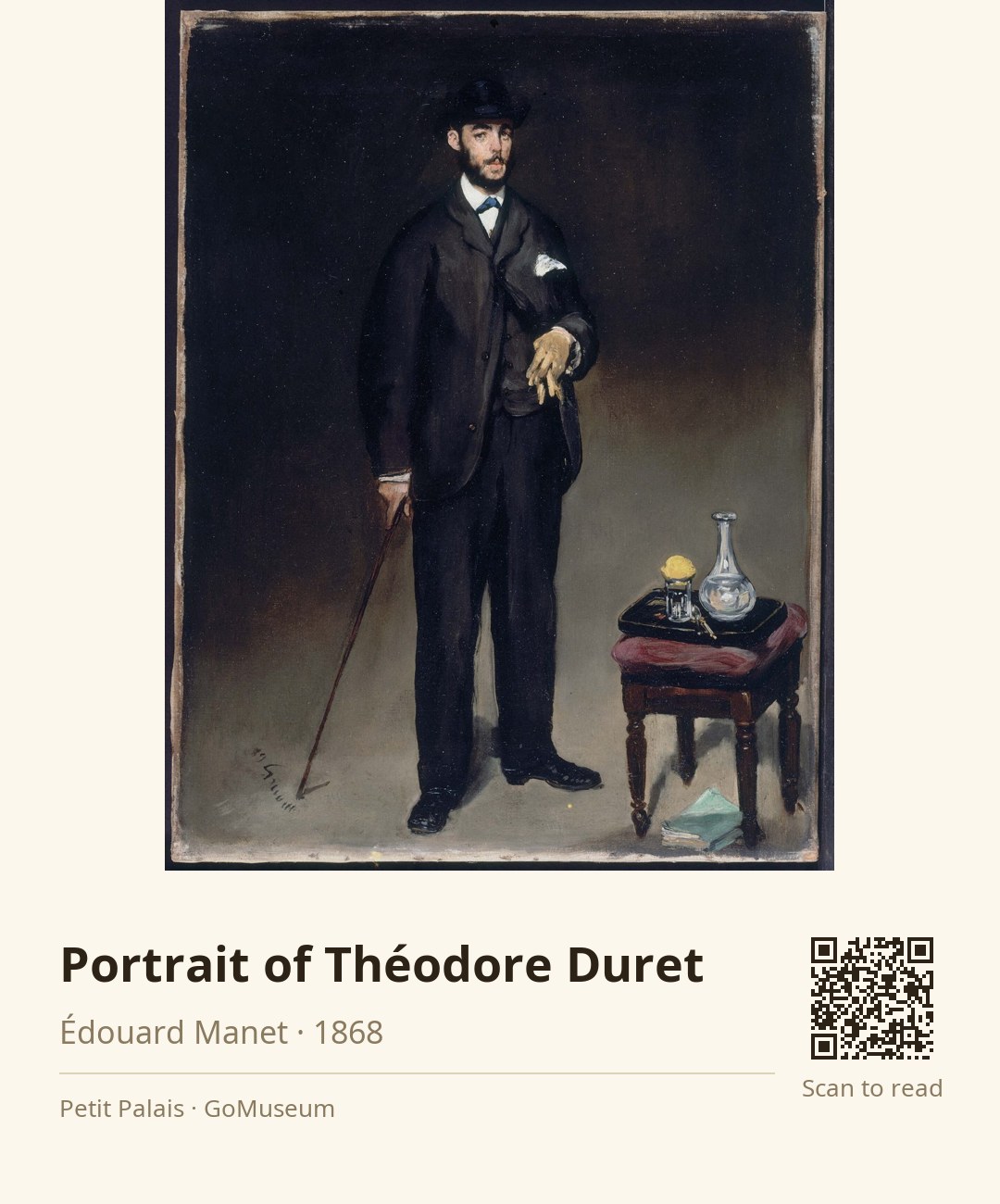
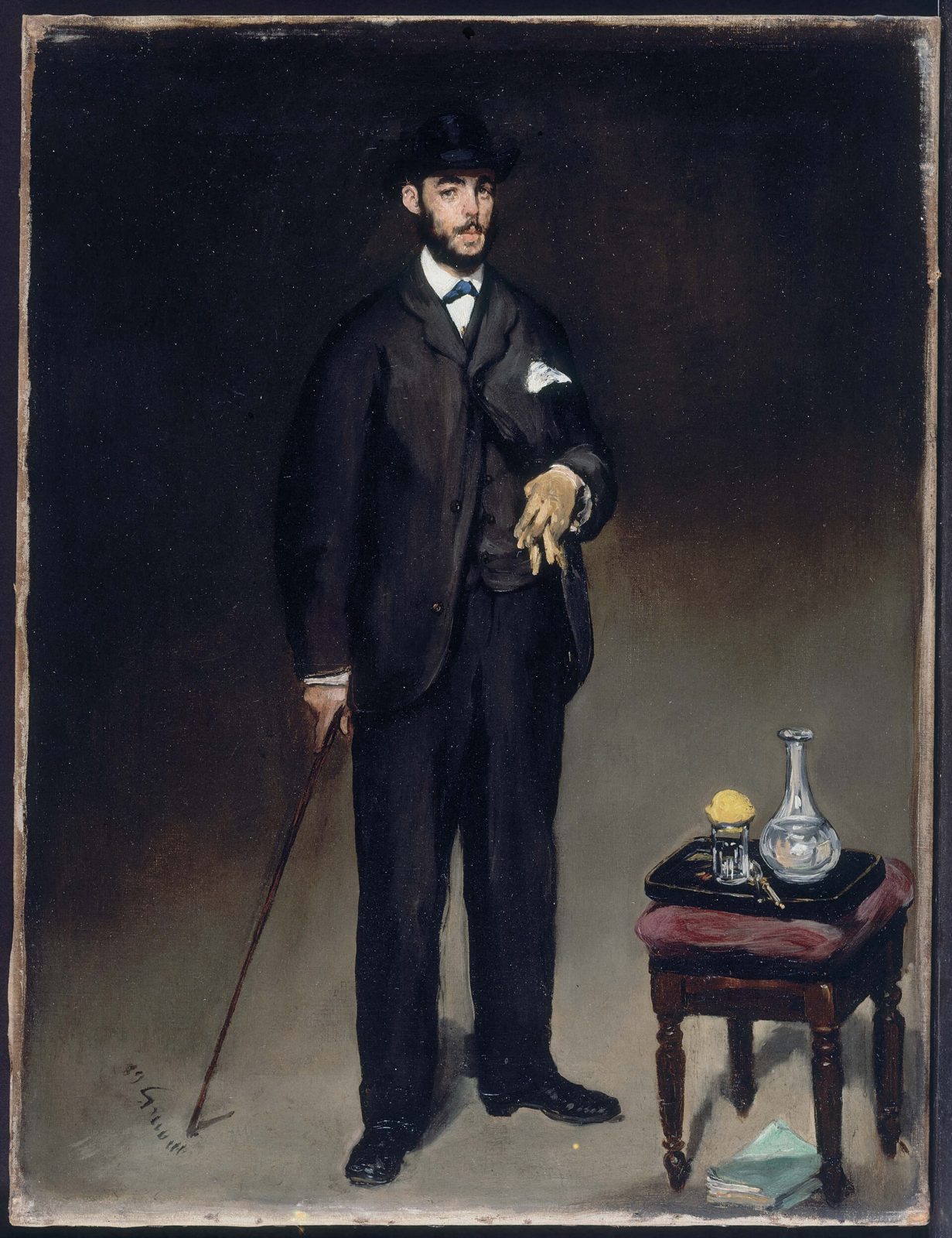
🎧 This work has audio narration — listen in the appThéodore Duret stands confidently in this portrait, dressed in a dark suit with a crisp white shirt and a black tie, topped off by a stylish black hat. His right hand grips a cane while his left, gloved, rests casually at his side, suggesting both elegance and ease. The small wooden table beside him, adorned with a red cushion, holds a glass decanter and a glass containing a yellow object, hinting at a moment of leisure or conversation.
This portrayal captures not just Duret's likeness but also the essence of the era, reflecting the social circles of Paris in the late 19th century. Manet’s choice of a muted background emphasizes Duret, drawing attention to the subtle details of his attire and the objects around him, which speak to his status and personality. The inclusion of everyday items like the decanter and books suggests a narrative beyond mere appearance, inviting viewers to ponder the life of the man depicted.
Édouard Manet, a pivotal figure in the transition from Realism to Impressionism, created this work in 1868, during a time when he was establishing himself as a modernist painter. His innovative approach to contemporary subjects marked a significant departure from traditional portraiture, making this painting a notable example of his evolving style.
Édouard Manet, born on January 23, 1832, in Paris, emerged as a pivotal figure in 19th-century art, bridging Realism and Impressionism. From an affluent family, he initially faced pressure to pursue a naval career but instead dedicated himself to painting, influenced by his uncle and the Old Masters. His early works, including "The Luncheon on the Grass" and "Olympia," sparked controversy and challenged traditional artistic norms, marking him as a revolutionary force.
Manet's style, characterized by loose brushwork and a focus on contemporary life, diverged from the meticulous techniques of his predecessors. He often depicted modern Parisian scenes, capturing the essence of leisure and social dynamics. Despite initial rejection from the art establishment, he gained recognition among progressive artists and became a mentor to the Impressionists.
Throughout his life, Manet formed connections with influential figures like Baudelaire and Zola, who defended him against critics. His later works, such as "A Bar at the Folies-Bergère," showcased his evolving style and mastery of color. Manet's contributions to art history are profound; he is celebrated not only for his innovative techniques but also for elevating still life and modern subjects to the forefront of artistic expression. He passed away on April 30, 1883, leaving behind a legacy that continues to inspire artists today.
In 'Portrait of Théodore Duret,' Manet employs oil paint on canvas, a medium that allows for rich texture and depth. The brushwork is both confident and loose, creating a sense of immediacy that draws you into Duret's world. The muted background serves a dual purpose: it not only emphasizes Duret's figure but also enhances the overall atmosphere of sophistication and leisure. Manet's choice of color is deliberate; the dark tones of Duret's suit contrast sharply with the bright white of his shirt and the vibrant red of the cushion, creating a striking visual impact. The composition is carefully balanced, with Duret's pose suggesting both authority and relaxation, while the objects on the table—especially the glass decanter—add layers of narrative, hinting at a moment suspended in time. This technique reflects Manet's innovative approach, merging realism with a modern sensibility that invites viewers to engage with the subject on a personal level.
The everyday items, such as the decanter and books, hint at a narrative that encourages viewers to consider the personal life and interests of Théodore Duret.
The muted background serves to highlight Duret's figure and the details of his clothing and surrounding objects, enhancing the overall composition.
Manet's focus on contemporary subjects and his loose brushwork represented a shift from the more formal and traditional styles of portraiture prevalent at the time.