Autumn, Portrait of Lydia Cassatt
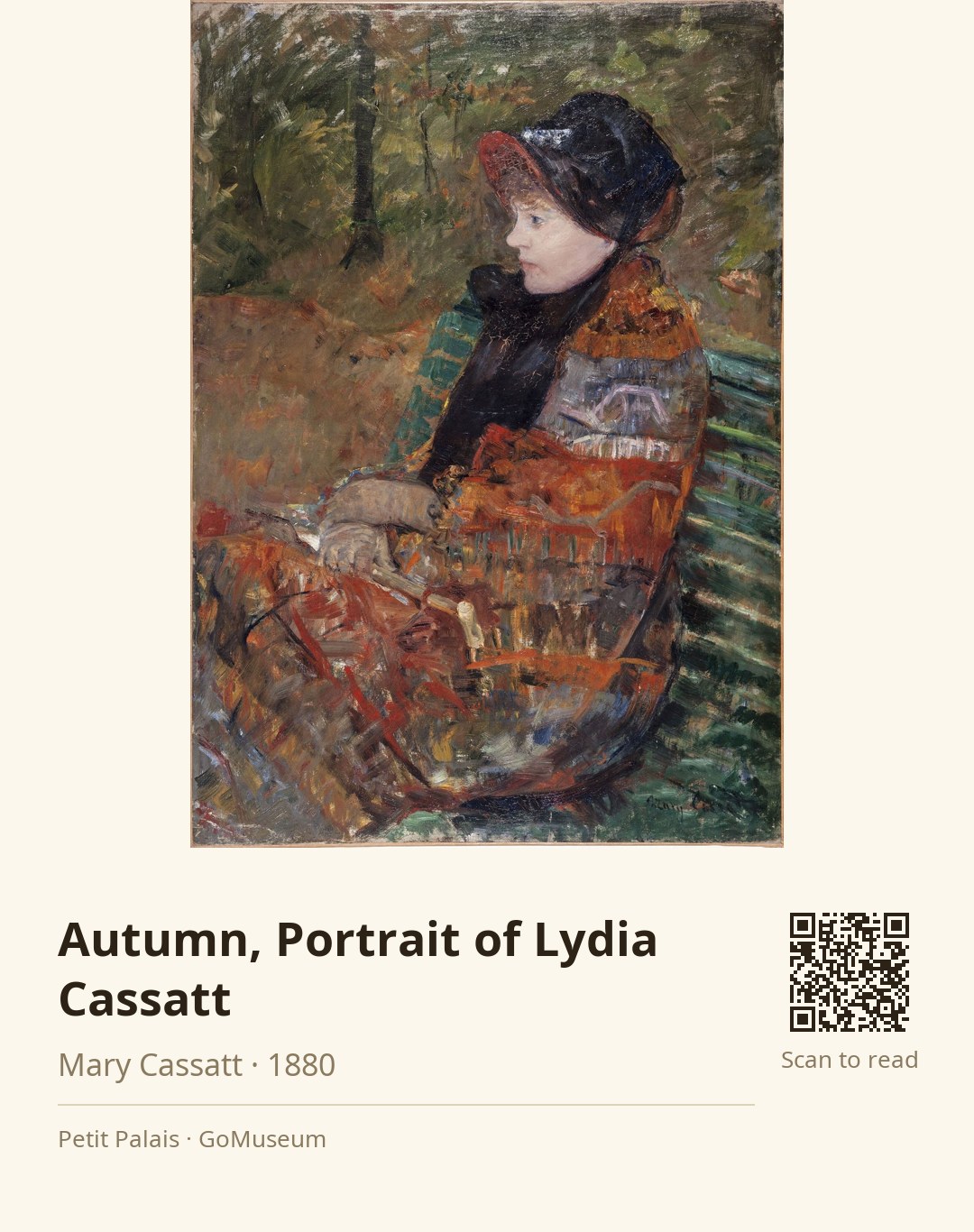
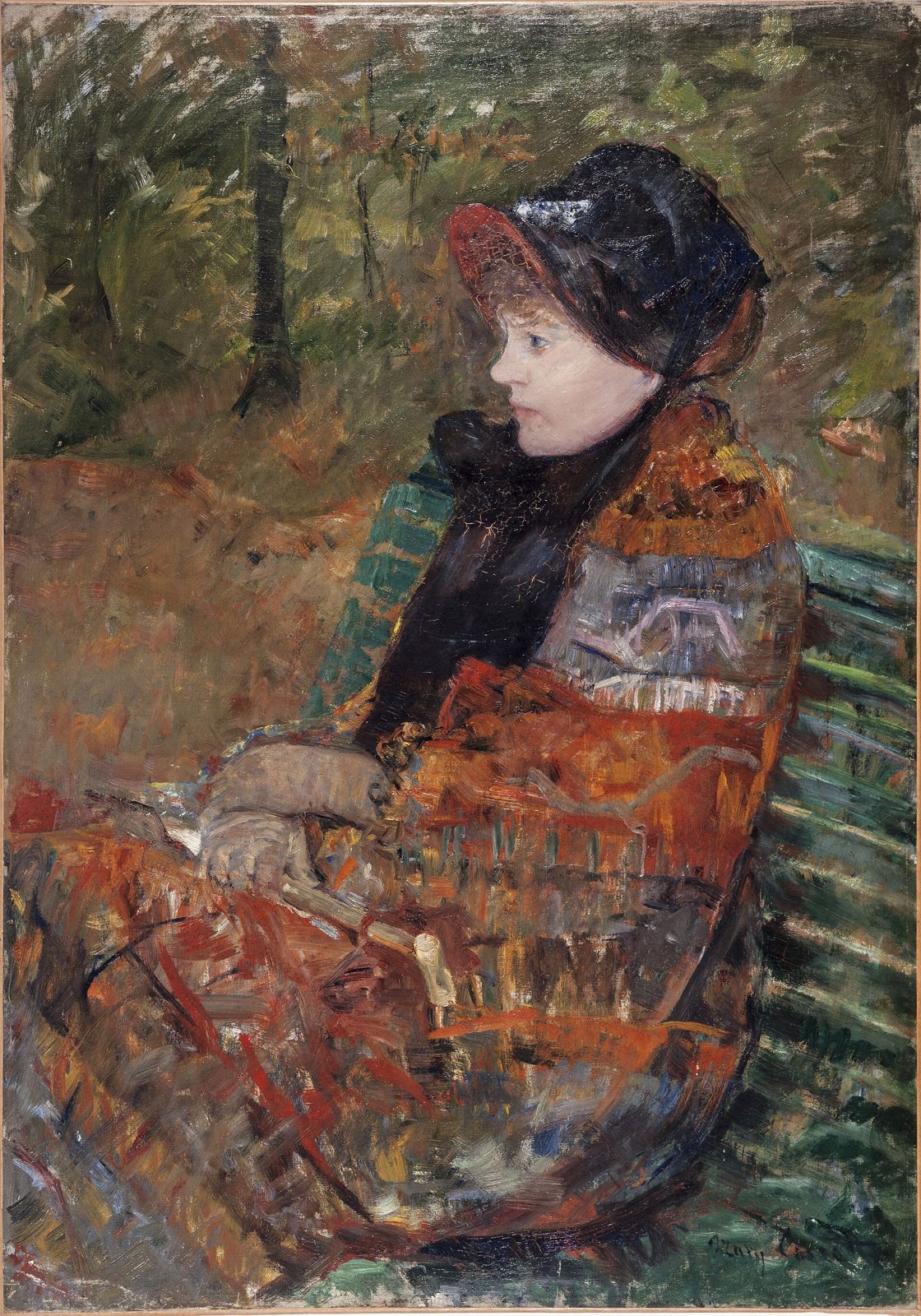
🎧 This work has audio narration — listen in the appLydia Cassatt sits gracefully on a green bench, her profile framed by a dark bonnet lined in red. The warm hues of her coat, a blend of orange and brown, contrast beautifully with the cool greens and browns of the impressionistic background, suggesting a serene autumn day. The loose brushstrokes create a sense of movement, capturing the essence of the season and the intimacy of the moment.
This portrait, painted by Mary Cassatt in 1880, is not just a depiction of her sister but an exploration of the quiet elegance and emotional depth found in everyday life. The way Lydia's hands rest in her lap, holding an indistinct object, invites viewers to ponder her thoughts, making her an embodiment of the reflective nature of autumn itself. Cassatt's choice of colors and the soft focus of the background enhance the feeling of nostalgia, evoking the fleeting beauty of the season.
Created during a period when Cassatt was establishing her reputation in the Impressionist movement, this work was exhibited at the sixth Impressionist exhibition in Paris in 1881. Cassatt's innovative approach to portraiture, particularly her focus on women and their experiences, marked a significant contribution to the art world of her time.
Mary Stevenson Cassatt was an American painter and printmaker born on May 22, 1844, in Allegheny, Pennsylvania. She spent most of her life in France, where she became a prominent figure in the Impressionist movement, closely associated with Edgar Degas. Cassatt's work primarily focused on the lives of women, particularly the intimate relationships between mothers and children, capturing the nuances of domestic life with sensitivity and depth.
Despite her family's initial objections to her artistic ambitions, Cassatt pursued her passion, studying at the Pennsylvania Academy of the Fine Arts before moving to Paris in 1866. There, she studied under notable artists and developed her unique style, influenced by both the Impressionists and Japanese prints. Her contributions to art were significant, as she played a crucial role in introducing Impressionism to American collectors, notably through her connections with the Havemeyer family.
Cassatt was recognized as one of the three great ladies of Impressionism, alongside Berthe Morisot and Marie Bracquemond. Her work, characterized by its focus on female subjects and domestic scenes, remains celebrated in major museums across Europe and the United States. Cassatt's legacy endures as a pioneering female artist who broke barriers in a male-dominated field, leaving an indelible mark on art history until her death on June 14, 1926.
Mary Cassatt's 'Autumn, Portrait of Lydia Cassatt' was painted in 1880, during a pivotal time in her career as she sought to establish herself within the Impressionist movement. This portrait of her sister, Lydia, was exhibited at the sixth Impressionist exhibition in Paris in 1881, a significant event that showcased the evolving styles of contemporary artists. The reception of the work was mixed, as was common for many Impressionist pieces at the time, often met with skepticism from traditional critics. However, it also garnered attention for its innovative portrayal of women, a theme Cassatt passionately explored throughout her career. The painting remains part of the collection at the Petit Palais, a testament to its enduring value and the artist's legacy. Cassatt's focus on intimate, everyday moments marked a departure from the grand historical themes that dominated much of the art world, making her a key figure in the evolution of modern art.
In 'Autumn, Portrait of Lydia Cassatt,' Mary Cassatt employs loose, expressive brushwork that captures the essence of her subject and the surrounding environment. The warm hues of Lydia's coat, intermingled with the cooler greens of the background, create a dynamic contrast that draws the viewer's eye. Cassatt's technique involves layering colors to achieve depth and texture, evident in the way the brushstrokes seem to dance across the canvas. The composition, with Lydia seated in profile, invites a sense of intimacy and contemplation, as if the viewer is privy to a private moment. The blurred background enhances this effect, suggesting a fleeting autumn day, while the indistinct object in Lydia's hands prompts curiosity and reflection. This approach not only highlights the emotional depth of the portrait but also showcases Cassatt's mastery of color and form, solidifying her place in the Impressionist canon.
Interestingly, Mary Cassatt was not only a painter but also a printmaker, and she was significantly influenced by Japanese woodblock prints. This influence is evident in her use of color and composition, which often reflect the flat, decorative qualities found in Japanese art. Cassatt's ability to blend these styles helped her create a distinctive voice within the Impressionist movement, setting her apart from her peers.