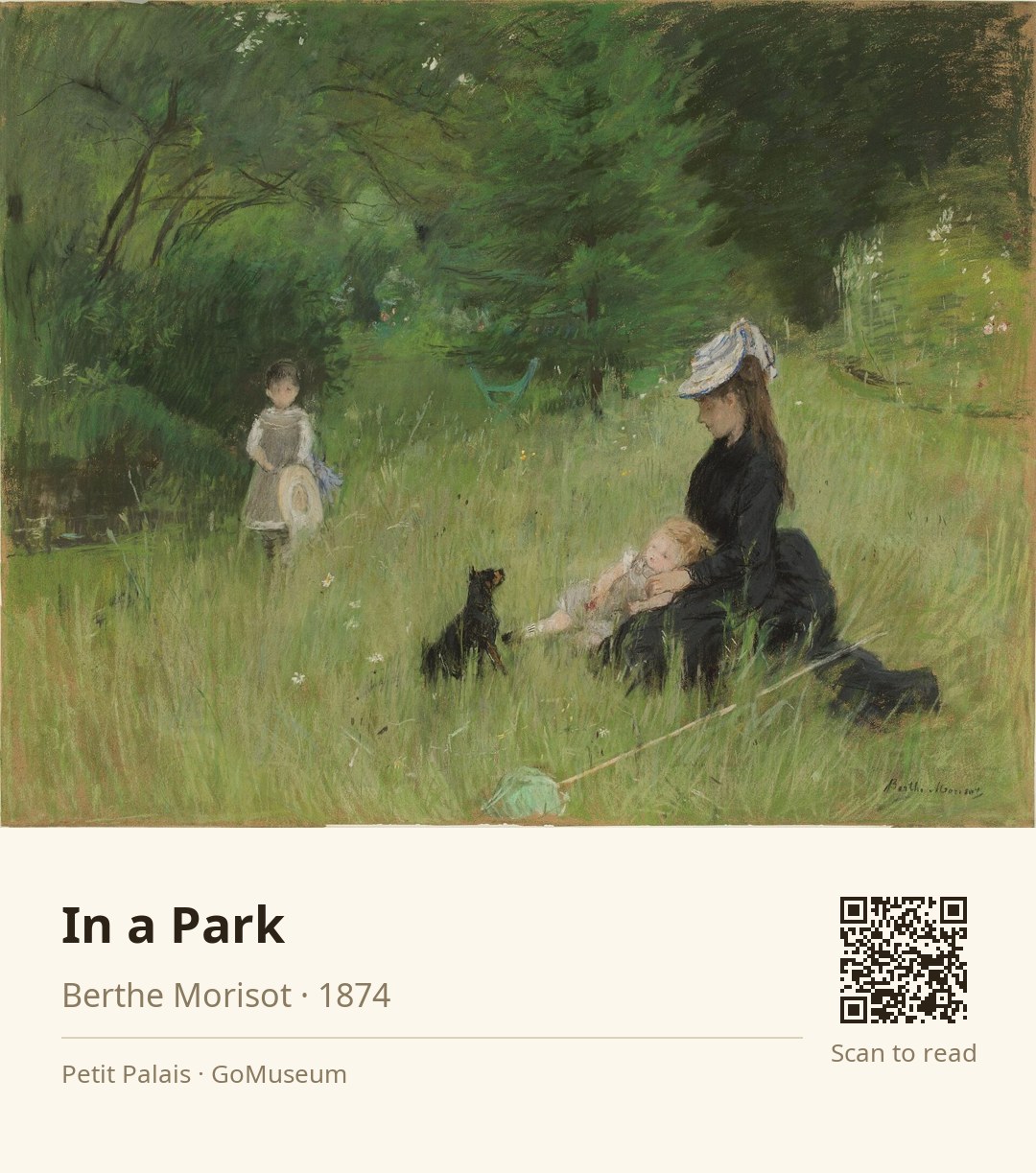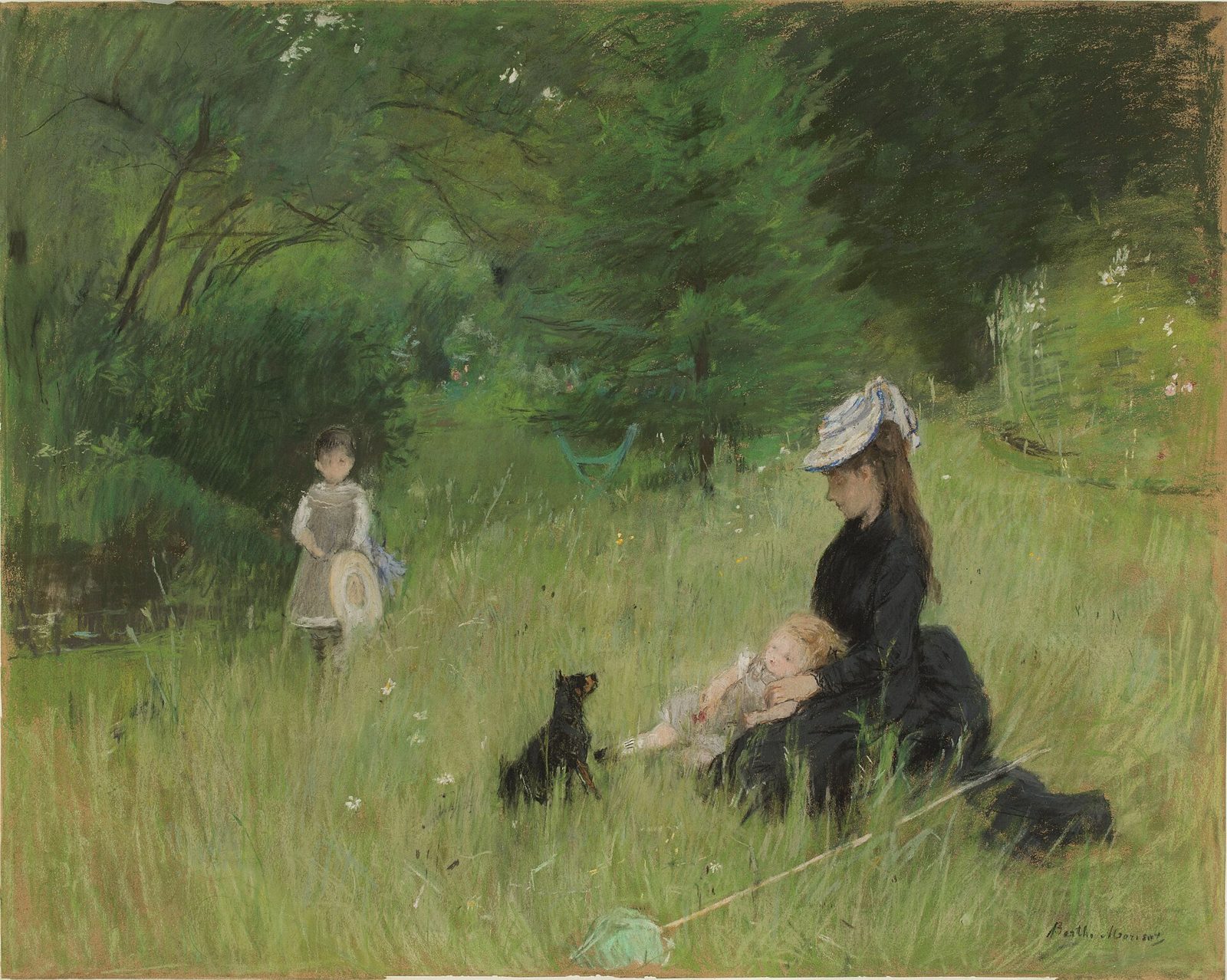
A woman in a dark dress sits on the grass, cradling a child while a small black dog watches closely. Nearby, a young girl stands, holding a straw hat, partially hidden by tall grass, while the lush greenery of trees and bushes envelops the scene. The soft, impressionistic brushwork captures the dappled light filtering through the leaves, creating a serene atmosphere that invites you into this intimate moment.
Morisot's choice of pastel on paper allows for a delicate rendering of the figures and the surrounding nature, emphasizing the tranquility of leisure time in the park.
Executed around 1874, "In a Park" showcases Morisot's ability to blend her influences from naturalism and impressionism, drawing on the styles of contemporaries like Camille Corot and Édouard Manet. This work is part of a broader narrative in Morisot's career, where she navigated the male-dominated art world, ultimately becoming a key figure in the Impressionist movement.
Berthe Morisot was a pioneering French painter born on January 14, 1841, in Bourges. Coming from an affluent family, she received a private art education alongside her sisters, fostering a deep passion for painting. Morisot first exhibited her work at the Paris Salon in 1864 and became a key figure in the Impressionist movement, participating in nearly all of its exhibitions from 1874 to 1886. Her innovative approach, characterized by light brushwork and a focus on domestic life and women’s experiences, distinguished her in a male-dominated art world. Married to Eugène Manet, brother of fellow artist Édouard Manet, she maintained close relationships with prominent Impressionists like Monet and Renoir. Art critic Gustave Geffroy recognized her as one of the three great ladies of Impressionism, alongside Mary Cassatt and Marie Bracquemond. Morisot's legacy endures as she broke barriers for women in art, leaving an indelible mark on the Impressionist movement before her death on March 2, 1895.
The brushwork is loose yet intentional, giving life to the figures while maintaining a sense of intimacy. The choice of a limited color palette, dominated by greens and earthy tones, enhances the natural setting, while the dappled light filtering through the trees adds a layer of warmth. The composition is dynamic, with the seated woman anchoring the foreground while the standing girl and dog create a sense of movement and depth. This careful arrangement draws the viewer into a serene moment, inviting them to feel the tranquility of the park.
Interestingly, Morisot was not only a painter but also a trailblazer in the art community, often exhibiting alongside her contemporaries. She was married to Eugène Manet, the brother of her close friend Édouard Manet, which further intertwined her life with the leading figures of Impressionism.
The children in the painting include Jeanne Pontillon, who is the niece of Berthe Morisot and the daughter of her sister Edma.
There is a net used for catching butterflies positioned to the left of the seated woman, adding a playful element to the scene.
Berthe Morisot was married to Eugène Manet, who was Édouard Manet's brother, creating a familial link between her and one of the leading figures of Impressionism.