Adolphe Alphand
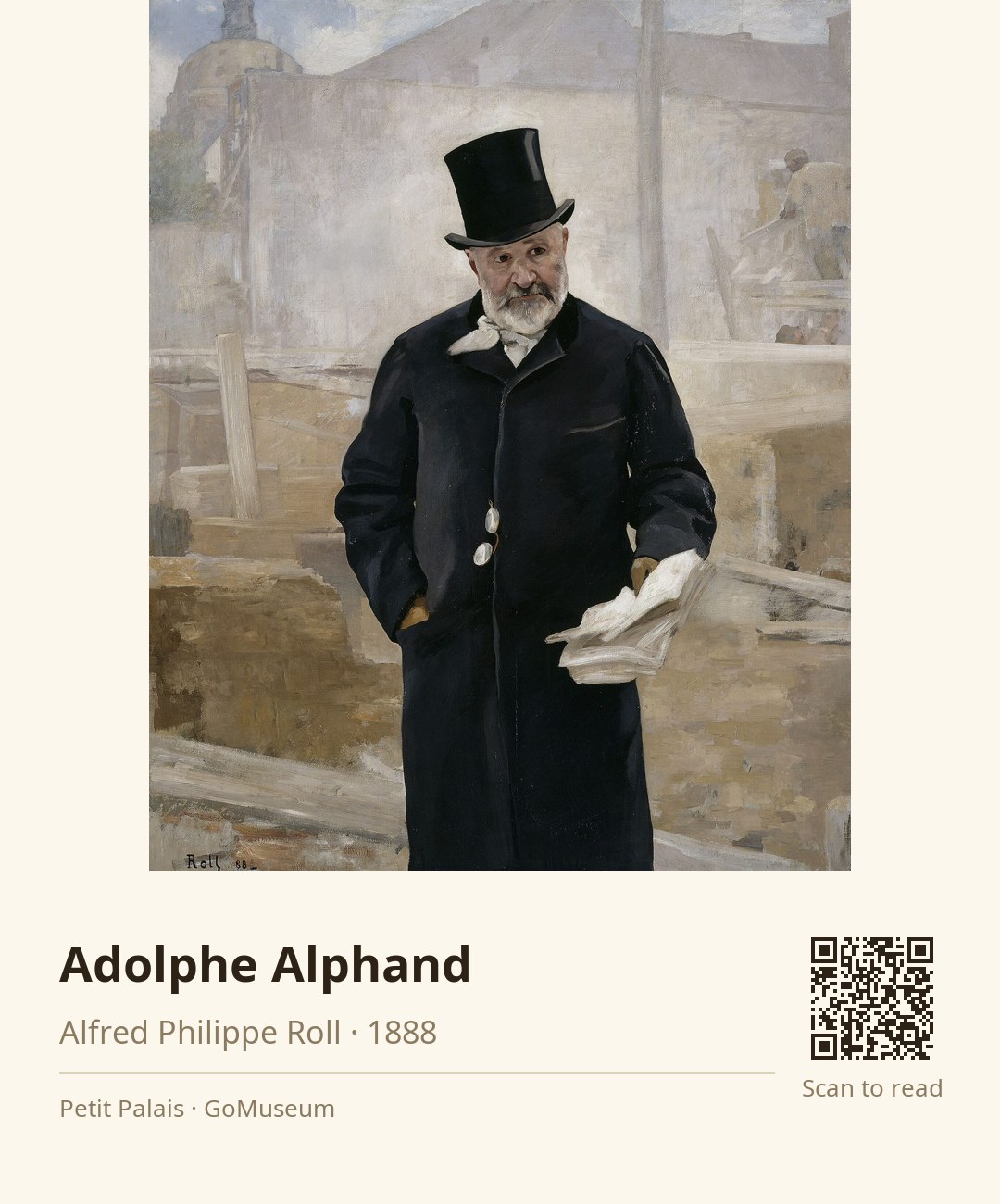
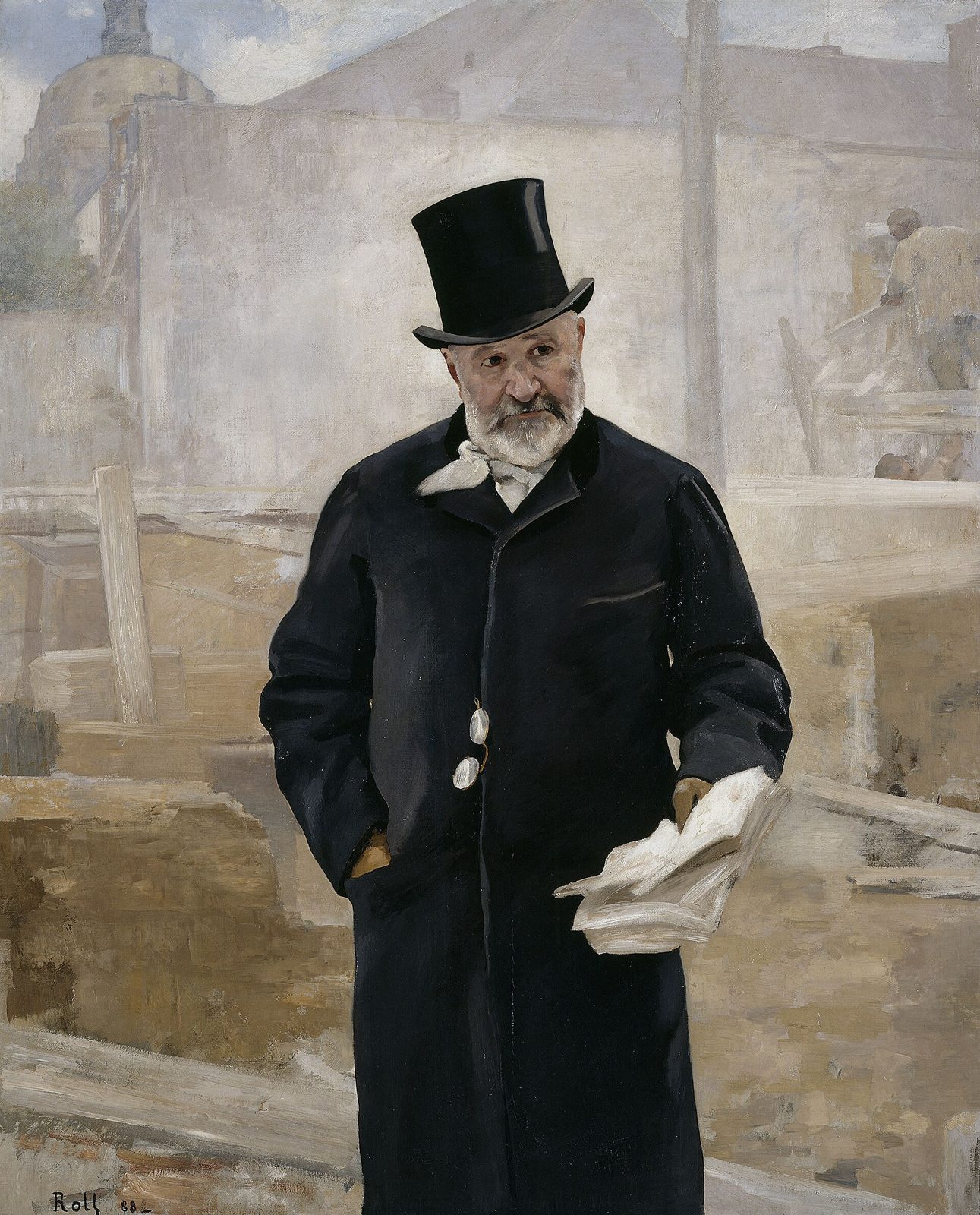
🎧 This work has audio narration — listen in the appAdolphe Alphand stands resolutely in the foreground, clad in a dark overcoat and a tall black top hat, his gloved hands clutching a stack of papers. His contemplative expression hints at the weight of his thoughts, while the muted palette of grays, browns, and beiges envelops him in a somber atmosphere, contrasting with the bustling construction site behind him, where indistinct figures labor amidst the skeletal outlines of buildings.
The construction site symbolizes progress and change, echoing the ambitions of a city reshaping its identity. Roll’s smooth brushwork emphasizes the textures of Alphand’s attire, suggesting a man of importance, while the indistinct workers in the background serve as a reminder of the collective effort behind monumental projects.
Alfred Philippe Roll, a prominent French painter, created this work in 1888, a period when he was establishing himself as a leading artist of his time, known for his focus on everyday life and significant figures in society. His career flourished as he became an official painter for the French government, producing numerous works that celebrated contemporary themes and historical moments.
Alfred Philippe Roll was a prominent French painter born on March 1, 1846, in Paris, where he also passed away on October 27, 1919. He studied at the École des Beaux-Arts under notable artists, including Jean-Léon Gérôme and Léon Bonnat. Roll initially embraced a romantic style, but his work evolved towards realism, focusing on everyday life and social themes. His breakthrough came with "The Flood at Toulouse" in 1875, which garnered significant attention and established his reputation.
Roll's career flourished as he became one of France's leading painters, known for his portraits and historical scenes. He received numerous state commissions, creating murals and significant works for public buildings, including the Palace of Versailles. His painting "Miner's Strike" in 1880 marked a turning point, solidifying his status as an official painter of the French Republic.
In 1905, he co-founded and became president of the Société Nationale des Beaux-Arts, influencing the art community. Roll's legacy includes a rich collection of works housed in various museums across France and Belgium. His contributions to the art world and his role in promoting fellow artists like Alfred Smith reflect his commitment to the artistic community. Roll's work remains celebrated for its blend of realism and social commentary, marking him as a significant figure in 19th-century French art history.
Roll's technique in 'Adolphe Alphand' showcases his mastery of smooth brushwork, which brings a tactile quality to the textures of Alphand's overcoat and the surrounding construction site. The muted palette of grays, browns, and beiges creates a somber yet reflective mood, emphasizing the weight of Alphand's thoughts. The composition centers on the figure of Alphand, drawing the viewer's eye to his contemplative expression while the indistinct workers in the background blur into the chaos of progress. This deliberate choice enhances the narrative of individual significance against the backdrop of collective effort, inviting viewers to ponder the relationship between the man and the monumental changes occurring around him.
Interestingly, Roll's career was not just about painting; he also played a significant role in promoting other artists. He discovered and championed the Bordeaux artist Alfred Smith, helping to elevate Smith's work and career during a time when the art scene was rapidly evolving. This mentorship highlights Roll's commitment to the artistic community and his influence beyond his own creations.
Alfred Philippe Roll served as a lieutenant of militia during the Franco-Prussian War.
In 1905, Alfred Philippe Roll became the president of the Societe Nationale des Beaux-Arts, an organization he co-founded.