 Image: VateGV
Soir antique
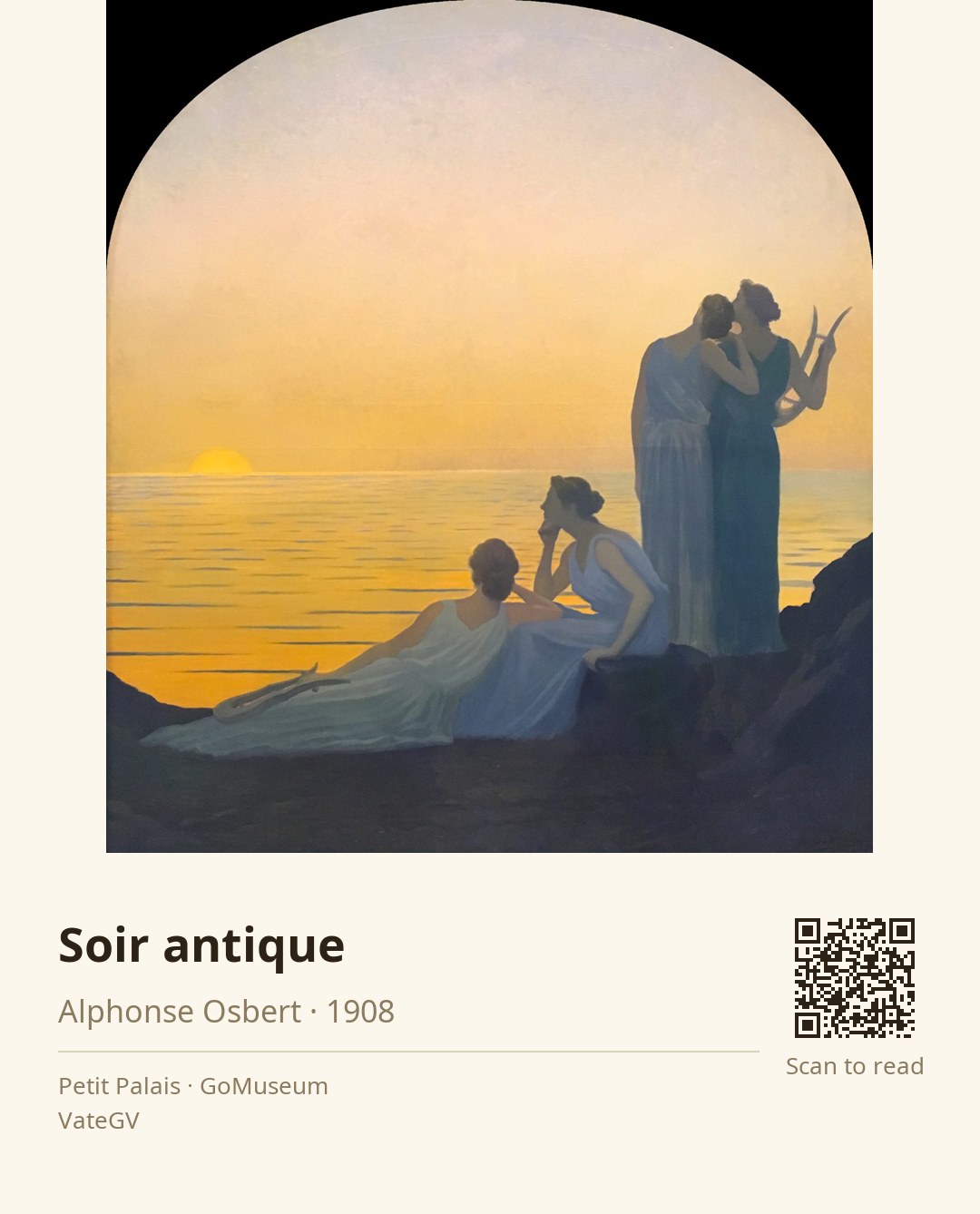
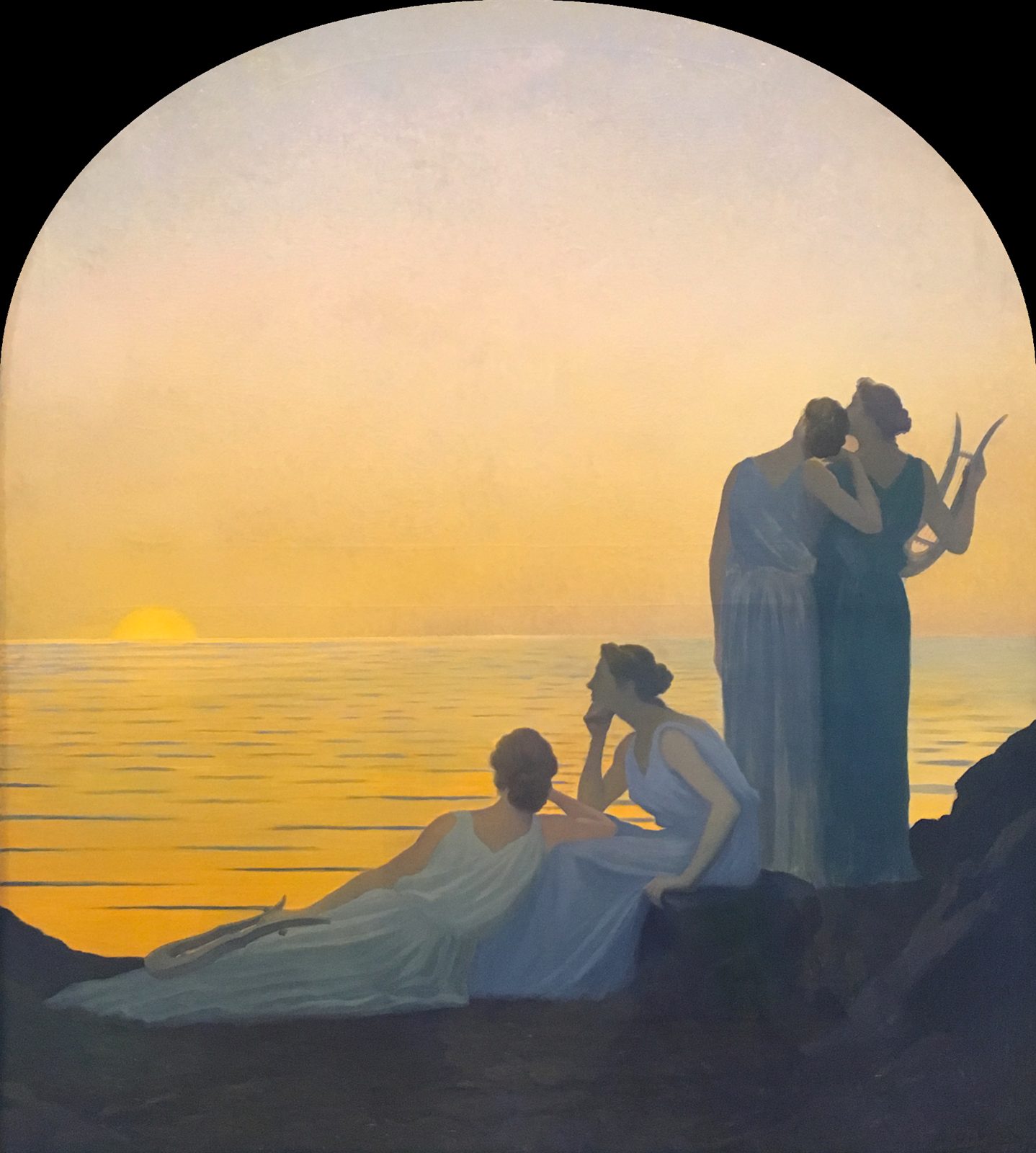
🎧 This work has audio narration — listen in the appThe figures in "Soir antique" are draped in flowing garments, their forms elegantly poised against a rocky shore. One figure reclines with a stringed instrument, while another sits upright, lost in thought as they gaze toward the horizon. In the middle distance, two figures stand closely together, one holding a lyre, suggesting a moment of shared contemplation or musical harmony.
The warm glow of the setting sun bathes the scene in soft yellows and oranges, creating a tranquil atmosphere that invites reflection. This serene palette, combined with the calm, reflective waters, enhances the sense of peace and timelessness that Osbert sought to convey. The arrangement of the figures leads the viewer’s eye toward the distant sunset, emphasizing the connection between humanity and nature, and the fleeting beauty of the moment.
Alphonse Osbert, a French Symbolist painter, was known for his ethereal compositions that often featured ghostlike figures in dreamlike landscapes. His shift away from naturalism in the late 1880s marked the beginning of a unique visual language, characterized by a poetic use of light and color. "Soir antique," created in 1908, exemplifies his signature style, blending elements of music and contemplation within a serene seascape.
Alphonse Osbert, born on March 23, 1857, in Paris, was a notable French Symbolist painter whose career spanned the late 19th and early 20th centuries. Educated at the École des Beaux-Arts, he initially embraced naturalism, influenced by Spanish masters and his academic mentors. However, by the late 1880s, Osbert's style evolved under the sway of Post-Impressionism and Symbolism, leading him to adopt a Pointillist technique reminiscent of Seurat and Signac.
Osbert's work is characterized by ethereal Muses set against mysterious landscapes, often illuminated by a haunting blue light. His artistic vision was shaped by his associations with figures like Joséphin Péladan and Pierre Puvis de Chavannes, marking him as a significant contributor to the Symbolist movement. Throughout his career, he received numerous commissions, including murals for the Centre Thermal des Dômes in Vichy and the Church of Saint-Louis.
Despite a relatively static style after 1900, Osbert's reputation flourished, earning him recognition and accolades, including the title of Chevalier of the Légion d'honneur in 1934. He passed away on August 11, 1939, in his Paris studio, leaving behind a legacy preserved in institutions like the Musée d'Orsay, which houses a substantial collection of his works. His contributions to Symbolism solidified his place in art history as a master of poetic visual language.
Alphonse Osbert's 'Soir antique' was painted in 1908 and is housed in the Petit Palais in Paris. This work is a testament to Osbert's evolution as a Symbolist artist, moving away from the naturalism of his earlier years. The painting was likely influenced by his associations with the Symbolist movement and his admiration for the works of Pierre Puvis de Chavannes. Osbert's career flourished in the early 20th century, and he received notable commissions, including murals for the Centre Thermal des Dômes in Vichy. His work was well-received, marking him as a significant figure in the Symbolist art scene, and he was recognized with the title of Chevalier of the Légion d'honneur in 1934.
Osbert's technique in 'Soir antique' showcases his mastery of oil paint on canvas, allowing for a rich, layered application that enhances the ethereal quality of the scene. The brushwork is fluid, with soft edges that create a dreamlike atmosphere, perfectly complementing the flowing garments of the figures. The warm palette of yellows and oranges, juxtaposed with serene blues, evokes the tranquility of a sunset, while the reflective water surface adds depth and dimension. The composition is carefully balanced, guiding the viewer's eye toward the horizon, where the sun dips below the water.
One intriguing aspect of Osbert's career is his close association with the Kabbalistic Order of the Rose-Cross, a group that blended art, mysticism, and philosophy. This connection not only influenced his artistic direction but also placed him at the heart of a vibrant intellectual community in Paris during the late 19th and early 20th centuries. His participation in the Salon de la Rose-Croix, alongside other prominent Symbolists, helped solidify his reputation as a leading figure in this avant-garde movement.
In addition to 'Soir antique', Osbert created several commissioned murals, including those for the Centre Thermal des Dômes in Vichy.