The Good Samaritan
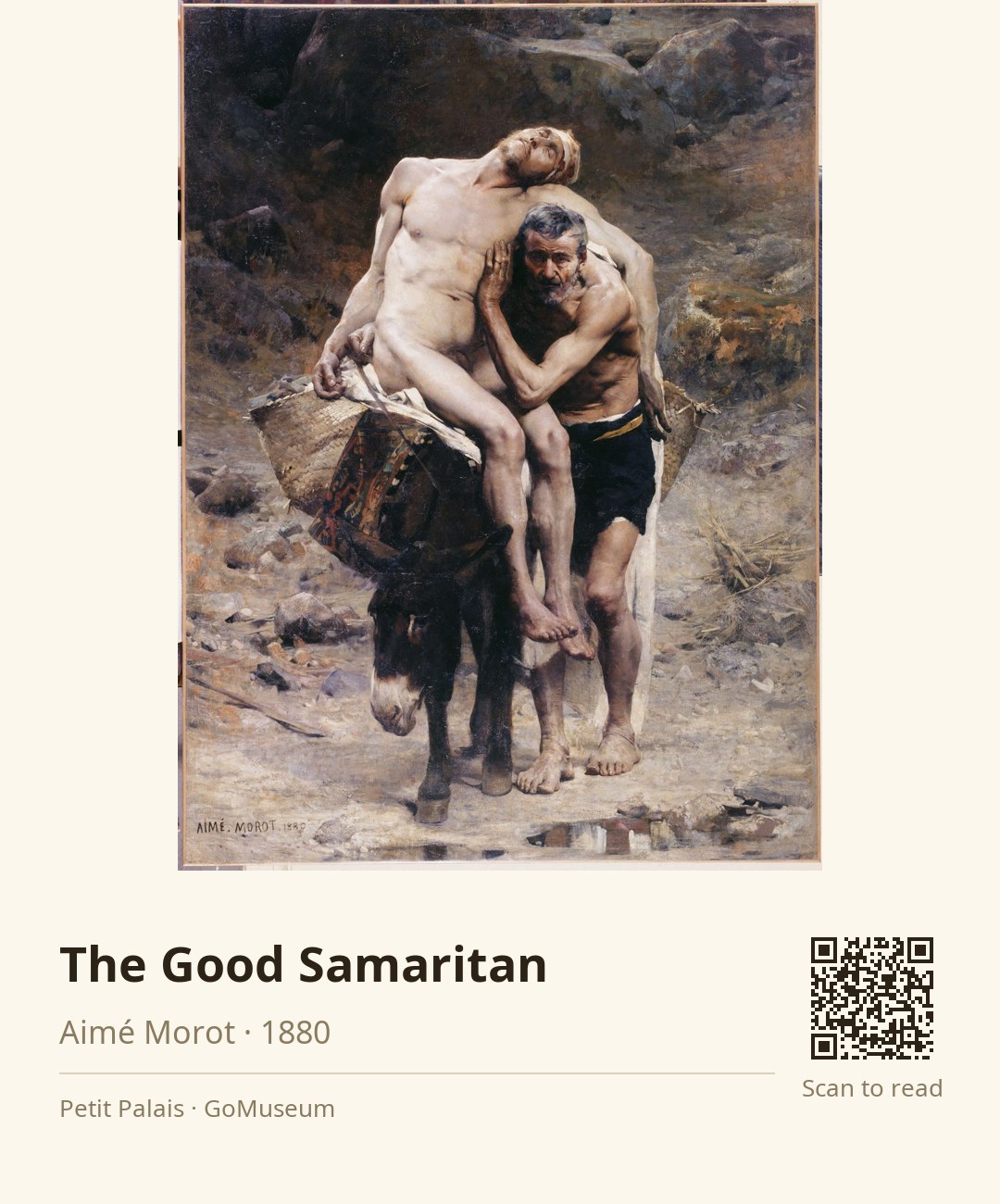
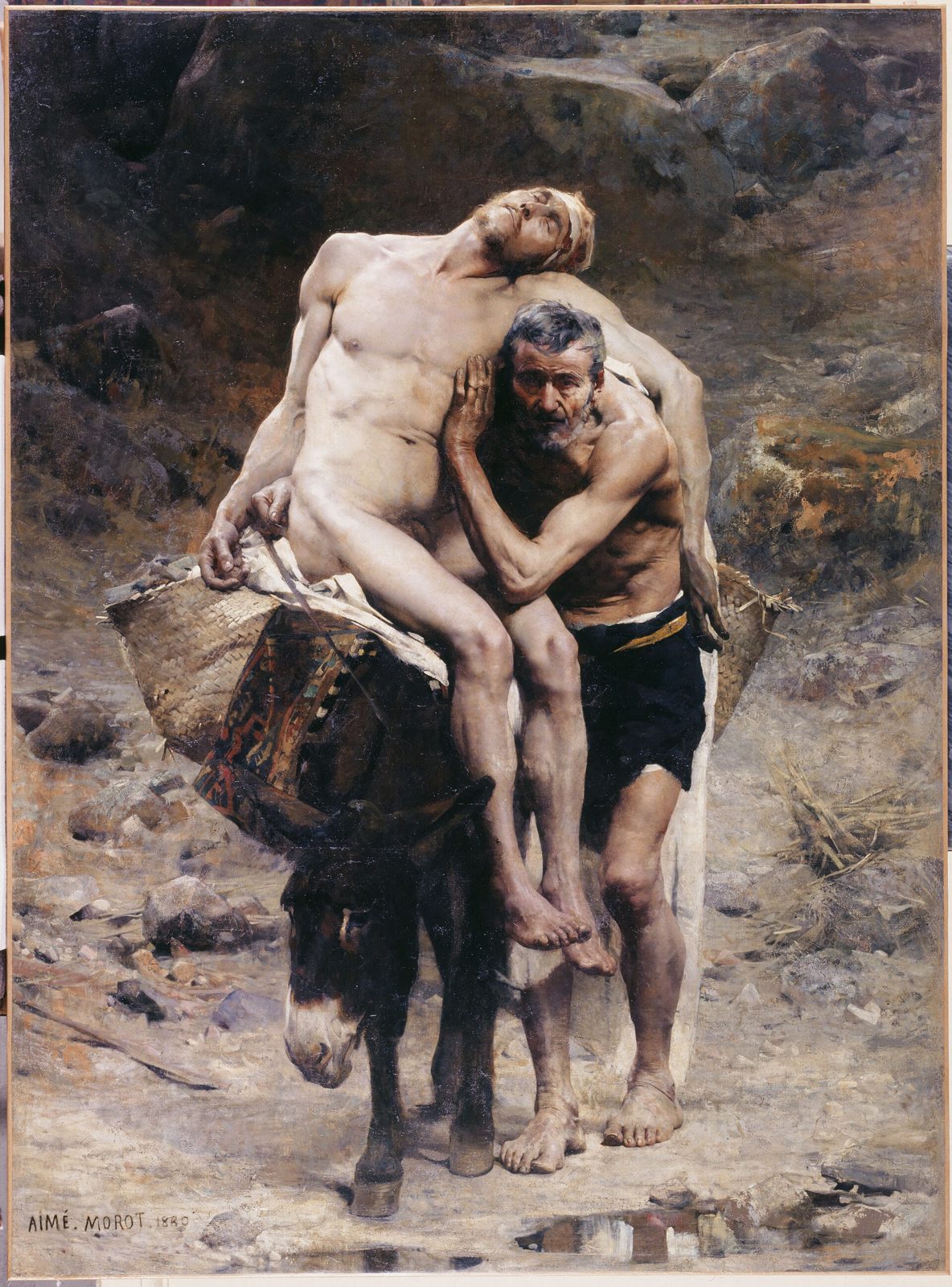
🎧 This work has audio narration — listen in the appThe unconscious man draped over the donkey's back in Aimé Morot's "The Good Samaritan" captures a moment of profound compassion and urgency. The Samaritan, with his weathered face and muscular frame, supports the injured figure with a gentle strength, while the barren landscape around them emphasizes their isolation. The rich textures of skin and fabric, rendered in earthy tones, draw you into their emotional connection, highlighting the gravity of the scene.
Morot's choice to focus tightly on these figures, reducing the original larger canvas, intensifies the viewer's engagement with their plight. This painting, influenced by 17th-century Spanish art, embodies a severe realism that reflects the human condition. The Samaritan's kindness stands in stark contrast to the harshness of their surroundings, evoking themes of empathy and social responsibility. The anatomical precision and naturalism evident in the work were celebrated at the 1880 Salon, where it won a medal of honor.
Aimé Nicolas Morot was a prominent French academic painter and sculptor, born on June 16, 1850, in Nancy. He began his artistic education at a young age, studying under notable instructors before winning the Grand Prix de Rome in 1873 with his work "Super Flumina Babylonis." This achievement allowed him to reside at the Villa Medici in Rome, where he produced significant works despite rarely using his workshop. Morot gained recognition at the Salon de Paris, earning multiple medals for his paintings, including "The Good Samaritan," which reflected his social concerns.
In 1880, he returned to Paris, marrying Suzanne-Mélanie Gérôme, the daughter of renowned painter Jean-Léon Gérôme. Morot's home became a vibrant space filled with exotic animals and artistic inspiration. As a professor at the École Nationale Supérieure des Beaux-Arts, he influenced many students and played a crucial role in the Parisian art scene, being recognized as one of its leading figures. His contributions to public art included notable decorations for municipal buildings.
Morot's legacy endures through his works and his impact on the next generation of artists. He passed away on August 12, 1913, leaving behind a rich artistic heritage that continues to be celebrated in art history.
Aimé Morot's 'The Good Samaritan' was painted in 1880 and first exhibited at the Salon that same year, where it garnered significant attention and won a medal of honor. Over the years, it has been showcased in various exhibitions, including 'Illusions of Reality' at the Van Gogh Museum and the 'Caritas' exhibition at the Musée de Picardie. The reception of the work was largely positive, with contemporaries praising Morot's ability to capture the human form and emotional depth. Notably, the artist's focus on realism and anatomical precision drew comparisons to other prominent artists of the time, though some critics felt the close composition limited the narrative's clarity. The painting's themes resonated with contemporary discussions about compassion and social responsibility, reflecting the societal context of post-Communard France.
Morot's technique in 'The Good Samaritan' is strikingly detailed, showcasing his mastery of oil painting. The brushwork is meticulous, capturing the textures of skin and fabric with an almost tactile quality. The earthy palette enhances the emotional weight of the scene, with browns and ochres dominating the landscape, creating a stark contrast to the figures. The composition is tightly focused, drawing the viewer's eye directly to the interaction between the Samaritan and the unconscious man. This choice not only emphasizes their physical connection but also heightens the emotional intensity of the moment. The scale of the figures, life-sized and rendered with anatomical precision, invites you to engage with their plight on a personal level, making the experience of viewing the painting deeply immersive.
Morot's technique is characterized by striking detail and mastery of oil painting, particularly in capturing textures of skin and fabric.
Morot's focus on realism and anatomical precision led to comparisons with artists like Léon Bonnat, who also emphasized the rendering of human skin.
Marie Bashkirtseff expressed profound admiration for 'The Good Samaritan,' stating it provided her with the most complete pleasure she had ever experienced from a painting.