Three Bathers
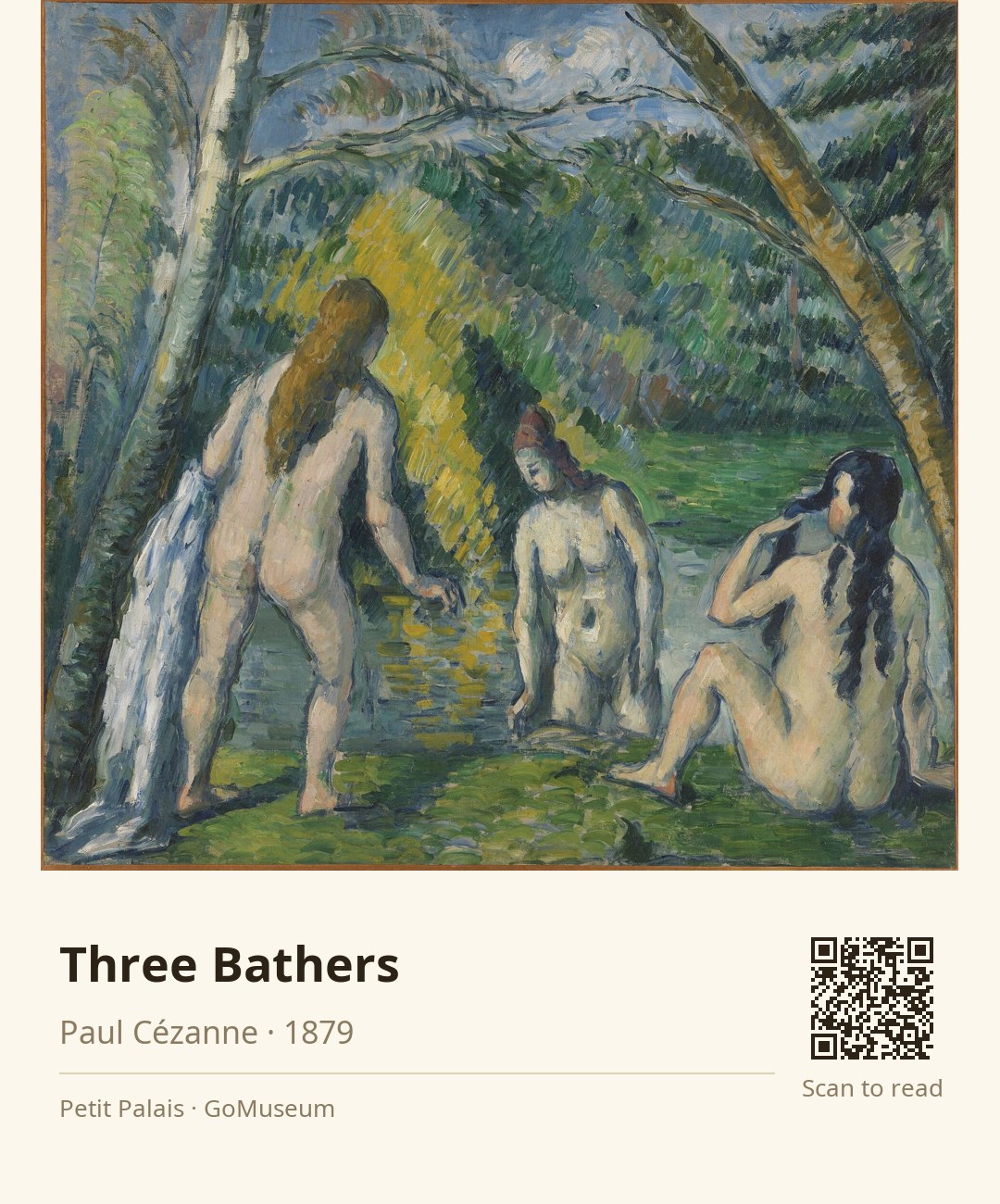
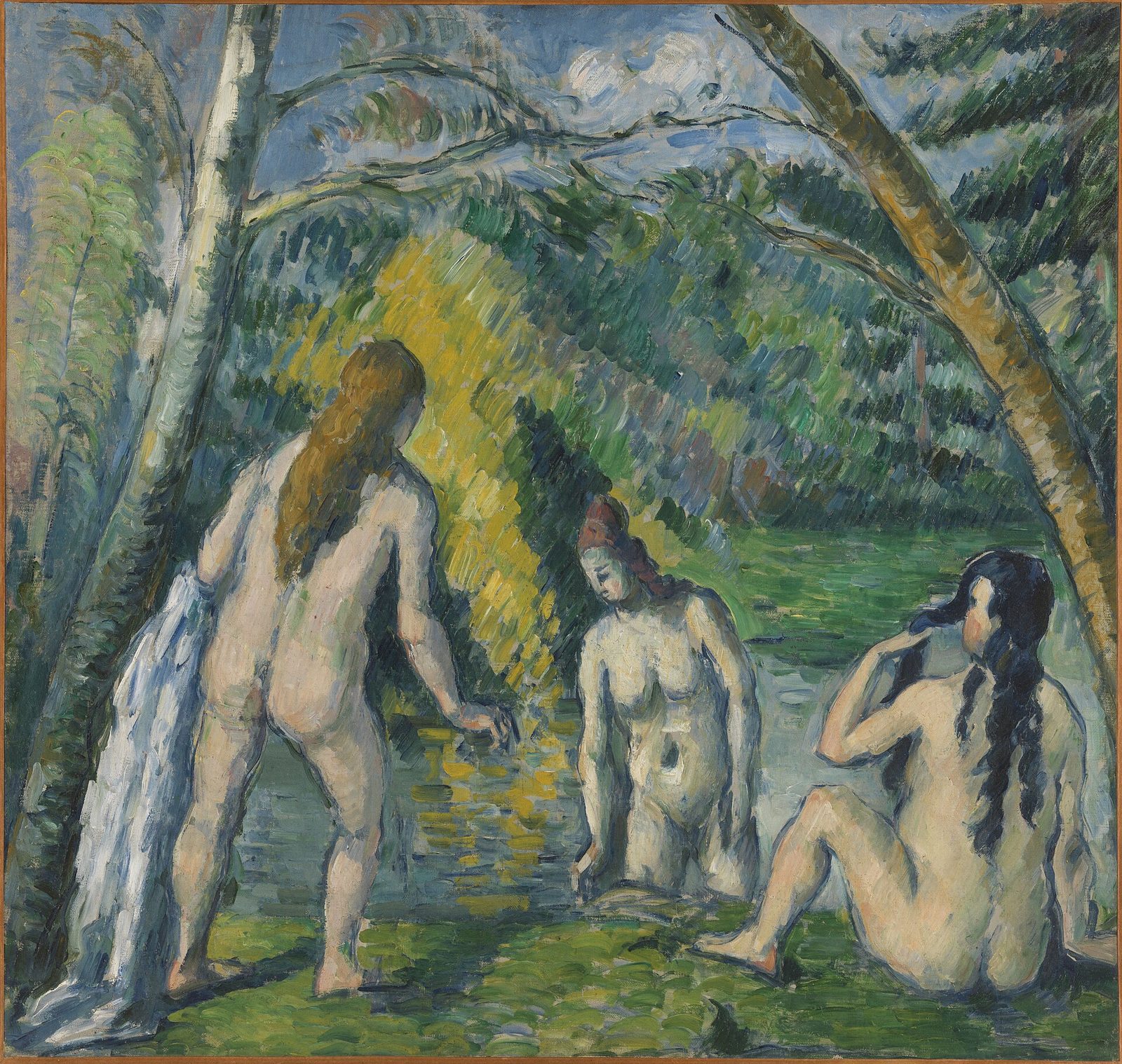
🎧 This work has audio narration — listen in the appThree nude women occupy a serene natural setting in Paul Cézanne's *Three Bathers*, painted in 1879. One figure stands with her back to us, holding a draped cloth, while another kneels in the water, and the third sits on the grass, her hand raised to her head. The slender trunks of trees frame the scene, with dappled sunlight filtering through the lush greenery, creating a vibrant interplay of greens, blues, and earthy tones.
Cézanne's loose and expressive brushwork captures the essence of the moment, emphasizing the figures’ stocky forms rather than idealized beauty. This choice reflects his focus on structural form and composition, as the three women are arranged in a triangular formation that draws the viewer's eye around the canvas. The painting echoes classical themes of bathing nudes, reminiscent of the Venetian Renaissance, while also showcasing Cézanne's unique approach to color and texture.
Throughout his career, bathers were a recurring theme for Cézanne, with approximately 200 works dedicated to this subject. His exploration of the nude in nature not only highlights the physicality of the figures but also invites contemplation of their relationship with the environment.
Paul Cézanne was a French Post-Impressionist painter born on January 19, 1839, in Aix-en-Provence. His innovative approach to color and form bridged the gap between Impressionism and the emerging Cubism of the early 20th century. Initially influenced by Romanticism and Realism, Cézanne developed a unique style that emphasized the underlying structure of objects, using repetitive brushstrokes and planes of color to create depth and complexity in his work.
Despite facing ridicule and misunderstanding from critics during his early career, Cézanne garnered support from fellow artists like Camille Pissarro and the art dealer Ambroise Vollard, who recognized his talent. His first solo exhibition in 1895 marked a turning point, leading to greater appreciation of his contributions to art. Cézanne's legacy is profound; both Henri Matisse and Pablo Picasso acknowledged him as a foundational figure in modern art, dubbing him "the father of us all." He passed away on October 22, 1906, leaving behind a transformative body of work that continues to influence artists today.
Cézanne's *Three Bathers* was painted between 1879 and 1882, a period when the artist was deeply engaged with the theme of bathers, producing around 200 works on this subject throughout his career. This particular painting was acquired by Henri Matisse in 1899 from the prominent art dealer Ambroise Vollard, who recognized its significance even then. Matisse kept the painting for over three decades, using it as a teaching tool for his students at the Académie Matisse. The work was eventually donated to the Petit Palais in Paris in 1936, where it remains today.
Cézanne's technique in *Three Bathers* is a masterclass in the use of color and brushwork. He employs short, heavy brushstrokes that create a textured surface, allowing the viewer to feel the vibrancy of the scene. The colors are not merely applied; they are layered, with greens, blues, and earthy tones blending seamlessly to evoke the lushness of nature. The triangular arrangement of the figures is not just a compositional choice; it directs the viewer's eye and creates a sense of harmony within the chaos of nature. The almost square canvas adds to the density of the scene, making the figures appear grounded within their environment. This careful structuring reflects Cézanne's desire to emphasize form over idealized beauty, showcasing the physicality of the bathers in a way that feels both intimate and monumental.
Yes, Cézanne created multiple versions of *Three Bathers*, including one from around 1875 in a private collection and another from 1876-1877 displayed at the Barnes Foundation in Philadelphia.
Yes, the painting inspired Henry Moore to create a bronze sculpture based on it in 1978.
Cézanne's technique features short, heavy brushstrokes that create a textured surface, allowing for a vibrant interplay of colors that evokes the lushness of nature.