The Emigrants
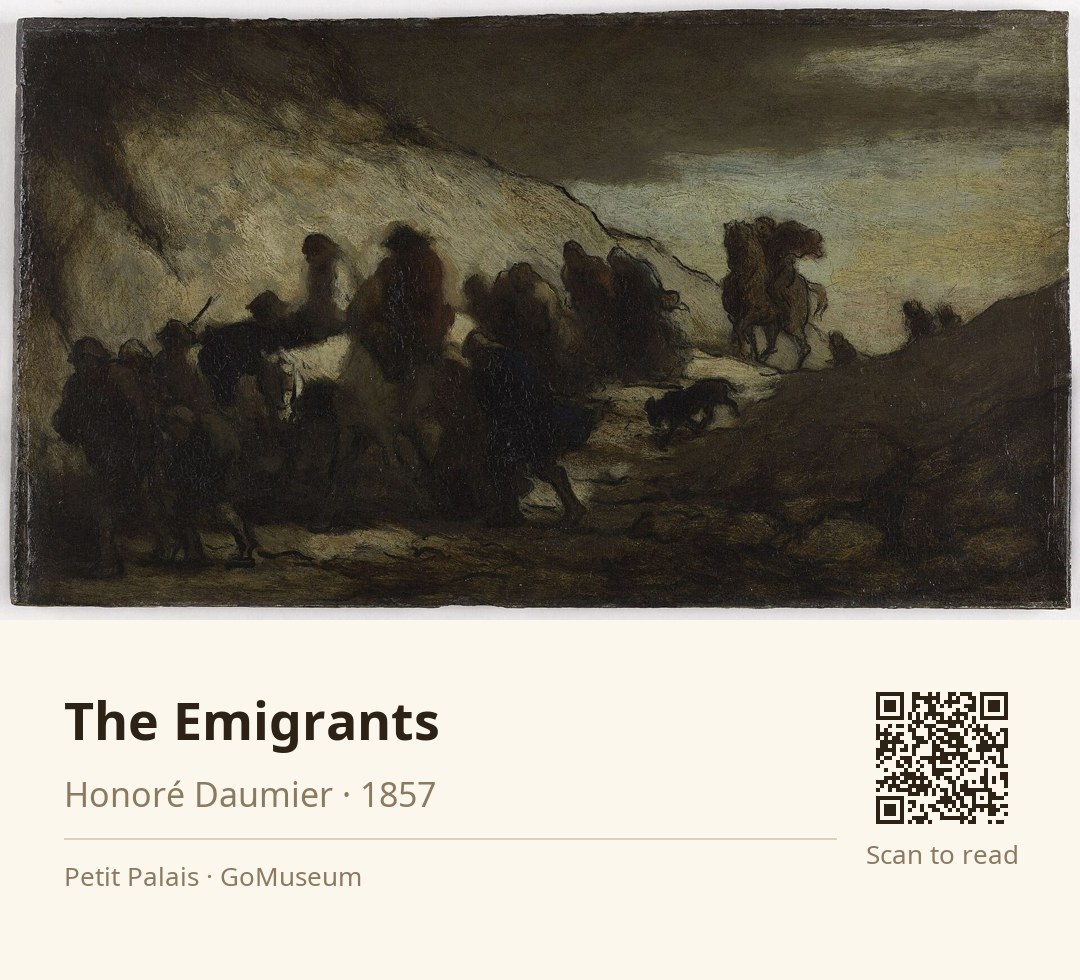
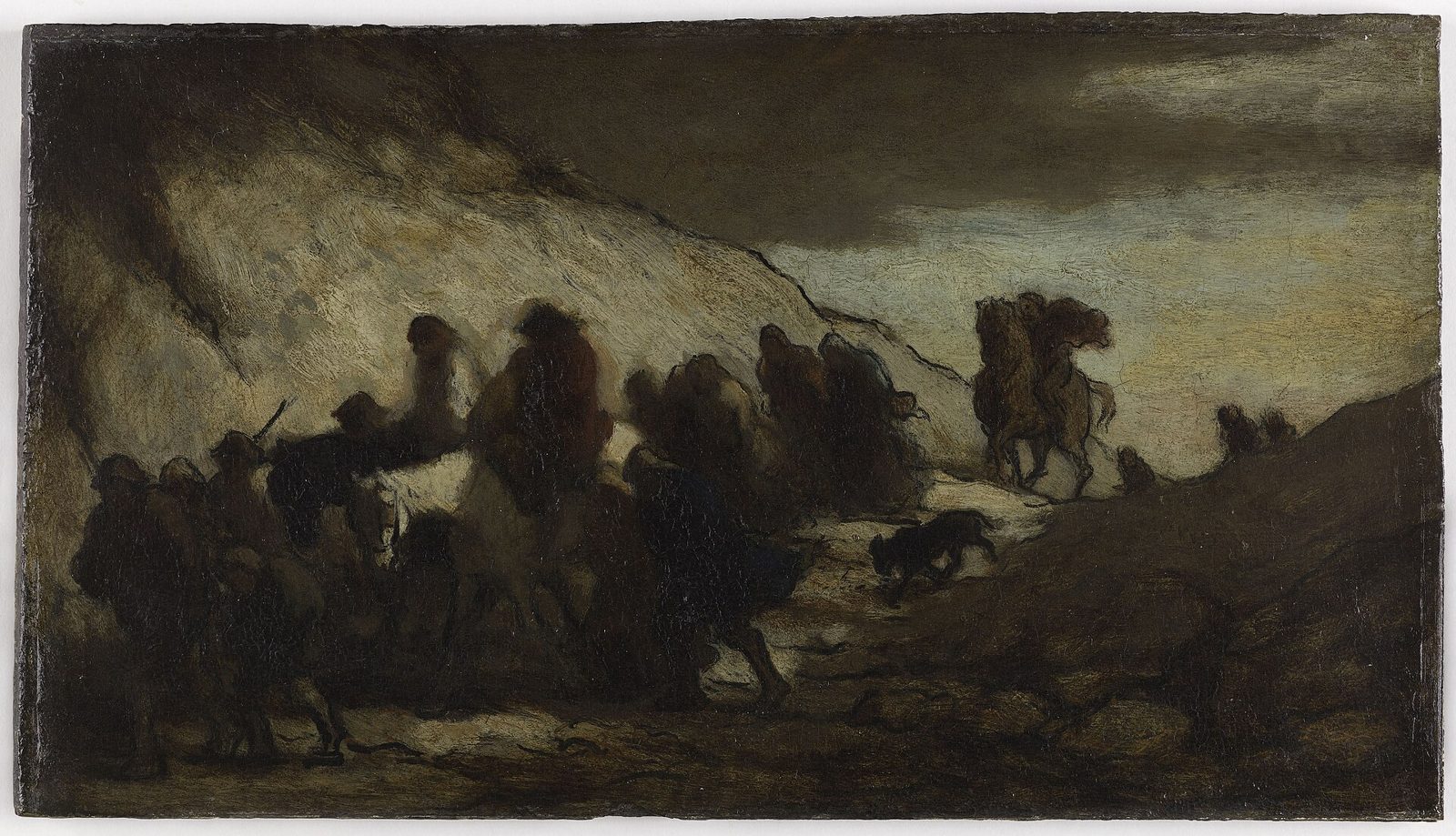
🎧 This work has audio narration — listen in the appA group of figures traverses a rugged landscape in Honoré Daumier's "The Emigrants," their silhouettes stark against the dark, rocky terrain. Some ride horses while others walk, and a dog adds a sense of urgency to their movement. The cloudy sky hints at dawn or dusk, with light breaking through, creating a dramatic backdrop that enhances the emotional weight of their journey.
This scene captures the plight of political fugitives fleeing repression after the workers' revolution of June 1848, a time when the government of Louis Philippe imposed harsh penalties, including deportations. Daumier's loose brushwork and dark palette evoke a sense of desperation and anguish, emphasizing the struggles faced by those forced to leave their homes. The diagonal composition leads the eye along their path, mirroring the uncertainty of their future.
Daumier created this painting between 1852 and 1855, as part of a series that included lithographs and reliefs, reflecting the turbulent political climate of 19th-century France. His work serves as a poignant reminder of the human cost of political upheaval.
Honoré-Victorin Daumier, born on February 26, 1808, in Marseille, was a pivotal French artist known for his incisive commentary on the social and political landscape of 19th-century France. A prolific lithographer, caricaturist, painter, and sculptor, Daumier's work often satirized the monarchy, the bourgeoisie, and human nature itself. He began his artistic journey at a young age, influenced by his family's struggles and his early exposure to the vibrant Parisian art scene.
Daumier's career took off after the July Revolution of 1830, when he became a prominent figure in political caricature, contributing to satirical publications like La Caricature and Le Charivari. His bold depictions of figures like King Louis-Philippe earned him both fame and imprisonment, reflecting his commitment to social critique. Despite facing financial hardships and a lack of recognition during his lifetime, he was admired by contemporaries such as Charles Baudelaire.
While Daumier produced thousands of lithographs, his paintings, though largely overlooked in his lifetime, would later be celebrated for their realism and emotional depth. His influence extended to later movements, including Impressionism, marking him as a significant figure in art history. Daumier passed away in February 1879, leaving behind a legacy that would reshape the understanding of political art.
Daumier's technique in 'The Emigrants' is strikingly effective, employing loose brushwork that conveys a sense of urgency and movement. The dark palette, dominated by browns and grays, evokes the somber mood of the figures' journey. The diagonal composition guides your eye along the path of the emigrants, enhancing the feeling of uncertainty and struggle. Each stroke seems to pulse with emotion, as if Daumier is capturing not just the physical movement of the figures but their inner turmoil. The use of chiaroscuro, with stark contrasts between light and dark, intensifies the drama, making the viewer acutely aware of the desperation faced by those fleeing oppression. The small scale of the painting, measuring just 16.2 cm by 28.7 cm, invites a closer inspection, drawing you into the intimate yet harrowing scene.
A fascinating tidbit about Daumier is that he was not just a painter but also a prolific caricaturist, producing over 4,000 lithographs throughout his career. His sharp wit and keen observations of society often landed him in trouble; he was jailed for several months after depicting King Louis Philippe in an unflattering light. This blend of humor and critique in his work showcases his unique ability to address serious social issues while engaging the public's imagination.
In addition to 'The Emigrants,' Daumier created lithographs and reliefs as part of a series that addressed similar themes of political fugitives.