Self-Portrait with a Black Dog
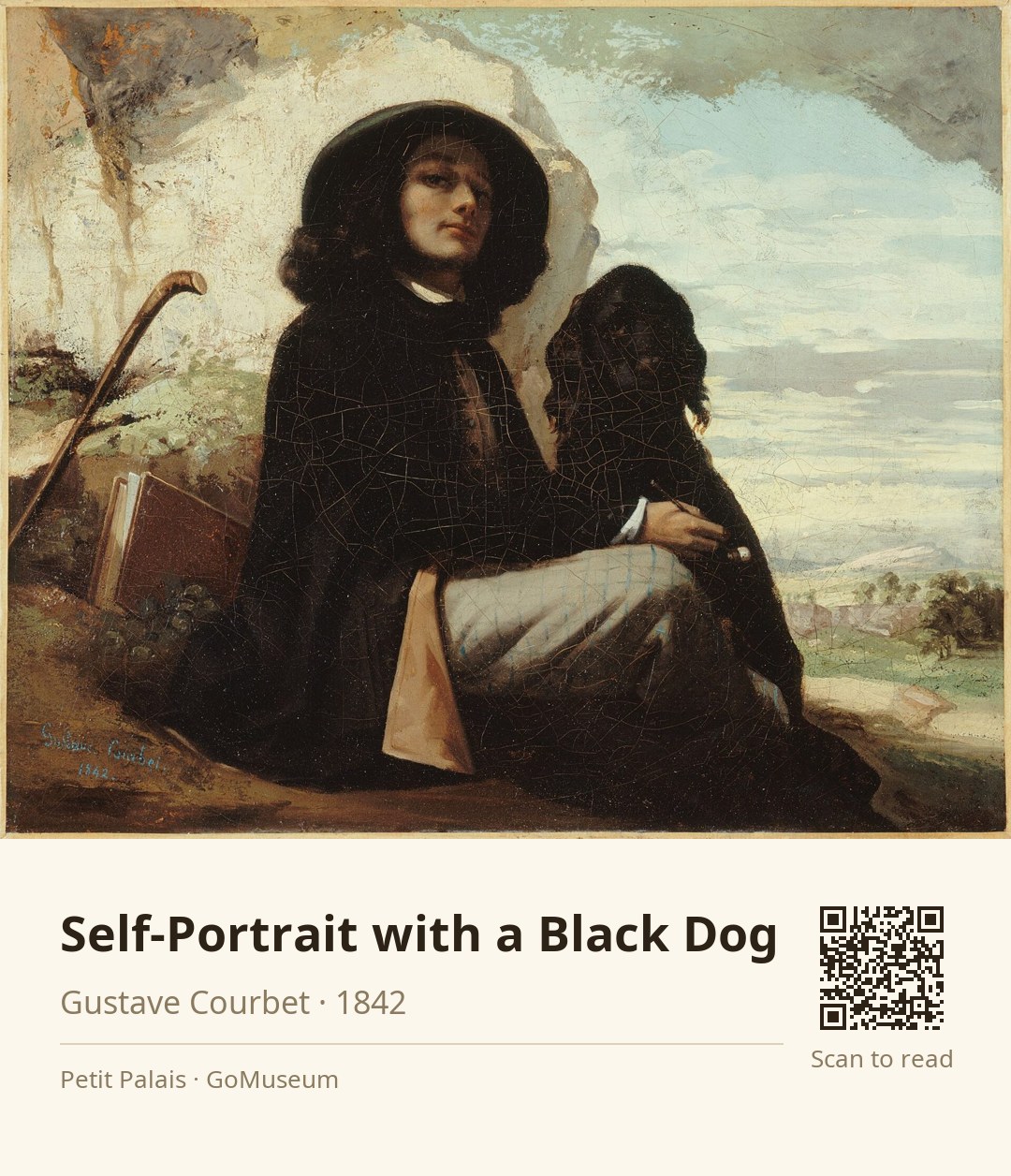
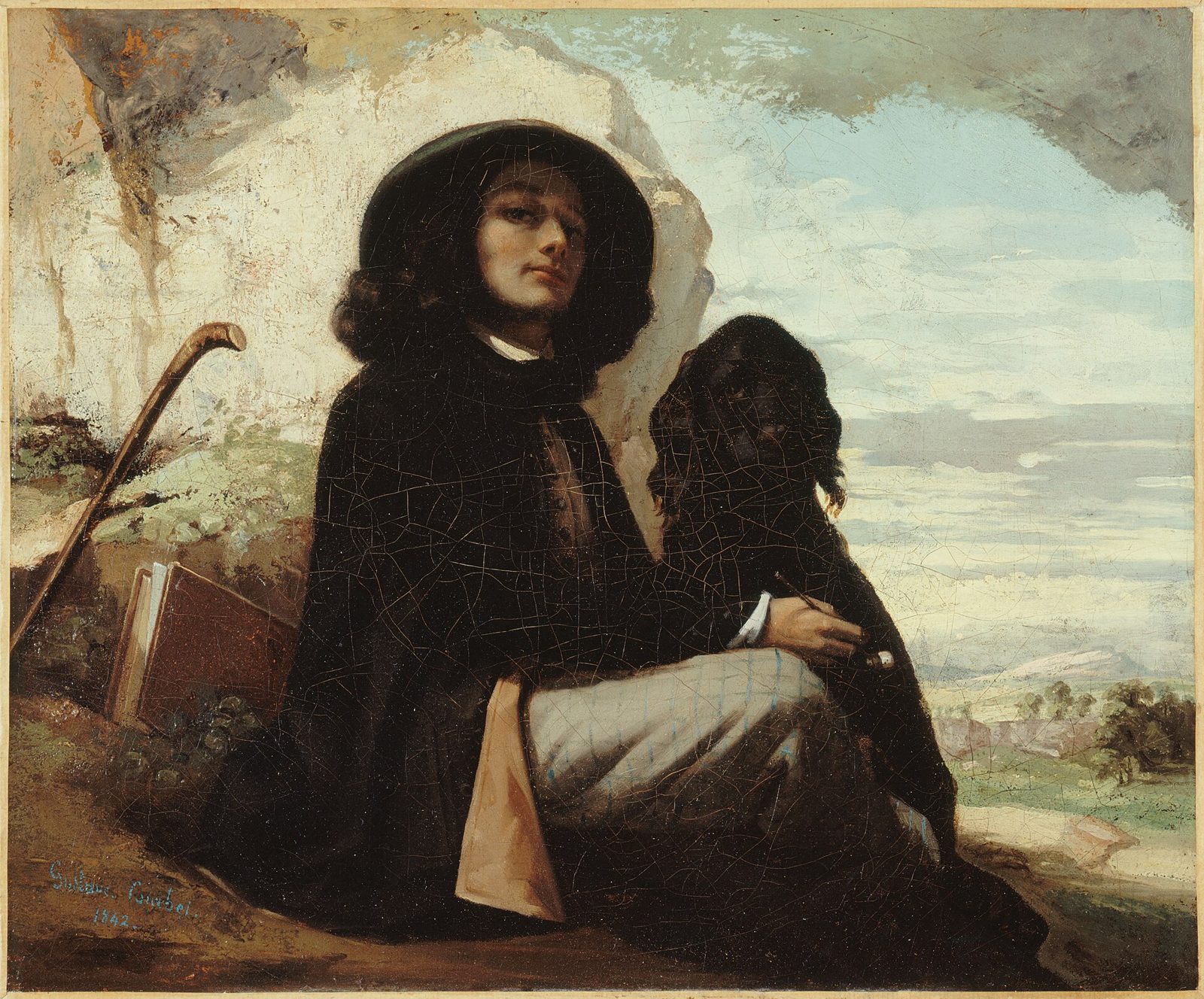
🎧 This work has audio narration — listen in the appGustave Courbet’s Self-Portrait with a Black Dog captures the artist seated against a rocky backdrop, his contemplative gaze directed outward while a dark-coated dog nestles closely by his side. The wide-brimmed hat and dark cloak he wears contrast with the bright sky and distant fields that stretch behind him, creating a vivid interplay of light and shadow that highlights both his figure and the natural landscape.
This portrayal is significant not just for its striking visual elements but also for how it embodies Courbet's bohemian spirit, reflecting the fashion and ethos of his time. The inclusion of the dog, a gift he received shortly before painting this work, adds a personal touch, suggesting companionship and loyalty. The book and walking stick beside him hint at a life of contemplation and creativity, grounding the artist in his environment while showcasing his connection to nature.
Courbet presented this painting at the Paris Salon in 1844, where it was one of the first works to gain him recognition. The piece was noted for its innovative approach, as it deviated from the idealized forms of the past, instead embracing a raw and honest representation of the artist himself.
Gustave Courbet, born on June 10, 1819, in Ornans, France, was a pioneering painter who championed the Realism movement in 19th-century art. Rejecting the conventions of academic painting and the idealism of Romanticism, he focused on depicting the world as he observed it, often portraying unidealized peasants and workers in monumental compositions. His early works gained recognition, notably "After Dinner at Ornans," which won him a gold medal at the Salon of 1849, allowing him to exhibit without jury approval.
Courbet's commitment to realism was revolutionary; he believed that art should stem from personal experience rather than historical or mythological themes. His bold approach often sparked controversy, challenging societal norms and addressing social issues, which resonated with later movements like Impressionism and Cubism. Despite facing criticism and imprisonment for his political involvement during the Paris Commune, Courbet continued to create until his death on December 31, 1877, in Switzerland.
His legacy endures as a transformative figure in art history, whose unflinching depictions of everyday life laid the groundwork for modern artistic expression. Today, Courbet is celebrated for his vigorous and uncompromising work, which continues to engage audiences with its raw honesty and depth.
Gustave Courbet's Self-Portrait with a Black Dog was painted in 1842 and later retouched in 1844. This work marked a significant moment in Courbet's career as it was one of the first pieces he submitted to the Paris Salon, where it gained acceptance—a notable achievement for an emerging artist. In the official catalog of the Salon, it was listed as 'Portrait of the Author' and was the only one of three submissions to be accepted. The painting was created during a period when Courbet was developing his unique style, moving away from the idealized forms of previous art movements.
Courbet's technique in Self-Portrait with a Black Dog showcases his mastery of oil paint on canvas, employing a detailed brushwork that captures the textures of both his clothing and the rocky landscape. The earthy color palette contrasts sharply with the bright sky, creating a dynamic visual experience. The artist's choice to depict himself in a contemplative pose, with the dog nestled close, adds an intimate layer to the work. The composition is structured to draw the viewer's eye towards Courbet's face, while the background landscape, possibly inspired by his native Bonnevaux valley, enhances the sense of place. The painting's slightly rounded form suggests it may have been intended for a specific location, perhaps above a door, inviting viewers to engage with it from below. This thoughtful arrangement reflects Courbet's innovative approach to realism, where he sought to portray not just the subject but the essence of the moment.
Interestingly, Courbet's Self-Portrait with a Black Dog was created using a canvas that had been repurposed, as evidenced by the traces of a coat hanger visible on the contours. This reuse of materials not only reflects Courbet's practical approach to art-making but also hints at the artist's resourcefulness during a time when he was still establishing his career.
Self-Portrait with a Black Dog was significant as it was one of Courbet's first works accepted at the prestigious Paris Salon, marking a pivotal moment in his career.
The detailed brushwork in the painting demonstrates Courbet's mastery of oil paint, effectively capturing the textures of his clothing and the rocky landscape.