Gallant Conversation
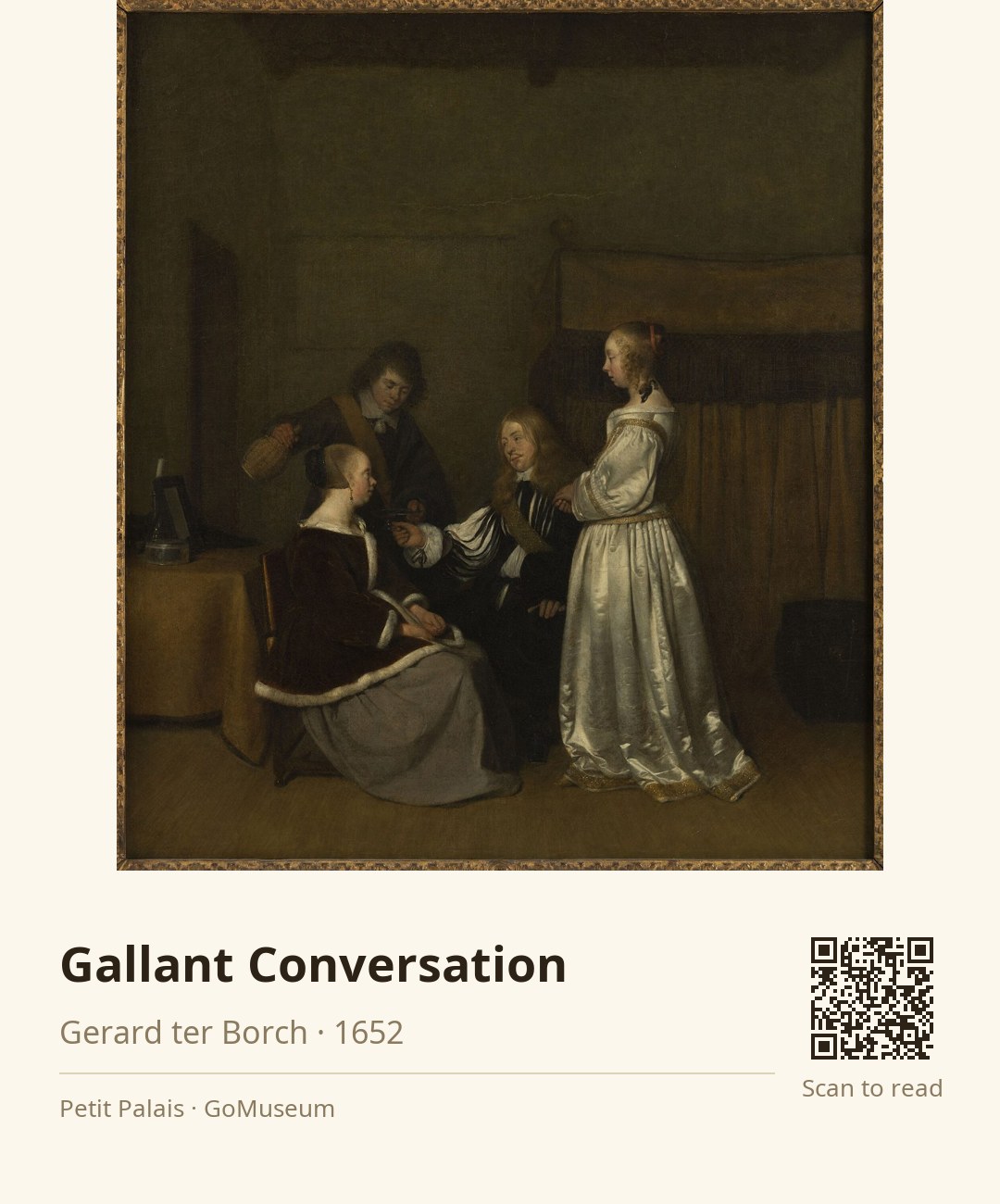
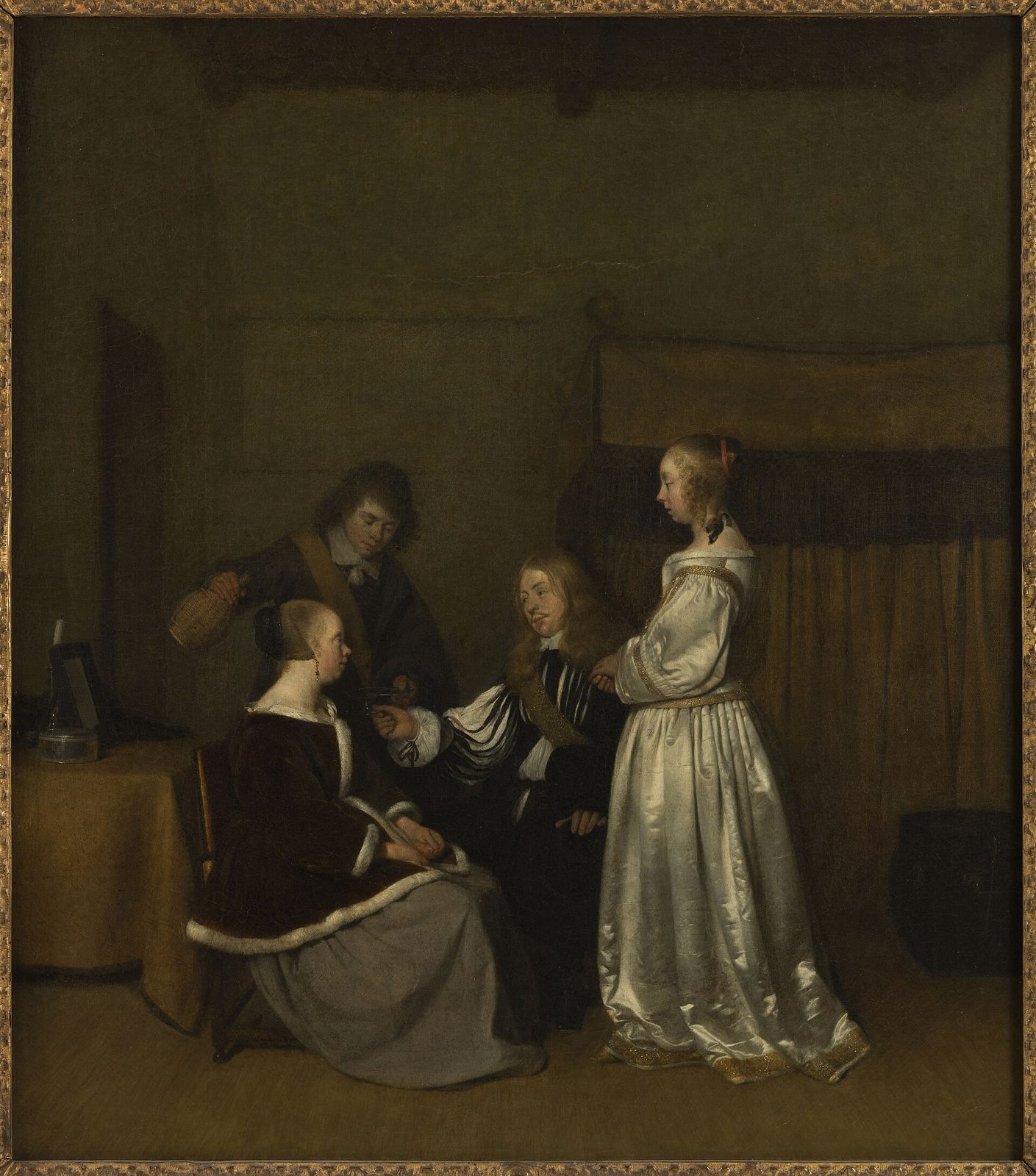
🎧 This work has audio narration — listen in the appThe seated woman in the dark fur-trimmed coat draws your attention, her expression caught between curiosity and caution as she faces the man gesturing towards her. The muted palette of dark browns and soft whites envelops the scene, while the shimmering gown of the standing woman to the right adds a touch of elegance, contrasting with the intimate setting of the room.
This careful arrangement of figures creates a triangular composition that invites the viewer into a moment of private conversation, hinting at the complexities of social interactions in the 17th century. The heavy drapery of the bed and the covered object on the table suggest a world of domesticity, where the subtleties of human connection unfold. Ter Borch’s mastery of texture is evident in the way he captures the richness of fabrics, from the softness of the woman's skirt to the sheen of the gown, each detail enhancing the sense of intimacy.
Gerard ter Borch, a prominent Dutch Golden Age painter, was known for his genre scenes that explored the nuances of everyday life. Born in 1617, he traveled extensively across Europe, developing a style that emphasized the emotional depth of his subjects. His works, including "Gallant Conversation," reflect the social dynamics of his time, showcasing the delicate balance of attraction and restraint in personal relationships. This painting was created in 1652, during a period when Ter Borch was establishing himself as a leading figure in the genre painting of the Dutch Republic.
Gerard ter Borch was a Dutch painter born in Zwolle in December 1617, known for his exquisite genre scenes and portraits. His early education in art came from his father, and he honed his skills under notable masters in Amsterdam and Haarlem. Ter Borch's travels across Europe, including significant time in Rome and Madrid, enriched his artistic perspective, allowing him to blend influences from various cultures into his work.
He is celebrated for his ability to capture the subtleties of human emotion and the intricacies of fabric textures, which are evident in works like "The Letter" and "The Gallant Conversation." His paintings often depict intimate domestic settings, revealing the complexities of everyday life. Ter Borch's influence extended to contemporaries such as Johannes Vermeer and Gabriel Metsu, establishing him as a pivotal figure in Dutch Golden Age painting.
Despite his significant contributions, his legacy was somewhat overshadowed by Vermeer in later art history. Ter Borch passed away in Deventer in 1681, leaving behind a relatively small but impactful body of work that continues to be appreciated for its elegance and depth.
The brushwork is delicate, allowing for a soft blending of colors that enhances the intimate atmosphere of the scene. The muted palette, dominated by dark browns and soft whites, creates a sense of warmth and closeness, drawing the viewer into the moment. The triangular composition is not just a structural choice; it guides the eye through the interaction between the figures, emphasizing their relationships. The textures of the fabrics are rendered with incredible detail — the sheen of the standing woman's gown contrasts beautifully with the rich, dark coat of the seated figure. This attention to texture not only highlights the social status of the characters but also adds a tactile quality that invites the viewer to imagine the feel of the materials. The subdued lighting further enhances this intimacy, suggesting a private conversation that unfolds within the confines of domestic life.
Ter Borch's influence on the art world is profound, particularly in the realm of genre painting. His ability to depict everyday life with such emotional depth set a new standard for artists who followed. He inspired contemporaries like Gabriel Metsu and Gerrit Dou, as well as the iconic Johannes Vermeer, who admired Ter Borch's focus on the subtleties of human interaction. This painting, along with others by Ter Borch, helped to elevate genre scenes from mere depictions of daily life to works that explore complex emotional narratives. His legacy is evident in the way later artists approached the portrayal of intimate moments, making 'Gallant Conversation' a significant milestone in the evolution of Dutch painting.
A fascinating tidbit about 'Gallant Conversation' is that it was once engraved by Johann Georg Wille, a notable printmaker of the 18th century. This engraving helped to popularize Ter Borch's work beyond the confines of the gallery, allowing a wider audience to appreciate his artistry. The print captured the essence of the original painting, showcasing the intricate details and emotional subtleties that Ter Borch was known for, further cementing his reputation in art history.