Holy Family with Christ as Imperator mundi
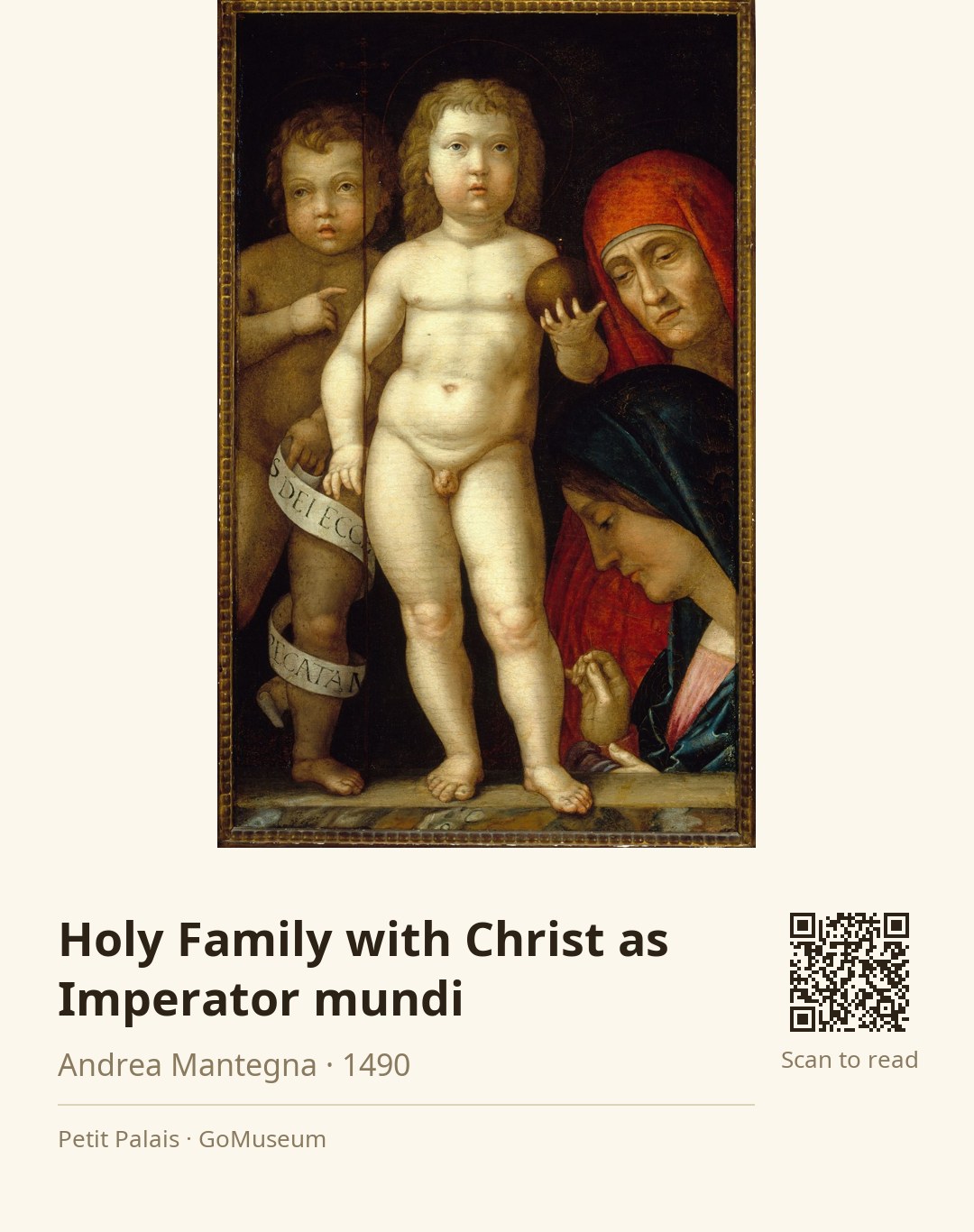
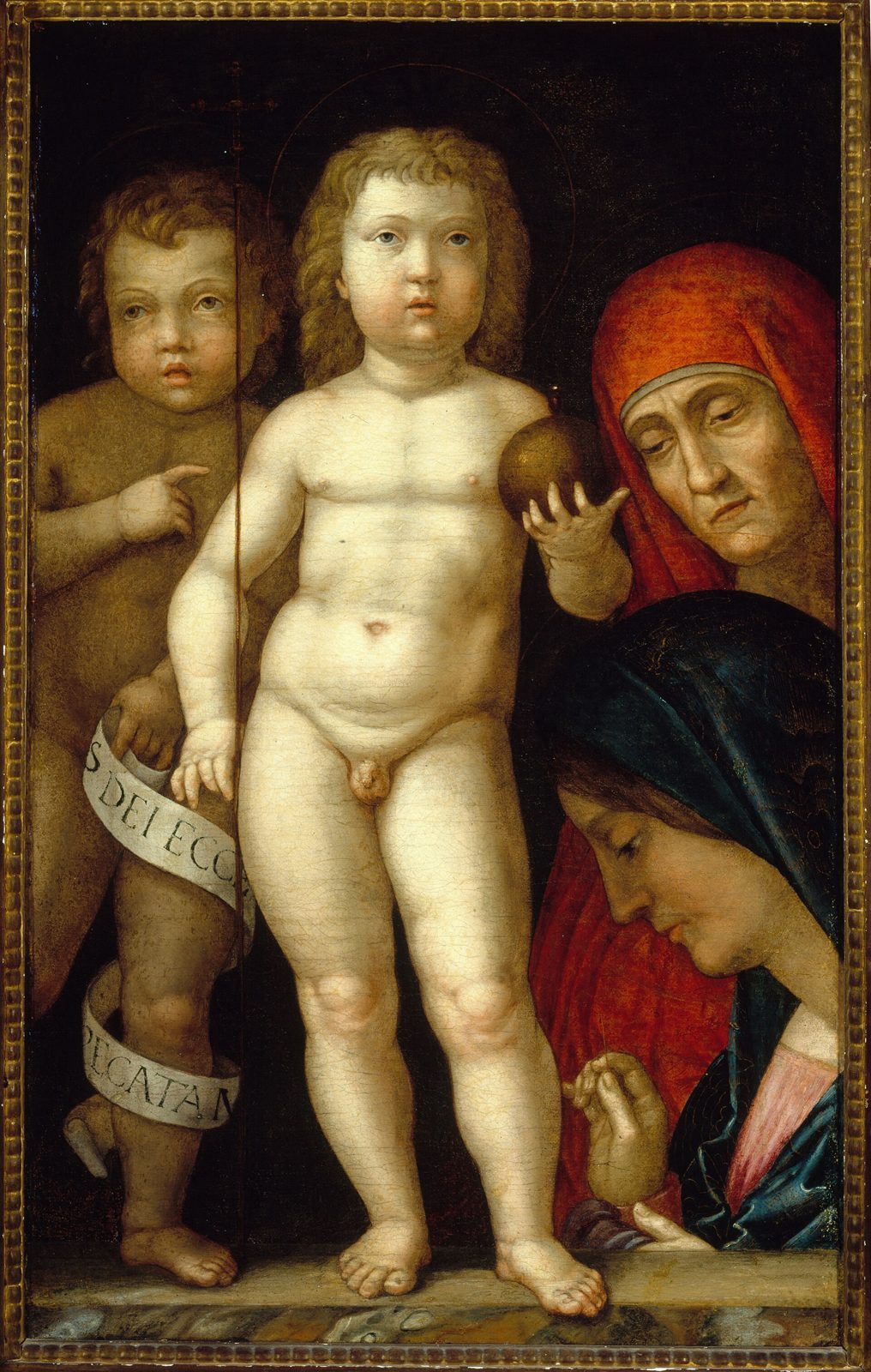
🎧 This work has audio narration — listen in the appThe central figure of a nude child, Christ, stands confidently, holding a golden orb in his right hand, symbolizing his authority as 'Imperator mundi' or ruler of the world. To his left, another child, John the Baptist, partially draped, points toward Christ while holding a scroll that reads "ECCE AGNUS DEI ECCE QUI TOLLIT PECCATA," a proclamation of Christ's role in salvation. The adults on the right, Mary and Elizabeth, are depicted in deep contemplation, their hands clasped in prayer, surrounded by a dark background that enhances the warmth of their flesh tones and the rich reds and blues of their garments.
This tightly arranged composition emphasizes the intimate connection between the figures, inviting viewers to reflect on the familial bond and the divine mission of Christ. Mantegna's choice to portray the Christ Child nude underscores his innocence and purity, while the scroll held by John serves as a direct link to the prophetic acknowledgment of Jesus' significance. The absence of Saint Joseph adds a layer of focus on the maternal figures, highlighting their roles in the sacred narrative.
Created around 1490, this oil painting on canvas showcases Mantegna's mastery of perspective and detail, hallmarks of his Renaissance style.
Andrea Mantegna, born around 1431 in Isola di Carturo, was a pivotal figure in the Italian Renaissance, renowned for his innovative approach to perspective and his sculptural style. Apprenticed to Francesco Squarcione, he absorbed a passion for classical antiquity, which profoundly influenced his artistic vision. Mantegna's early works, including the frescoes in the Ovetari Chapel, showcased his mastery of dramatic perspectives and detailed architectural elements, although many were tragically lost during World War II.
His marriage to Nicolosia, daughter of Jacopo Bellini, further anchored him in the vibrant artistic community of Venice. Mantegna's distinct style, characterized by flinty landscapes and statuesque figures, often drew criticism for its rigidity, yet it marked a significant departure from Gothic traditions. He was instrumental in elevating the status of the artist in society, embodying the Renaissance ideal of the creative genius. Mantegna's legacy endures, influencing generations of artists and cementing his place in art history as a master of both painting and printmaking. He passed away in 1506, leaving behind a rich body of work that continues to inspire.
An interesting tidbit about 'Holy Family with Christ as Imperator mundi' is that it shares a striking resemblance to another of Mantegna's works, 'Holy Family with the Infant Saint John the Baptist,' which is housed in the National Gallery in London. This similarity has led art historians to speculate about Mantegna's creative process and his exploration of recurring themes and figures, suggesting that he may have been refining his ideas across multiple canvases.
The nude portrayal of the Christ Child highlights his innocence and purity, which may reflect Mantegna's desire to emphasize the divine nature of Christ.
This painting closely resembles Mantegna's 'Holy Family with the Infant Saint John the Baptist,' suggesting he was refining similar themes and figures across different canvases.
Mantegna's workshop was notable for being the leading producer of prints in Venice prior to 1500, indicating his influence on the dissemination of art during the Renaissance.