Virgin and Child
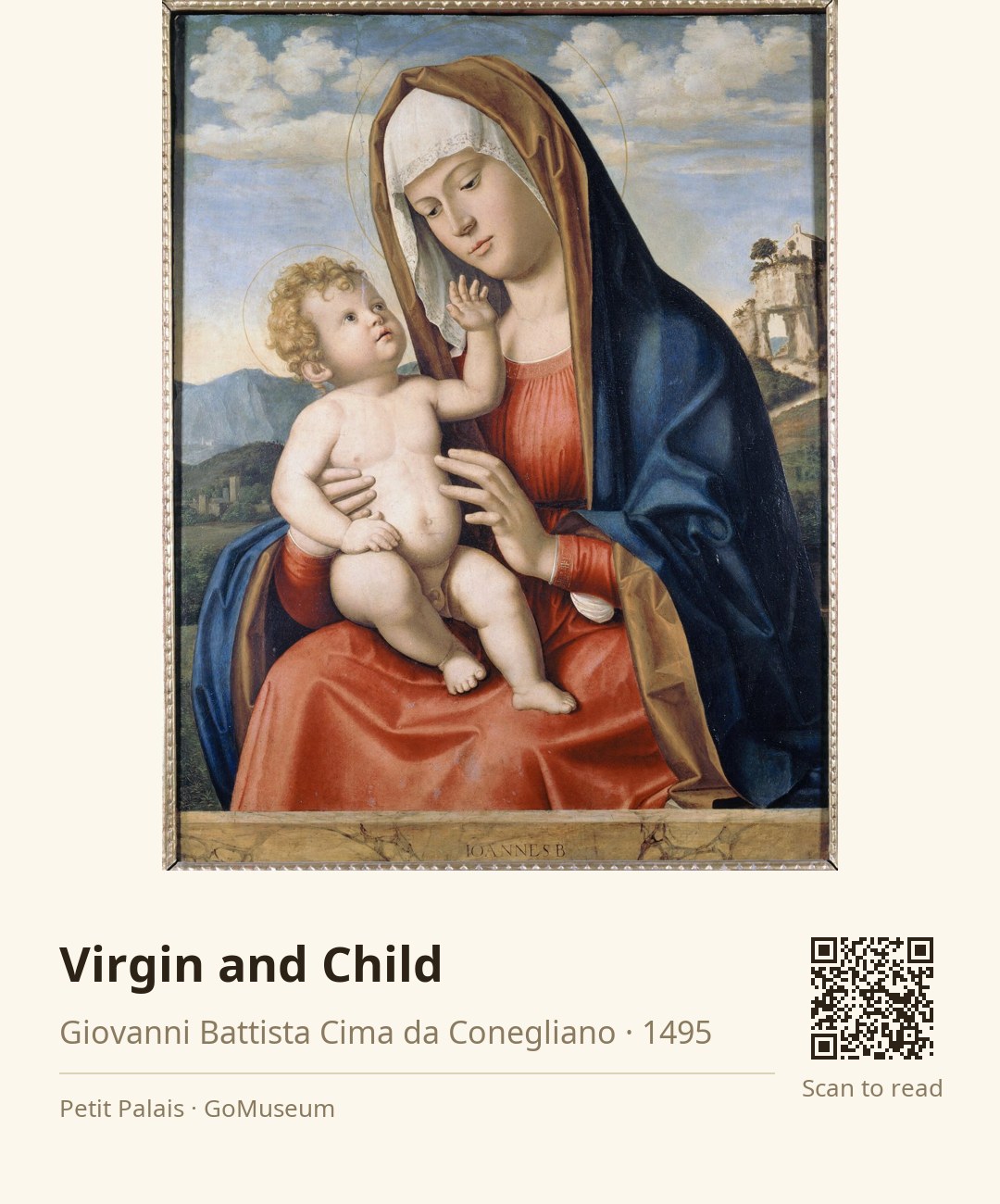
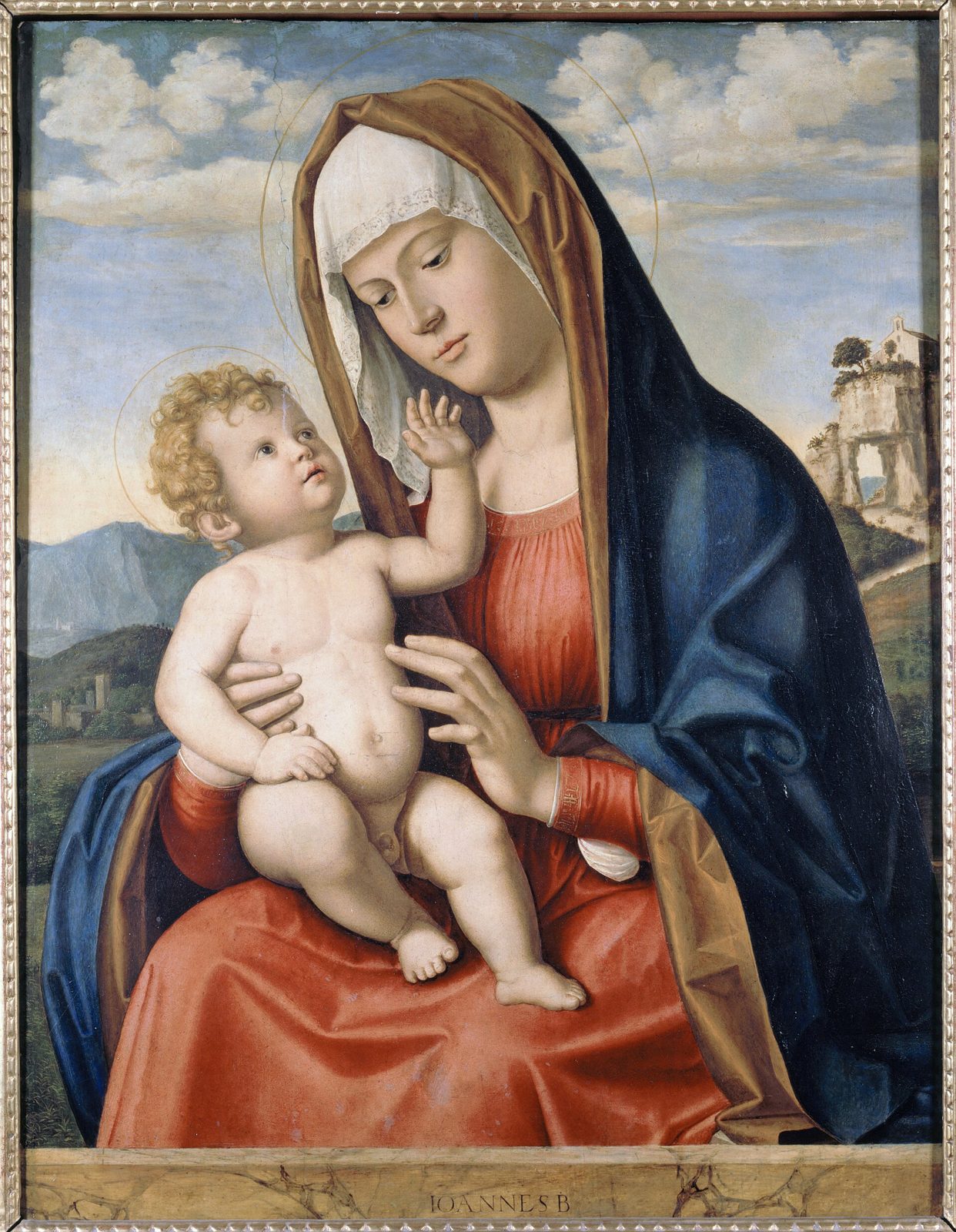
🎧 This work has audio narration — listen in the appThe seated figure of Mary, draped in a vibrant red dress and a blue cloak, cradles the Christ Child on her lap, their gentle gazes locked in a moment of tenderness. The child, nude and reaching up, embodies innocence, while both figures are adorned with halos, emphasizing their sanctity. The rich colors of reds and blues contrast beautifully against the soft earth tones of the landscape behind them, where rolling hills and a distant building create a serene backdrop.
This intimate portrayal of the Virgin and Child reflects the Renaissance's deepening exploration of human emotion and divine connection. Cima da Conegliano's smooth brushwork lends a soft texture to the fabric and figures, inviting viewers into a sacred yet relatable scene. The landscape, a hallmark of Cima’s style, not only enhances the composition but also signifies the importance of nature in his work, bridging the earthly with the divine.
Created around 1495, this oil painting on panel exemplifies Cima's ability to blend religious themes with a tranquil atmosphere, marking him as a significant figure in the Venetian Renaissance.
Giovanni Battista Cima, known as Cima da Conegliano, was an influential Italian Renaissance painter born around 1459 in Conegliano. His artistic journey began in Vicenza, where he developed a style marked by serene compositions and a deep appreciation for landscape, influenced by Antonello da Messina and Giovanni Bellini. Cima primarily focused on religious themes, creating intimate works intended for private homes rather than grand churches. His paintings often featured variations of popular subjects, particularly Madonnas, showcasing a gentle symmetry and a tranquil atmosphere.
Cima's early works reveal a calm and almost passionless spirit, evolving into a more graceful style while retaining dignity. His landscapes were groundbreaking for their atmospheric depth and light distribution, as seen in pieces like "Baptism of Christ." He became a vital link between Bellini and later masters like Titian, establishing a legacy that contributed significantly to the Venetian school of painting. Cima's influence extended through his pupils, including his son Carlo, and his works remain celebrated for their serene beauty and technical mastery, securing his place in art history. He passed away around 1517, leaving behind a rich collection of paintings that continue to inspire.
This painting, titled 'Virgin and Child', was created by Giovanni Battista Cima da Conegliano around 1495. It found its way into the collection of Sir William Abdy in London before being acquired by Edward Tuck, an American vice-consul in Paris. Tuck gifted it to the Petit Palais in 1930, where it remains today. The artwork has been dated variably between 1495 and 1497 by different scholars, reflecting the ongoing discussions about Cima's timeline.
Cima's technique in this painting is a masterclass in smooth brushwork, which creates a soft texture that enhances the figures' gentle expressions. The oil paint allows for rich, saturated colors, particularly the vibrant reds and blues of Mary's garments, which draw your eye immediately. The halos, rendered with a delicate touch, add a sense of divine light without overwhelming the scene. Cima's composition is carefully balanced, with the seated figures of Mary and Christ Child occupying the foreground, while the rolling hills and distant buildings in the background create a sense of depth and tranquility. This layering of elements not only invites the viewer into the sacred moment but also reflects Cima's understanding of atmospheric perspective, a hallmark of his style.
Interestingly, Cima often repeated popular subjects with slight variations, creating multiple versions of his Madonnas. This practice not only catered to the demand for religious art in private homes but also showcased his ability to reinterpret familiar themes, allowing viewers to connect with the sacred in diverse ways.
Cima often painted variations of popular subjects, such as his Madonnas and Saint Jerome in a Landscape, showcasing his ability to reinterpret familiar themes.
Cima's father was a cloth-shearer, which is reflected in their surname 'Cima', suggesting a connection to the textile trade.
Cima employed smooth brushwork in his technique, which contributed to the soft texture and gentle expressions of the figures.