The Death of Seneca
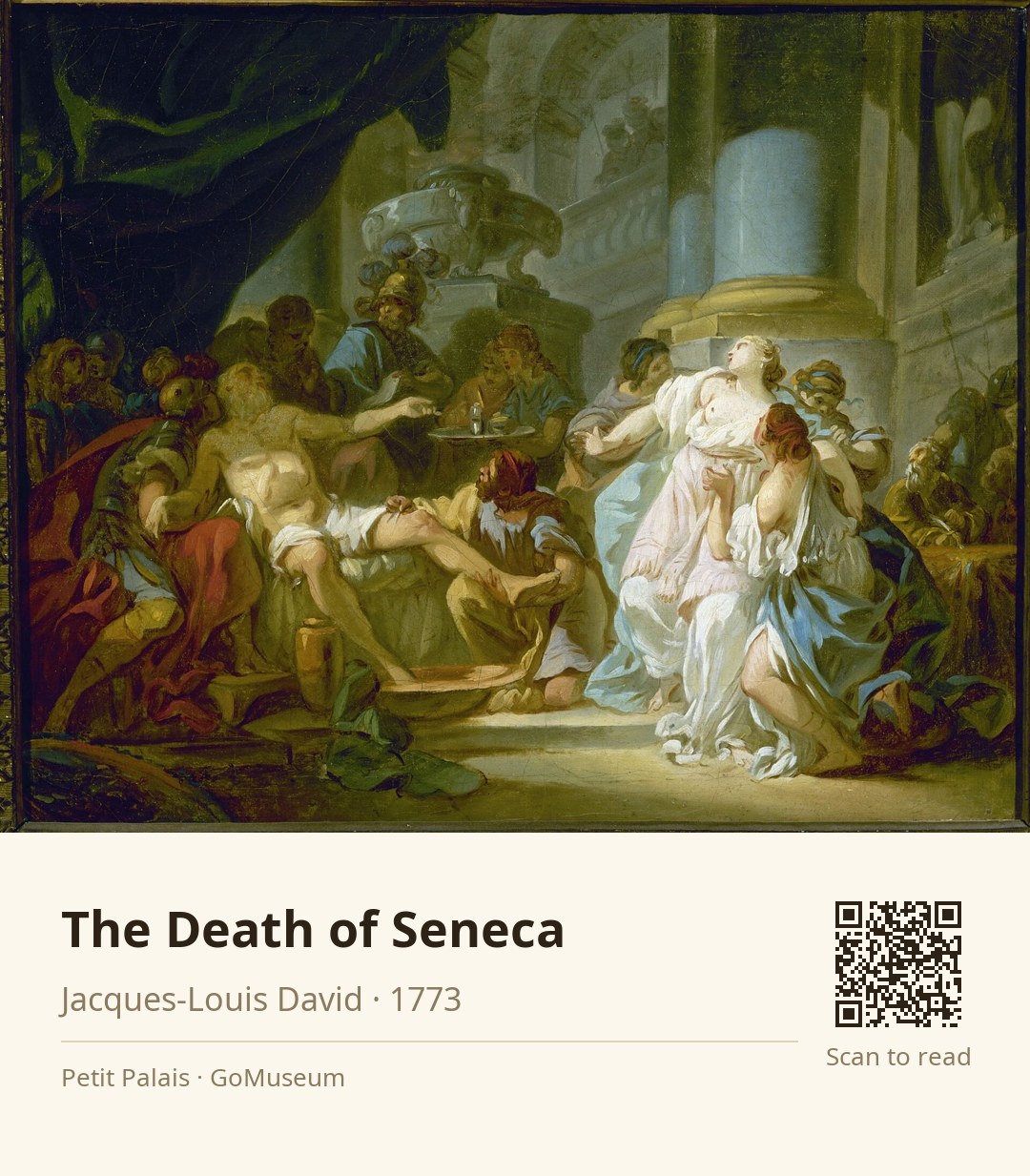
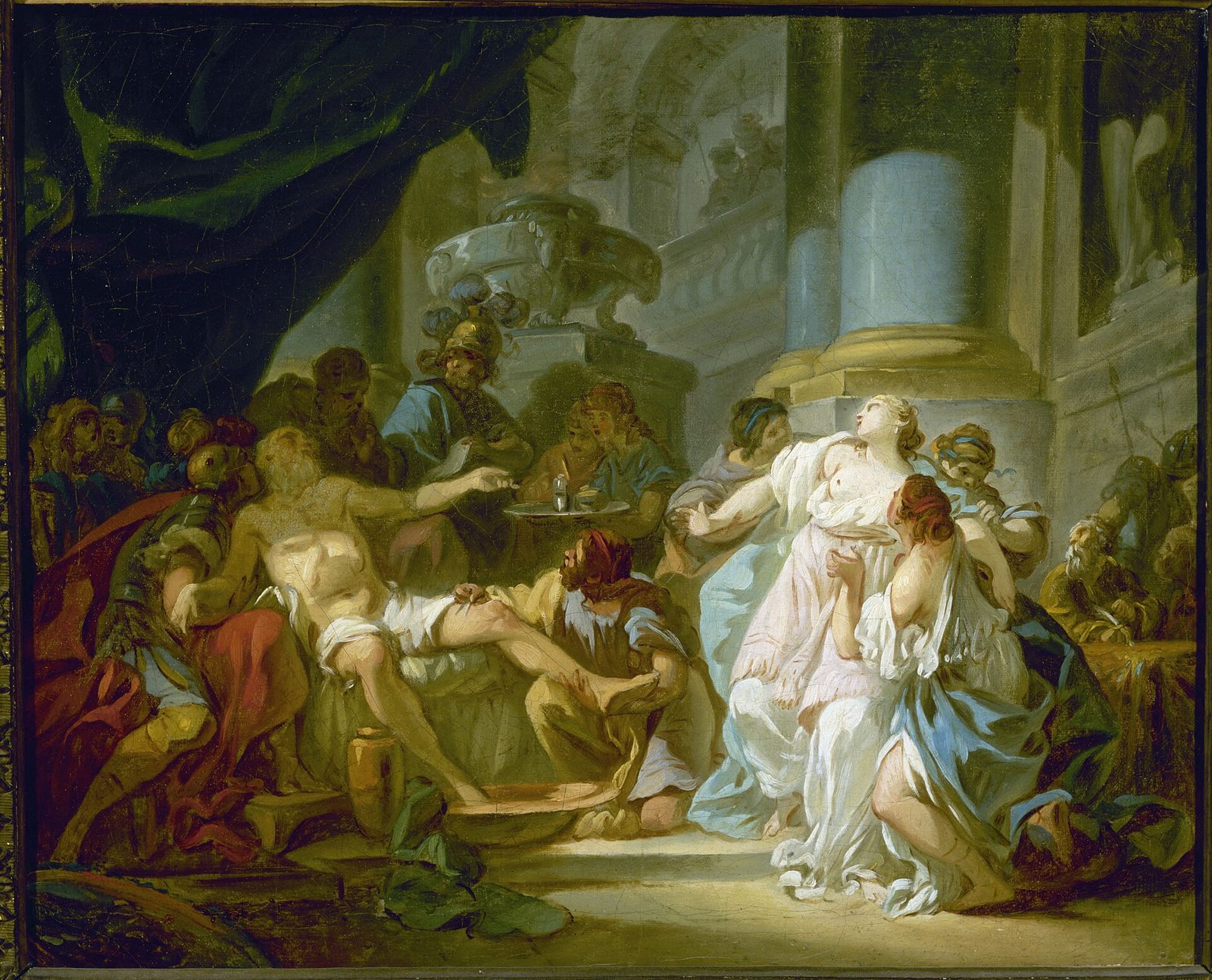
🎧 This work has audio narration — listen in the appSeneca the Younger lies in a dramatic pose, his lifeless body partially draped, surrounded by figures in a lavish interior. To the right, a woman in a flowing white gown, presumably his wife Paulina, is being supported by others, her head tilted back in despair. The opulence of the setting, with grand columns and a large urn, contrasts sharply with the tragic scene unfolding in the foreground.
This juxtaposition of wealth and suffering highlights the emotional intensity of the moment, as Seneca faces his unjust death ordered by Emperor Nero. The figures, arranged in a semi-circle, convey a palpable sense of urgency and drama, their gestures and expressions amplifying the gravity of the situation. The rich palette of deep reds, blues, and golds enhances the painting's emotional impact, drawing viewers into the turmoil of Seneca's final moments.
Created in 1773, Jacques-Louis David's "The Death of Seneca" was his third attempt to win the prestigious Prix de Rome, a competition he ultimately lost to Pierre Peyron, who portrayed the same subject with a more subdued palette. David's work, rich in detail and Rococo flair, was a bold statement against the austere expectations of the Academy, reflecting his struggle to define his artistic voice within the emerging Neoclassical movement.
Jacques-Louis David was a pivotal French painter born on August 30, 1748, in Paris. He emerged as the leading figure of the Neoclassical movement, marking a significant shift in artistic taste from the frivolity of Rococo to a more austere and emotionally charged classical style. His early life was marked by personal tragedy, losing his father at a young age, which shaped his character and determination to pursue art against familial expectations.
David's career flourished during the tumultuous political landscape of France, where he became an ardent supporter of the French Revolution, aligning himself with figures like Robespierre. His political engagement influenced his art, producing iconic works such as "The Death of Marat" and "The Coronation of Napoleon," which reflect both historical narratives and his personal convictions. After the fall of Napoleon, David faced exile but continued to influence generations of artists, establishing a legacy that shaped academic painting in the early 19th century. His works remain celebrated in major museums, particularly the Louvre, solidifying his status as a cornerstone of Western art history. David's life and art were inextricably linked to the evolving identity of France, embodying the spirit of revolution and the quest for artistic integrity.
Jacques-Louis David's 'The Death of Seneca' was painted in 1773 as his third attempt to win the coveted Prix de Rome. This competition was a significant milestone for artists of the time, offering a chance to study in Italy. David, however, faced stiff competition from Pierre Peyron, who also chose the same subject but executed it with a more subdued palette. The jury ultimately favored Peyron, leaving David frustrated yet determined. Despite this setback, David's work laid the groundwork for his later success, as he eventually won the Prix de Rome the following year with a different piece. The painting now resides in the Petit Palais in Paris, where it continues to evoke discussions about its dramatic portrayal of Seneca's tragic fate.
In 'The Death of Seneca', David employs oil paint on canvas to create a vivid, dynamic scene that captures the emotional intensity of the moment. The brushwork is expressive, with bold strokes that enhance the dramatic gestures of the figures. The rich color palette, dominated by deep reds, blues, and golds, amplifies the opulence of the setting while simultaneously underscoring the tragedy unfolding. David's composition is meticulously balanced, with the figures arranged in a semi-circle that draws the viewer's eye toward Seneca's lifeless form. This arrangement not only heightens the sense of urgency but also creates a visual dialogue among the characters, each contributing to the overall narrative. The lavish Rococo elements, such as the grand columns and intricate details, serve to juxtapose the wealth of the setting with the somber act of suicide, making the emotional impact all the more striking.
Paulina attempted to take her own life alongside Seneca but was stopped by Nero's orders after she became unconscious.
David's painting featured more intricate details and a vibrant color palette, while Peyron's work adopted a simpler, darker approach closer to classical antiquity.