Combat of the Giaour and the Pasha
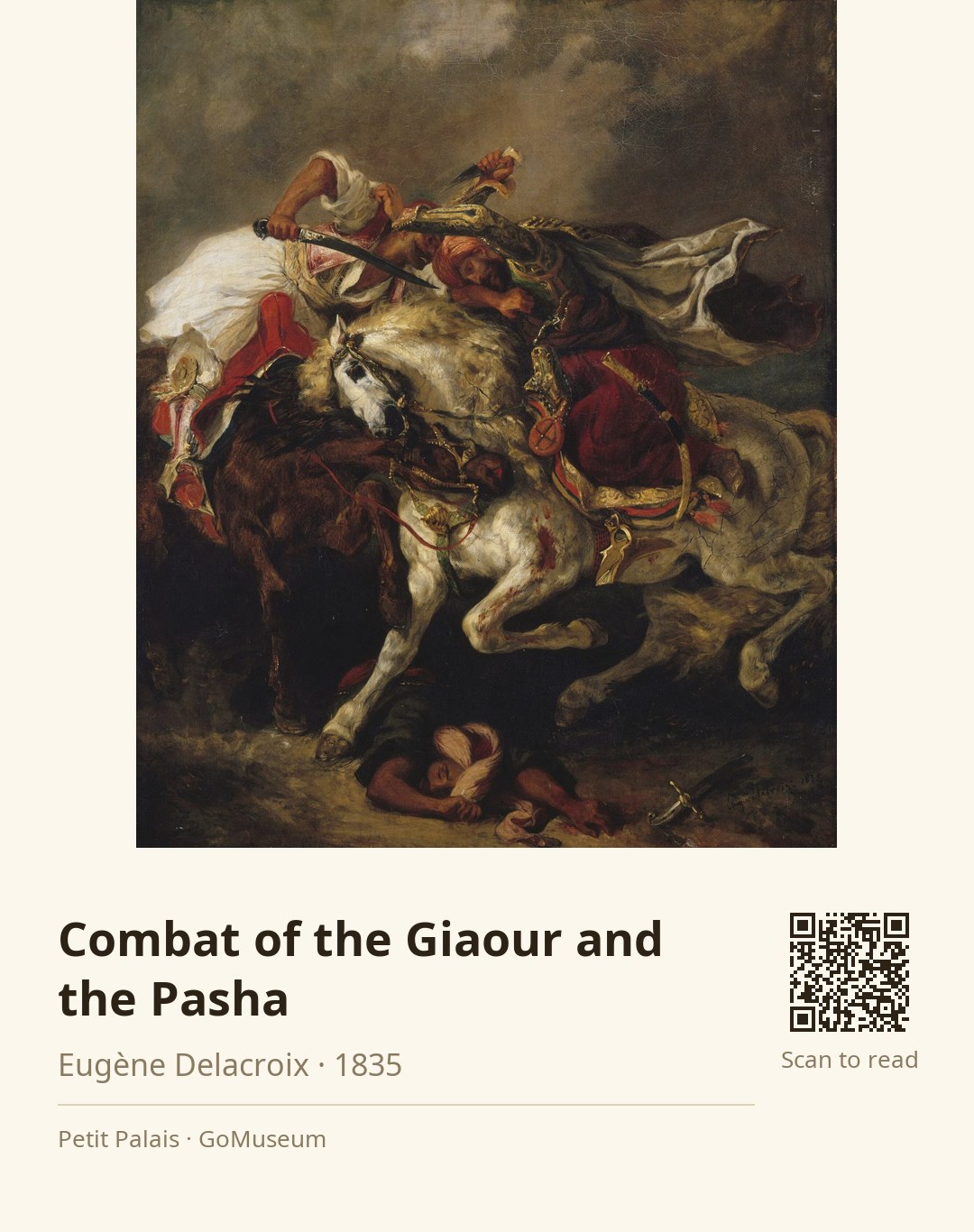
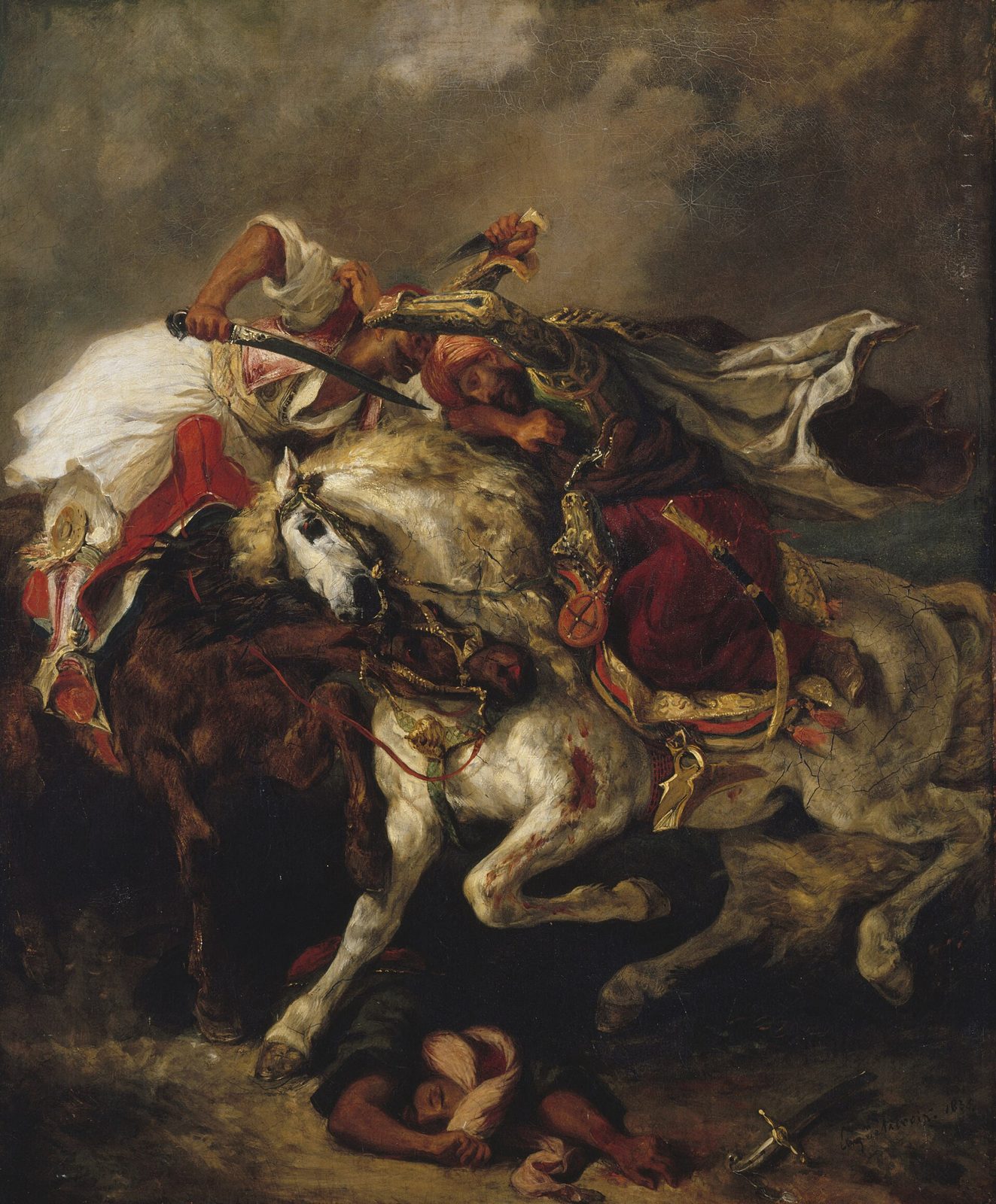
🎧 This work has audio narration — listen in the appThe fierce clash between two horsemen in "Combat of the Giaour and the Pasha" captures a moment of intense struggle, with the central figure on a striking white horse, adorned in a red turban and wielding a sword, facing off against his opponent on a darker steed, also armed and dressed in white. The horses rear up, their powerful forms adding to the chaos of the scene, while a fallen figure lies in the foreground, partially hidden, suggesting the brutal consequences of this battle.
Delacroix's choice of a rich palette filled with deep reds, browns, and whites enhances the drama, while his dynamic brushwork conveys a sense of movement and urgency. This painting reflects the Romantic era's fascination with emotional intensity and the sublime, drawing inspiration from both historical narratives and the exoticism of the East. Delacroix, influenced by the works of Rubens and the Venetian Renaissance, sought to evoke passion and turmoil rather than the clarity of Neoclassical art, which was dominated by his rival Ingres. His travels to North Africa and his engagement with contemporary events, such as the Greek War of Independence, further fueled his artistic vision.
Created in 1835, "Combat of the Giaour and the Pasha" exemplifies Delacroix's commitment to capturing the raw energy of human conflict and emotion, marking a significant moment in the evolution of Romantic painting.
Eugène Delacroix, born on April 26, 1798, in Charenton-Saint-Maurice, emerged as a pivotal figure in the French Romantic movement. He diverged from the Neoclassical ideals of his contemporaries, such as Ingres, drawing inspiration from the vibrant colors and dynamic forms of Rubens and the Venetian Renaissance. His works, characterized by dramatic themes and a passion for the exotic, often reflected his travels in North Africa and his fascination with the sublime forces of nature, influenced by literary figures like Lord Byron.
Delacroix's career was marked by both acclaim and controversy; his early painting, "The Barque of Dante," stirred public debate but was ultimately recognized by the state. His later masterpieces, including "Liberty Leading the People," showcased his ability to blend historical and contemporary narratives, solidifying his status as a master of expressive brushwork and color theory. His innovative techniques laid the groundwork for Impressionism and inspired the Symbolist movement.
Despite personal struggles, including early orphanhood and financial hardships, Delacroix's legacy endures. He is celebrated not only for his paintings but also for his lithographs and writings, which reveal his artistic philosophy. As one of the last old masters, his influence resonates through art history, marking him as a cornerstone of Romanticism and a precursor to modern artistic movements. Delacroix passed away on August 13, 1863, leaving a profound impact on the art world.
Eugène Delacroix's "Combat of the Giaour and the Pasha" was created in 1835, a time when the Romantic movement was gaining momentum in France. This painting was commissioned by François Charles Jean Marie d'Harcourt, the Duke, who was a notable patron of the arts. After its completion, the work was exhibited at the prestigious Paris Salon, where it stirred a mix of admiration and controversy, typical of Delacroix's career. Critics often found his style too wild and emotional, contrasting sharply with the Neoclassical ideals of his contemporaries. Despite the mixed reception, the painting was acquired by the state and has since become a key piece in the history of Romantic art.
Delacroix's technique in "Combat of the Giaour and the Pasha" is a masterclass in dynamic brushwork and vibrant color application. The artist employs thick, expressive strokes that create a sense of movement, as if the horses and riders are leaping off the canvas. The rich palette—deep reds, browns, and whites—conveys not just the physical clash of the combatants but also the emotional intensity of the scene. Delacroix's choice to depict the figures in a swirling, chaotic background enhances the drama, while the contrasting colors of the horses symbolize the conflict between the two men. The scale of the painting, at 73 by 61 cm, allows for an immersive experience, drawing viewers into the tumultuous moment. This approach reflects Delacroix's fascination with capturing the sublime, where beauty and terror coexist, a hallmark of the Romantic era.
The chaotic background is intended to enhance the dramatic effect of the scene, emphasizing the turmoil and intensity of the conflict.
This influence led Delacroix to focus on color and movement, prioritizing emotional expression over the clear outlines typical of Neoclassical art.