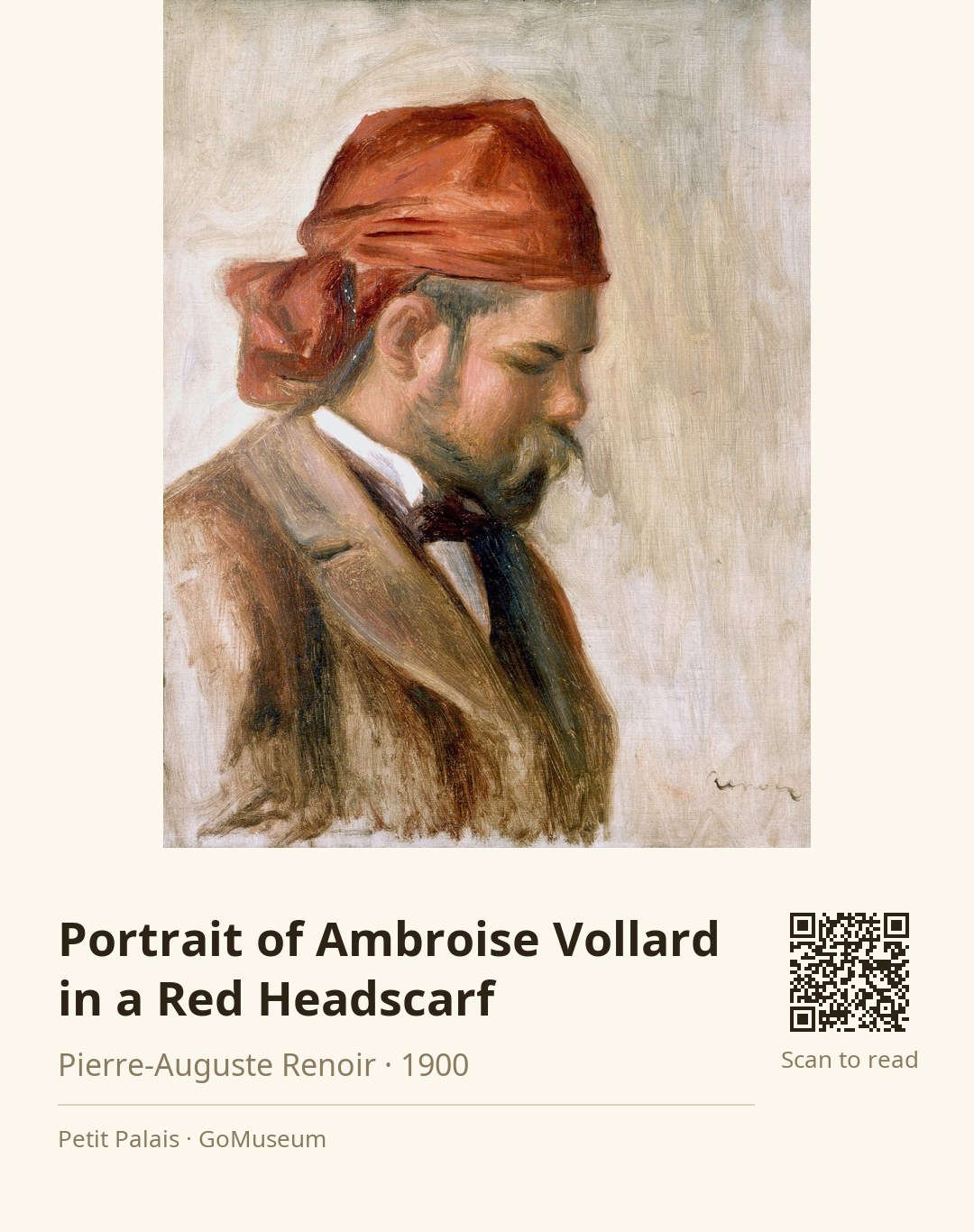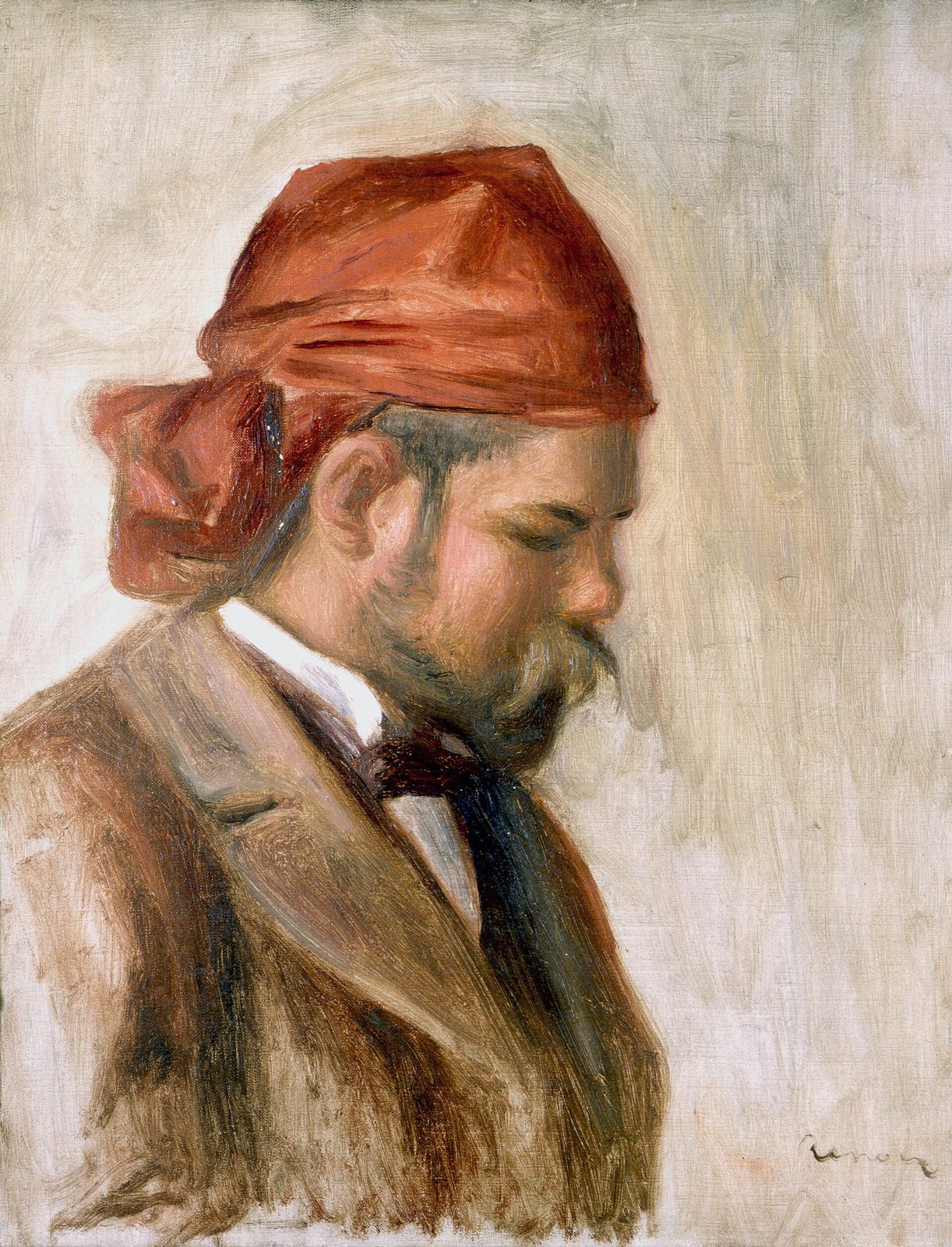
Portrait of Ambroise Vollard in a Red Headscarf
🎧 This work has audio narration — listen in the appAmbroise Vollard, the influential art dealer, is captured here in profile, adorned with a striking red headscarf that ties at the back of his neck. His brown suit, complemented by a crisp white shirt and dark bow tie, contrasts with the warm, earthy tones that envelop him, while his slightly bowed head and downcast eyes evoke a sense of contemplation.
The red headscarf is not merely a fashion choice; it serves as a nod to Vollard's roots from the Indian Ocean island of Réunion, grounding the portrait in his personal history. The loose brushwork, especially in the clothing, breathes life into the composition, suggesting movement and texture that invite the viewer to ponder the man behind the attire. Renoir's choice of a neutral, textured background enhances the focus on Vollard, allowing his character to emerge from the canvas with warmth and depth.
Vollard, who was painted by Renoir on multiple occasions, played a significant role in promoting the artist's work, making this portrait not just a representation of a man, but a testament to their professional relationship.
Pierre-Auguste Renoir, born on February 25, 1841, in Limoges, France, emerged as a pivotal figure in the Impressionist movement. His early life in a modest family led him to Paris, where he honed his artistic skills amidst the masterpieces of the Louvre. Initially apprenticed in a porcelain factory, Renoir's passion for painting flourished, particularly after studying under Charles Gleyre, where he befriended fellow artists like Monet and Sisley.
Renoir's work celebrated feminine beauty and vibrant social scenes, exemplified in iconic pieces like "Dance at Le Moulin de la Galette." Despite facing criticism early on, he gained recognition, especially after participating in the first Impressionist exhibition in 1874. His style evolved over the years, transitioning towards realism influenced by classical masters like Raphael.
Throughout his life, Renoir balanced personal struggles, including health issues, with a prolific output, reportedly creating around four thousand works. He became a beloved figure in art history, known for his warm palette and expressive brushwork. Renoir passed away on December 3, 1919, leaving a legacy that continues to inspire artists and art lovers alike.
Renoir's technique in this portrait is characterized by loose, expressive brushwork that brings a sense of vitality to the subject. The warm palette, dominated by earthy browns and the striking red of the headscarf, creates an inviting atmosphere. The brushstrokes are particularly dynamic in the clothing, suggesting movement and texture that almost breathe life into the fabric. The neutral background, with its soft texture, serves to elevate Vollard, allowing his contemplative pose to take center stage. Renoir's choice to depict Vollard in profile adds a layer of introspection, inviting viewers to ponder the thoughts behind those downcast eyes. The overall composition is simple yet profound, focusing on the essence of the man rather than elaborate details, which is a hallmark of Renoir's later style.
Interestingly, Vollard was not only a subject for Renoir but also posed for other artists of the time, including being depicted in various guises—once even dressed as a matador! This playful approach to portraiture highlights the vibrant and sometimes whimsical nature of the art scene during this period, where artists often explored different facets of their subjects' personalities.
Vollard posed for several artists during his time, including Renoir and others, and was depicted in various roles, such as a matador.
Renoir employed loose and expressive brushwork in this portrait, which contributes to a sense of vitality and movement in the depiction.