Portrait of Joost van Bronckhorst-Bleiswijk
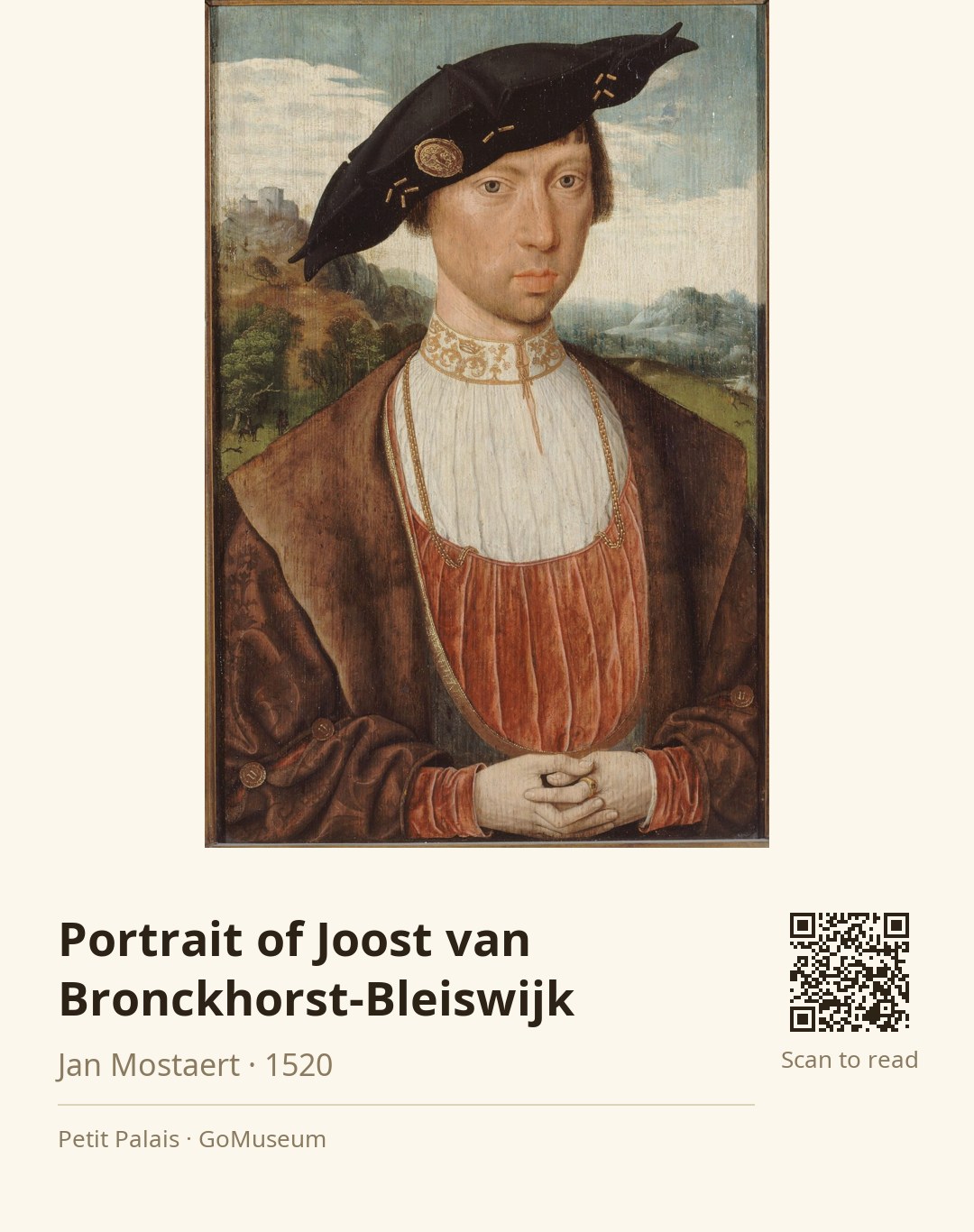
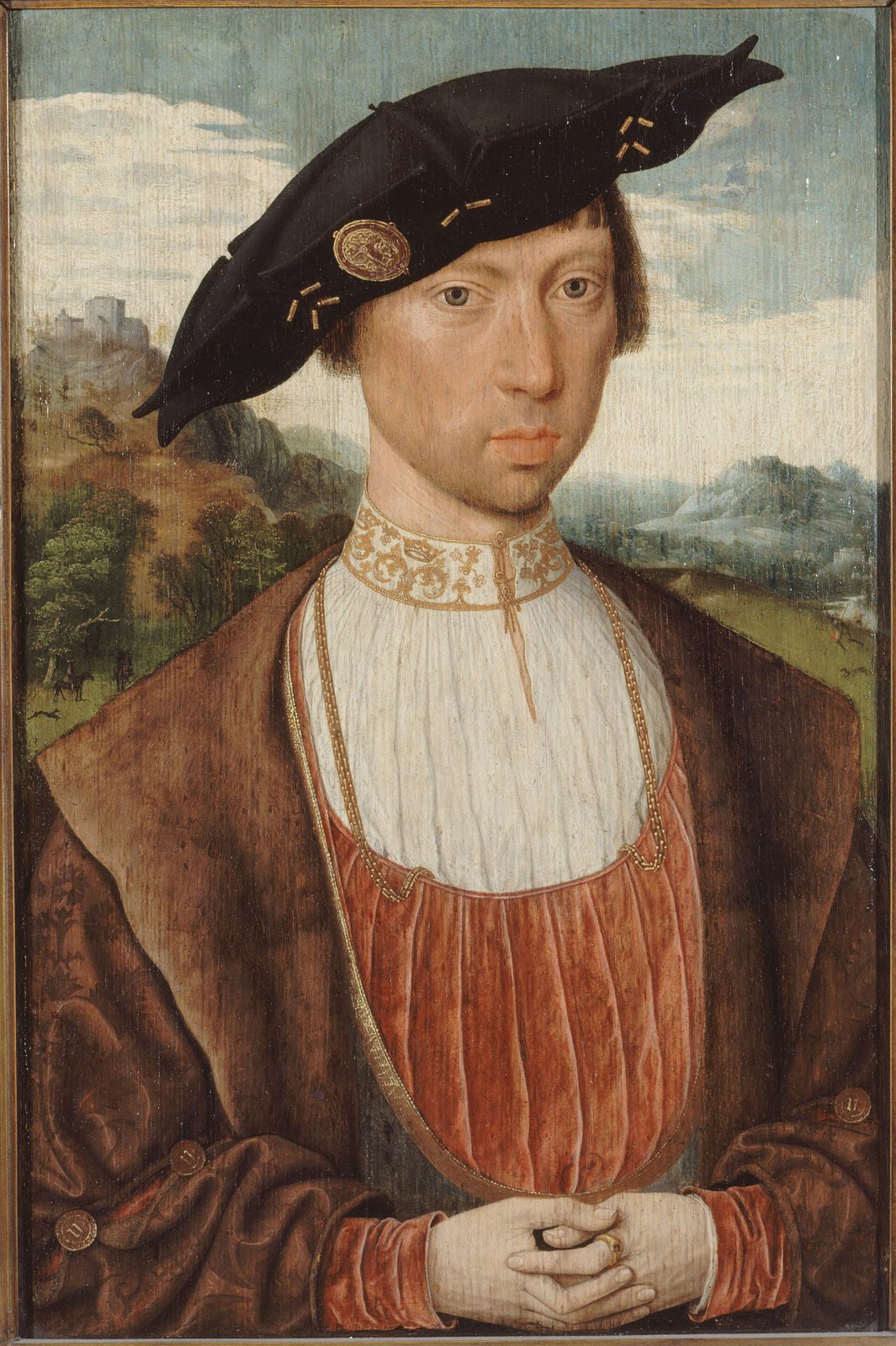
🎧 This work has audio narration — listen in the appJoost van Bronckhorst-Bleiswijk gazes out at you, his dark hat adorned with a gold medallion, and a richly embroidered collar framing his face. The vibrant red of his pleated garment contrasts beautifully with the muted tones of the rolling hills and distant castle behind him, creating a striking visual narrative that draws you in.
The meticulous detail in his attire, from the delicate textures of the fabric to the glint of the ring on his finger, speaks to the artist's skill in capturing not just the likeness of his subject, but also his status and personality. This portrait, created by Jan Mostaert in 1520, reflects the societal importance of portraiture during the Renaissance, where clothing and accessories were symbols of wealth and identity.
Mostaert, a prominent Dutch Renaissance painter, often explored themes of humanity and nature in his work, blending religious subjects with intricate landscapes. His style evolved from influences like Geertgen tot Sint Jans, leading to a refined approach characterized by thoughtful compositions and detailed brushwork. Mostaert's career was largely centered in Haarlem, where he was active in the local guild and produced a range of portraits and religious scenes until his death in the early 1550s.
Jan Mostaert, born around 1475 in Haarlem, was a notable Dutch Renaissance painter recognized for his religious works and portraits. His most acclaimed piece, "Landscape with an Episode from the Conquest of America," reflects his fascination with distant lands and cultures. While much of his life remains shrouded in mystery, he is documented in Haarlem's records from 1498 until his presumed death in 1553, with a significant gap between 1516 and 1526. Mostaert was likely influenced by earlier artists like Geertgen tot Sint Jans and Jacob van Haarlem, which shaped his refined style characterized by delicate figures and vibrant landscapes.
Despite claims by art historian Karel van Mander regarding Mostaert's role as a court painter for Margaret of Austria, modern scholars suggest he spent his career in Haarlem, where he achieved commercial success and held positions in the local painters' guild. His works, often blending Christian and pagan themes, showcase a meticulous attention to detail and a romantic approach to landscape. Sadly, many of his creations were lost in a fire in Haarlem in 1576, yet his legacy endures as a significant figure in the Northern Renaissance, bridging the gap between medieval and modern artistic expressions.
Jan Mostaert's 'Portrait of Joost van Bronckhorst-Bleiswijk' was painted in 1520, during a time when portraiture was gaining prominence in the Netherlands. Mostaert, a notable figure in the Haarlem art scene, was commissioned to create this work, likely reflecting the social status of his subject, Joost van Bronckhorst-Bleiswijk, a prominent local figure. The painting has been part of various collections, with its provenance tracing back to Edward and Julia Tuck, who owned it before it found its way to the Petit Palais in Paris. His career flourished in Haarlem, where he was actively involved in the local guild, contributing to the rich tapestry of Dutch Renaissance art.
This portrait showcases Mostaert's remarkable skill in oil painting, particularly in his meticulous brushwork that captures the intricate textures of clothing and the subtleties of human expression. The use of oil paint allows for a depth of color and detail that enhances the vibrancy of Joost's red garment against the muted landscape. Mostaert's technique involves layering thin glazes, which gives a luminous quality to the fabric and skin tones. The composition is structured to draw the viewer's eye directly to Joost's face, framed by the embroidered collar and dark hat, creating a strong focal point. The background, with its rolling hills and distant castle, adds a sense of place and context, grounding Joost's figure in a recognizable world. The partly cloudy sky introduces a dynamic element, suggesting a narrative beyond the portrait itself.
Interestingly, Jan Mostaert's life is shrouded in some mystery, with many details about his career coming from the writings of Karel van Mander, a 16th-century artist and historian. However, modern scholars have questioned the accuracy of van Mander's accounts, particularly regarding Mostaert's supposed role as a court painter for Margaret of Austria. It appears that Mostaert may have spent his entire career in Haarlem, away from the royal courts, which adds an intriguing layer to his legacy as a painter who thrived in a provincial setting.
Much of what we know about Mostaert's life comes from Karel van Mander's writings, which modern scholars have questioned for accuracy, adding an element of mystery to his biography.