The Chess players
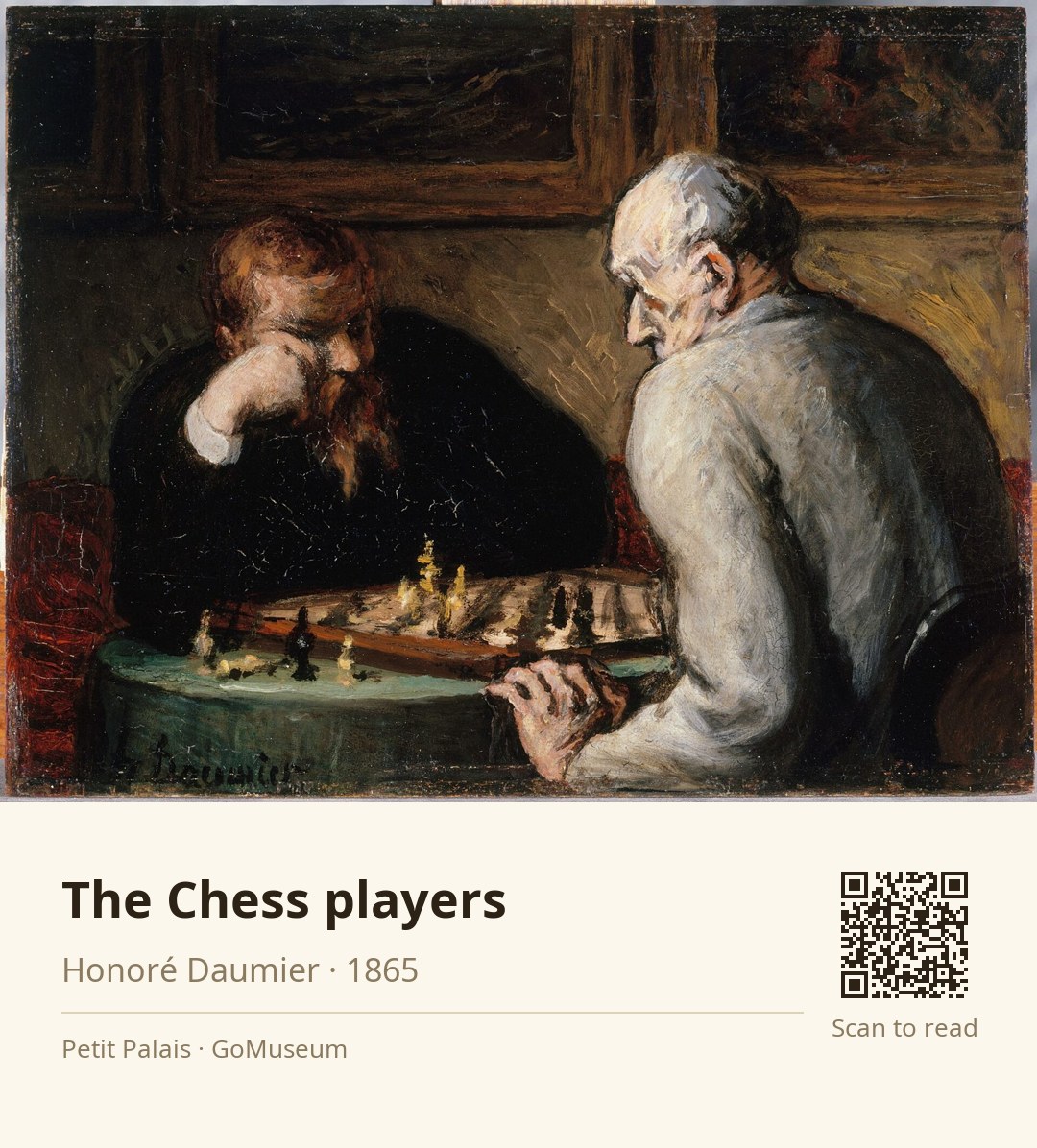
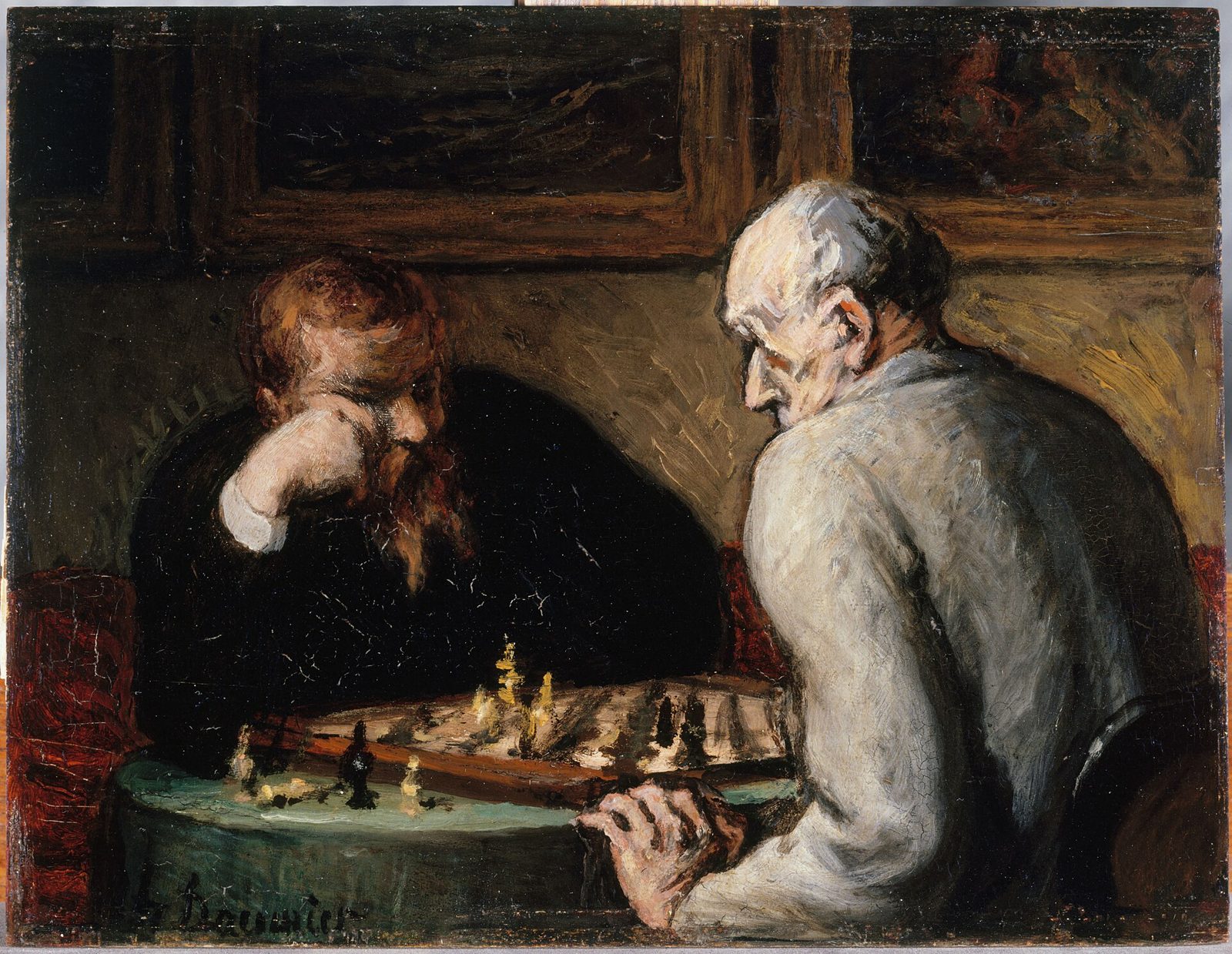
🎧 This work has audio narration — listen in the appTwo men are locked in concentration over a chessboard, their contrasting expressions telling a story of tension and strategy. The man on the left, with a beard and dark garment, leans thoughtfully on his hand, while the bald man on the right, dressed in a light shirt, is seen from behind, his focus entirely on the game. The green cloth covering the round table adds a touch of warmth to the otherwise dark and indistinct background, where hints of framed artwork suggest a space filled with history.
This scene captures not just a game, but the emotional stakes involved, as the older man's tense grip on the table edge suggests he may be struggling, while the younger man appears more relaxed, perhaps indicating he is winning. Daumier's expressive brushwork enhances the drama, with visible strokes that lend texture to the figures, evoking a sense of immediacy and intimacy. The colors of their clothing echo the chess pieces, with the light suit of one contrasting sharply against the dark sweater of his opponent, heightening the visual tension.
Created between 1863 and 1867, "The Chess Players" reflects Daumier's interest in the social dynamics of his time, often depicted through theatrical motifs. His unique style, characterized by exaggerated features and a focus on the grotesque, mirrors the influences of the Commedia dell'arte, where characters often wore masks that simplified their expressions. Daumier, who faced declining eyesight during this period, infused his work with a raw emotionality that resonates deeply, capturing not only the game but the human experience itself.
Honoré-Victorin Daumier, born on February 26, 1808, in Marseille, was a pivotal French artist known for his incisive commentary on the social and political landscape of 19th-century France. A prolific lithographer, caricaturist, painter, and sculptor, Daumier's work often satirized the monarchy, the bourgeoisie, and human nature itself. He began his artistic journey at a young age, influenced by his family's struggles and his early exposure to the vibrant Parisian art scene.
Daumier's career took off after the July Revolution of 1830, when he became a prominent figure in political caricature, contributing to satirical publications like La Caricature and Le Charivari. His bold depictions of figures like King Louis-Philippe earned him both fame and imprisonment, reflecting his commitment to social critique. Despite facing financial hardships and a lack of recognition during his lifetime, he was admired by contemporaries such as Charles Baudelaire.
While Daumier produced thousands of lithographs, his paintings, though largely overlooked in his lifetime, would later be celebrated for their realism and emotional depth. His influence extended to later movements, including Impressionism, marking him as a significant figure in art history. Daumier passed away in February 1879, leaving behind a legacy that would reshape the understanding of political art.
Created between 1863 and 1867, 'The Chess Players' is a captivating piece by Honoré Daumier, a man known for his sharp social commentary through art. While the exact date of its creation remains uncertain, it carries the artist's signature, 'h Daumier', in the lower left corner. This painting was part of Eugène Jacquette's private collection until 1899, when it found a new home at the Petit Palais in Paris, where it still resides today.
Daumier's technique in 'The Chess Players' is strikingly expressive, with bold brushwork that creates a palpable tension between the two figures. The oil paint is applied with a roughness that mirrors the emotional stakes of the game, enhancing the drama of the scene. The contrasting colors of the players' garments—dark for the older man and light for the younger—are not just aesthetic choices; they echo the chess pieces themselves, reinforcing the visual narrative of conflict and strategy. The composition is intimate, drawing you into the players' world, while the dark, indistinct background serves to heighten the focus on their intense expressions.
An intriguing tidbit about Daumier is that despite his prolific output in caricature and lithography, he reportedly never mastered the games he depicted, such as chess and dominoes. This paradox adds a layer of irony to his work, as he captured the essence of these games and their players without being a skilled player himself, suggesting a keen observational talent and a deep understanding of human nature.
The dark and indistinct background hints at framed artwork or windows, suggesting that the chess game takes place in a space rich with history and possibly other artistic influences, which may reflect Daumier's own environment and inspirations.
As Daumier's eyesight deteriorated, his brushwork became more expressive and exaggerated, leading to the grotesque features of his characters, which added a raw emotionality to his work that resonated with the themes of struggle and tension.
Despite creating numerous works featuring chess, Daumier reportedly never mastered the game himself, which adds an ironic layer to his ability to capture the essence of the players' emotional stakes and strategies without being a skilled player.