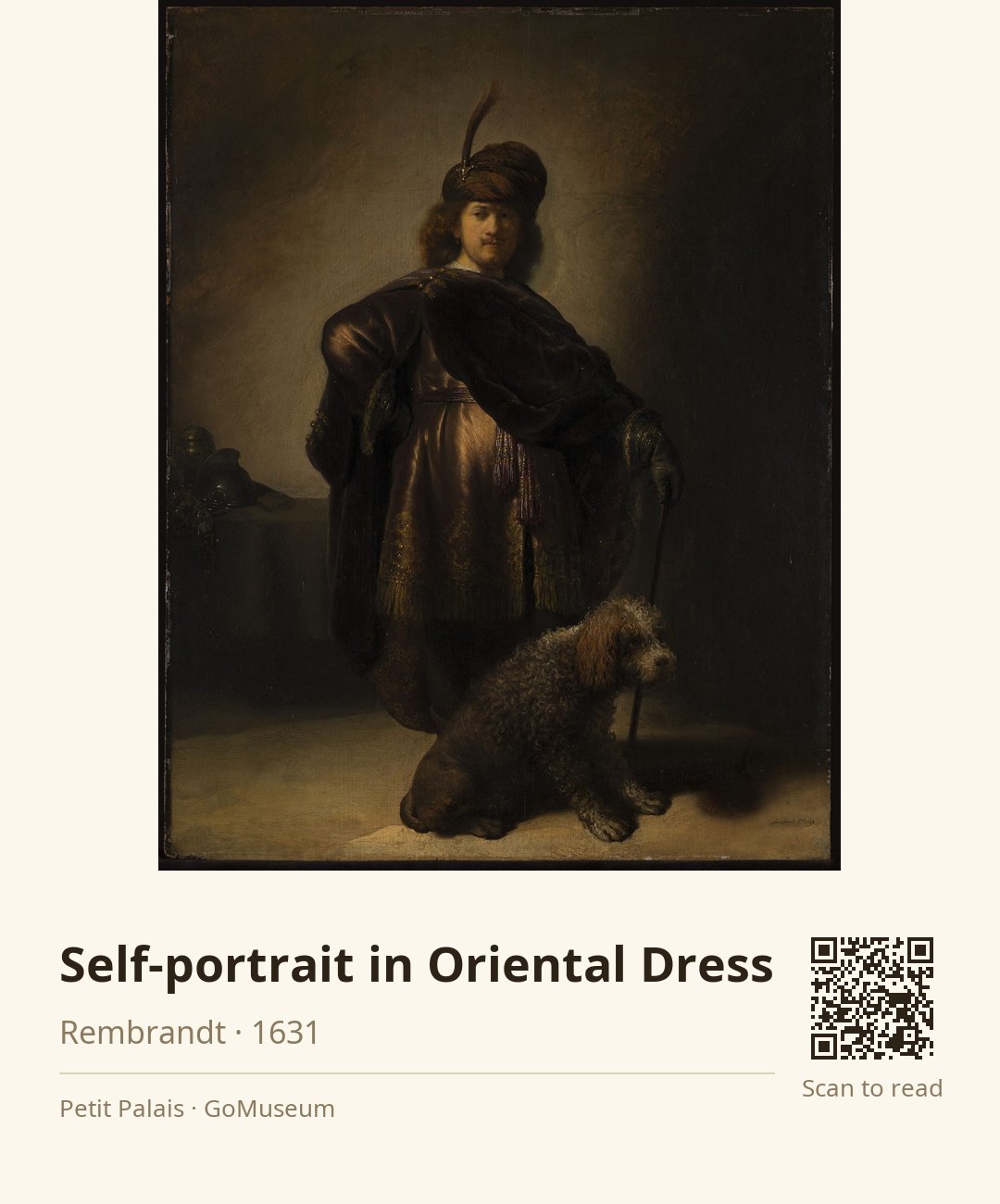
Self-portrait in Oriental Dress
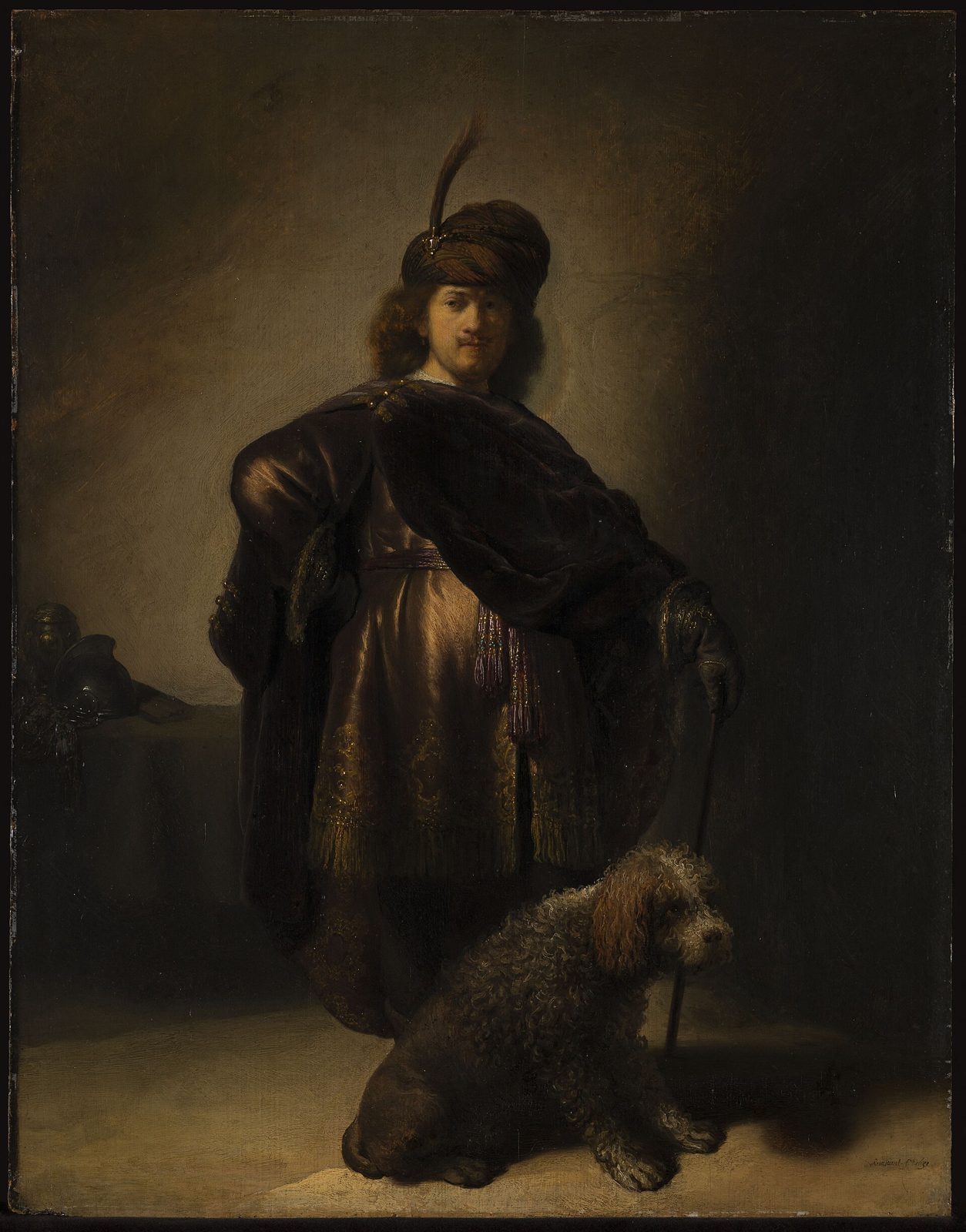
🎧 This work has audio narration — listen in the appThe luxurious dark robe adorned with gold embroidery and the striking feathered turban immediately draw your eye in Rembrandt's "Self-portrait in Oriental Dress." The artist stands confidently, cane resting on the ground, while his left hand rests on his hip, projecting authority. A curly-haired dog sits obediently at his feet, adding a touch of warmth to the commanding presence of the figure.
This self-portrait is unique among Rembrandt's body of work, as it is the only one where he appears fully standing, dressed in an exotic costume that hints at the fascination with the East during the 17th century. The rich textures of the fabric and the dog's fur are illuminated by light, creating a dramatic contrast against the dark background. This interplay of light and shadow not only enhances the visual appeal but also emphasizes the artist's mastery of oil painting, showcasing his ability to convey depth and character through texture.
Painted in 1631, this work likely emerged during Rembrandt's time in Leiden, just before he moved to Amsterdam, where he would achieve great success as a portraitist. The painting reflects the artist's innovative approach to self-representation, blending personal identity with the allure of the exotic. Rembrandt's exploration of different styles and subjects during this period would come to define his legacy in the history of Western art.
Rembrandt Harmenszoon van Rijn, born on July 15, 1606, in Leiden, was a pivotal figure of the Dutch Golden Age and is celebrated as one of the greatest artists in Western art history. His oeuvre includes around three hundred paintings, three hundred etchings, and numerous drawings, showcasing a remarkable range of styles and subjects, from intimate portraits to grand historical and biblical scenes.
Rembrandt's artistic journey began in Leiden, where he was influenced by both Dutch and Italian masters. He opened his studio in 1625 and quickly gained recognition for his portrait work. His move to Amsterdam marked a significant turning point, as he became a sought-after portraitist and married Saskia van Uylenburgh, a union that brought both joy and tragedy. The couple faced immense personal losses, including the deaths of their children and Saskia's own passing in 1642, which deeply affected his work.
Despite financial struggles later in life, Rembrandt's innovative techniques, particularly in etching, transformed the medium into a respected art form. His mastery of light and shadow, known as chiaroscuro, and his empathetic portrayal of human experience set him apart from his contemporaries. Rembrandt's legacy endures through his profound ability to capture the complexities of the human condition, making him a cornerstone of art history.
The brushwork is both confident and expressive, with thick applications of paint that create a rich texture, particularly in the dark robe and the intricate gold embroidery. The use of chiaroscuro is pronounced, with the figure dramatically illuminated against a shadowy background, enhancing the sense of depth and three-dimensionality. The composition is vertically oriented, drawing the viewer's eye upward through the figure's confident stance. The scale of the painting, at 65 by 52 centimeters, allows for an intimate engagement with the subject, inviting viewers to appreciate the subtleties of expression and detail, such as the soft curls of the dog at his feet, which contrast with the rigidity of the figure's pose.
Rembrandt employed thick brushwork and expressive applications of paint to create a rich texture, especially in the robe and gold embroidery.