The Little Alms Collector
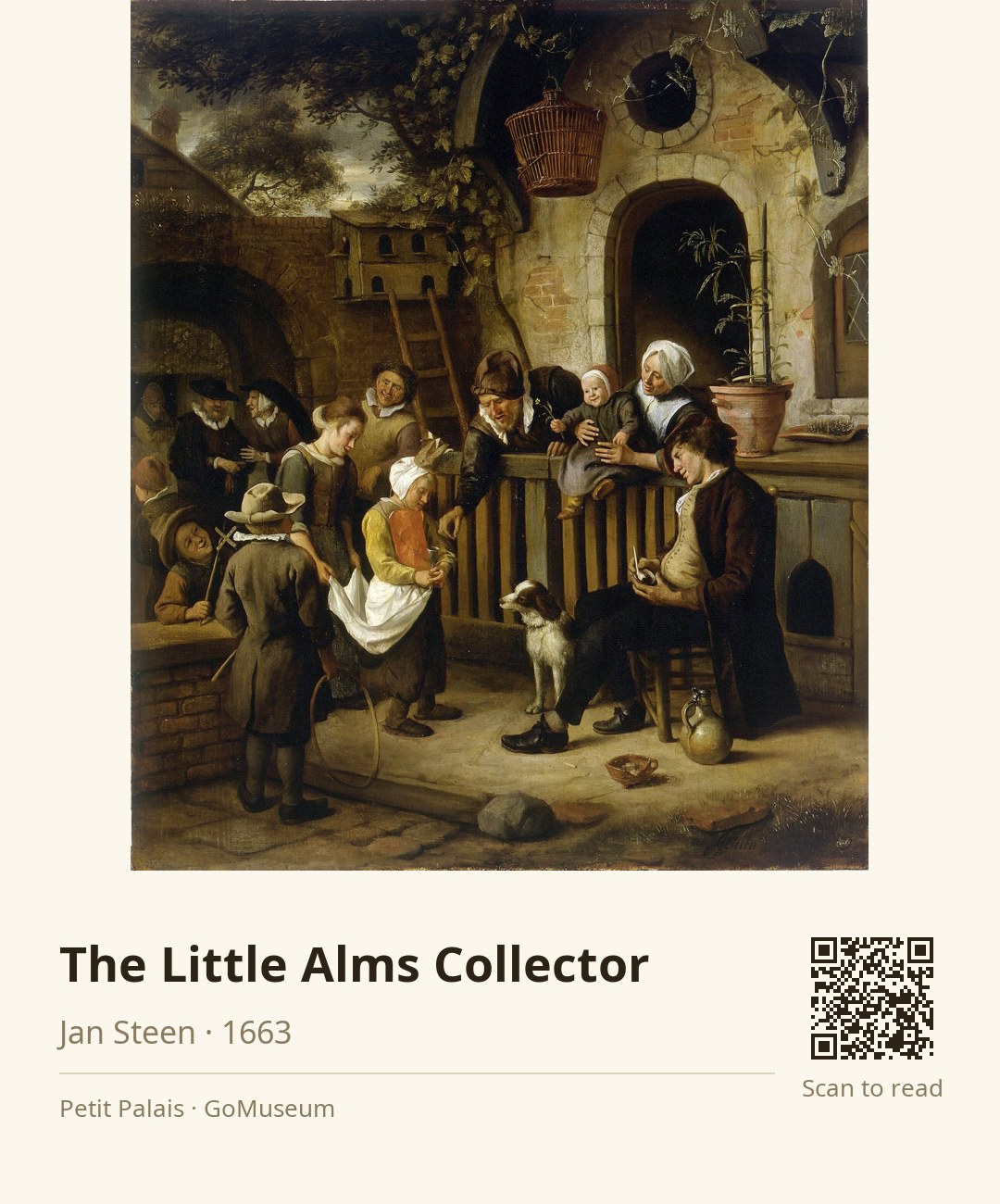
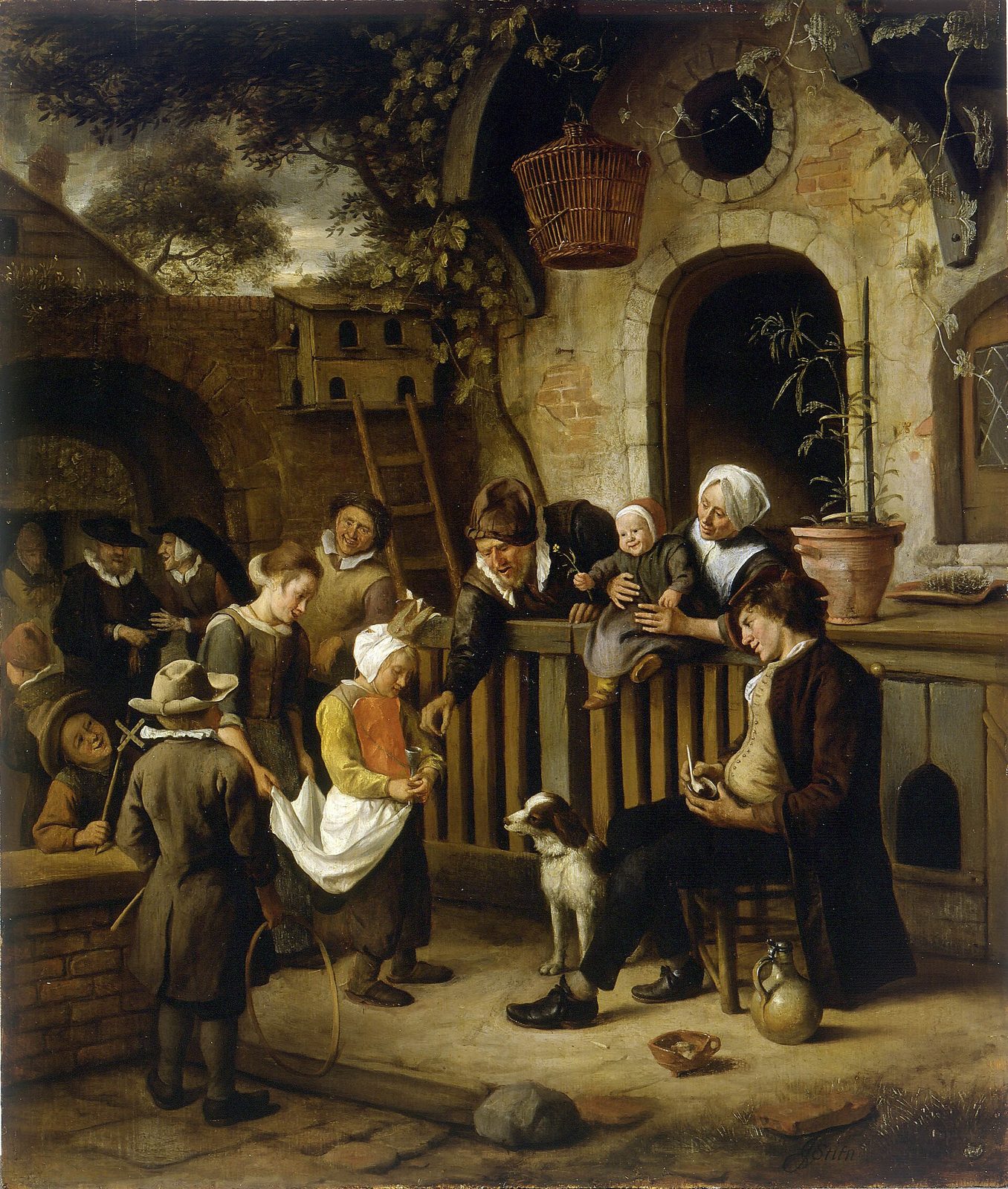
🎧 This work has audio narration — listen in the appA child in a white cloth stands at the center of Jan Steen's "The Little Alms Collector," surrounded by a lively group of figures in a bustling courtyard. To the left, a man sits casually in a chair, a jug resting at his feet, while a dog watches nearby, adding a touch of domesticity to the scene. Above, a basket hangs, hinting at the almsgiving theme, while the brick archway and potted plant frame the action, creating a sense of depth and community.
This gathering reflects the social dynamics of 17th-century Dutch life, where charity and community interaction were vital. The child’s role as an alms collector symbolizes innocence and the importance of generosity, a common theme in Steen's works. His use of earthy tones and detailed brushwork captures not just the textures of clothing and brick but also the warmth of human connection, inviting viewers to reflect on their own social responsibilities.
Jan Steen, born in Leiden in 1626, became one of the leading genre painters of his time, known for his vibrant depictions of everyday life. "The Little Alms Collector," created in 1663, exemplifies his ability to blend humor with moral lessons, showcasing the lively interactions that characterize his artistic vision.
Jan Havickszoon Steen was a prominent Dutch painter of the Golden Age, born around 1626 in Leiden. Coming from a well-off Catholic family of brewers, he was the eldest of at least eight children. Steen's artistic journey began with a classical education and apprenticeships under notable painters like Nicolaes Knupfer and Jan van Goyen, the latter becoming his father-in-law. His career was marked by a blend of humor and psychological insight, often portraying the everyday lives of the Dutch bourgeoisie with a satirical twist.
Steen's works are characterized by vibrant colors and a theatrical quality, reflecting influences from the Rederijkers, a guild of rhetoricians. His genre scenes, such as "The Doctor's Visit," reveal a knack for storytelling, often embedding moral lessons within chaotic yet lively compositions. Despite personal hardships, including the loss of his wife and financial struggles, Steen remained prolific, producing hundreds of paintings that captured the essence of 17th-century life.
He played a significant role in the art community, co-founding the Guild of Saint Luke in Leiden and serving as its president. Steen's legacy endures as a master of genre painting, his works celebrated for their rich detail and social commentary, solidifying his place in art history as a key figure of the Dutch Baroque movement. He passed away in 1679, leaving behind a rich body of work that continues to resonate today.
Steen's technique in "The Little Alms Collector" showcases his mastery of oil paint, with a rich palette of earthy tones that evoke warmth and familiarity. His brushwork is both detailed and expressive, capturing the textures of clothing and the roughness of the brickwork in the courtyard. The composition is dynamic, with figures arranged in a way that draws the eye across the scene, creating a sense of movement and interaction. The use of light is subtle yet effective, enhancing the three-dimensionality of the figures and the architectural elements.
One fascinating tidbit about Jan Steen is that his chaotic scenes were so emblematic of disorder that they inspired a Dutch saying: 'een huishouden van Jan Steen,' which translates to 'a household of Jan Steen.' This phrase is used to describe a messy or chaotic household, highlighting how deeply his work resonated with the culture of his time and continues to influence language even today.
Jan Steen's chaotic scenes became so iconic that they inspired a saying in Dutch, referring to a messy household, indicating his deep resonance with the culture of his time.
Jan Steen co-founded the painters' Guild of Saint Luke in Leiden, which played a crucial role in the local art community and supported artists of the time.
Steen's uncle was part of the Rhetoricians, a theatrical guild, which likely influenced his artistic style and themes, connecting him to the theatrical culture of his time.