The Birth of Venus
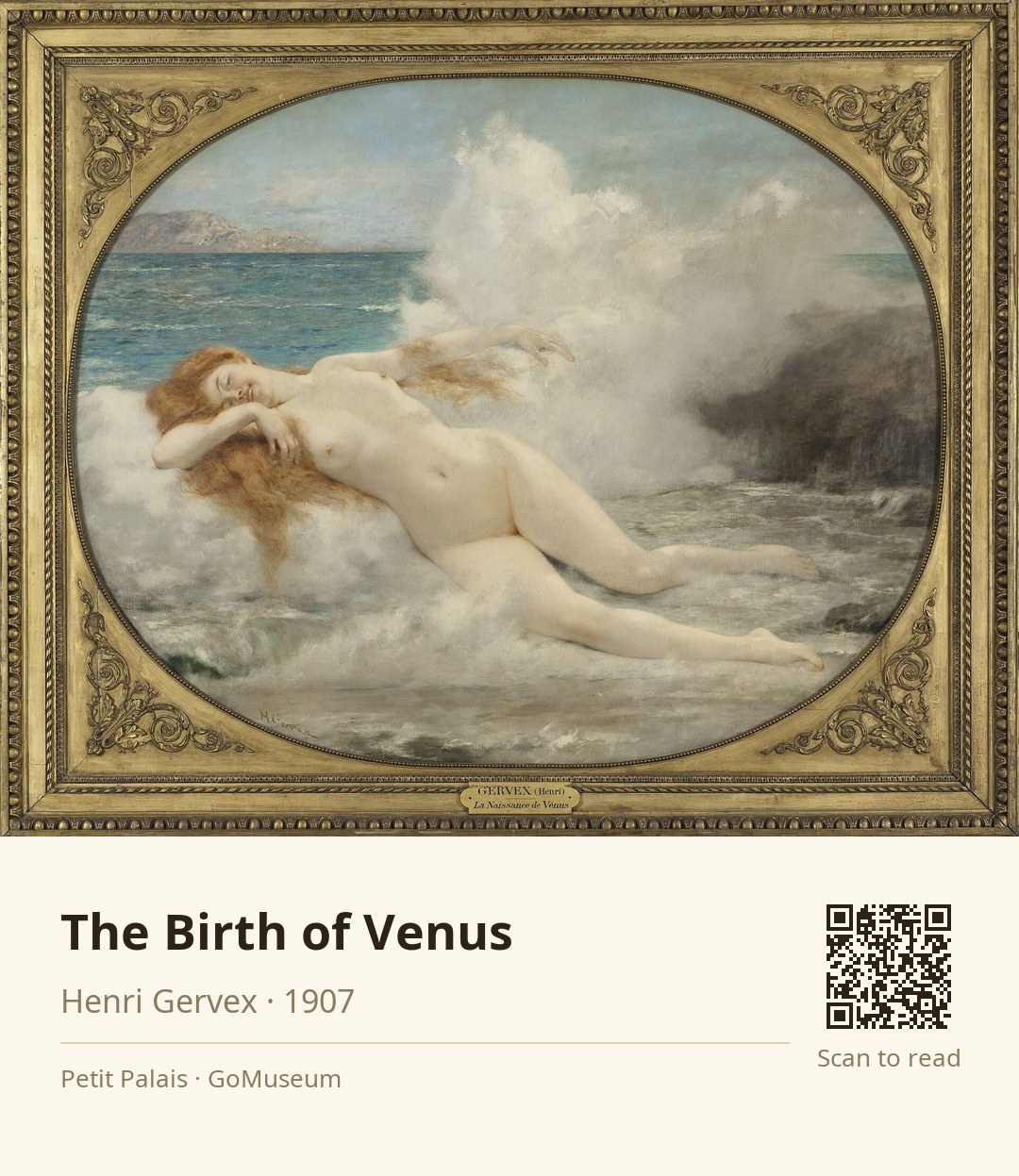
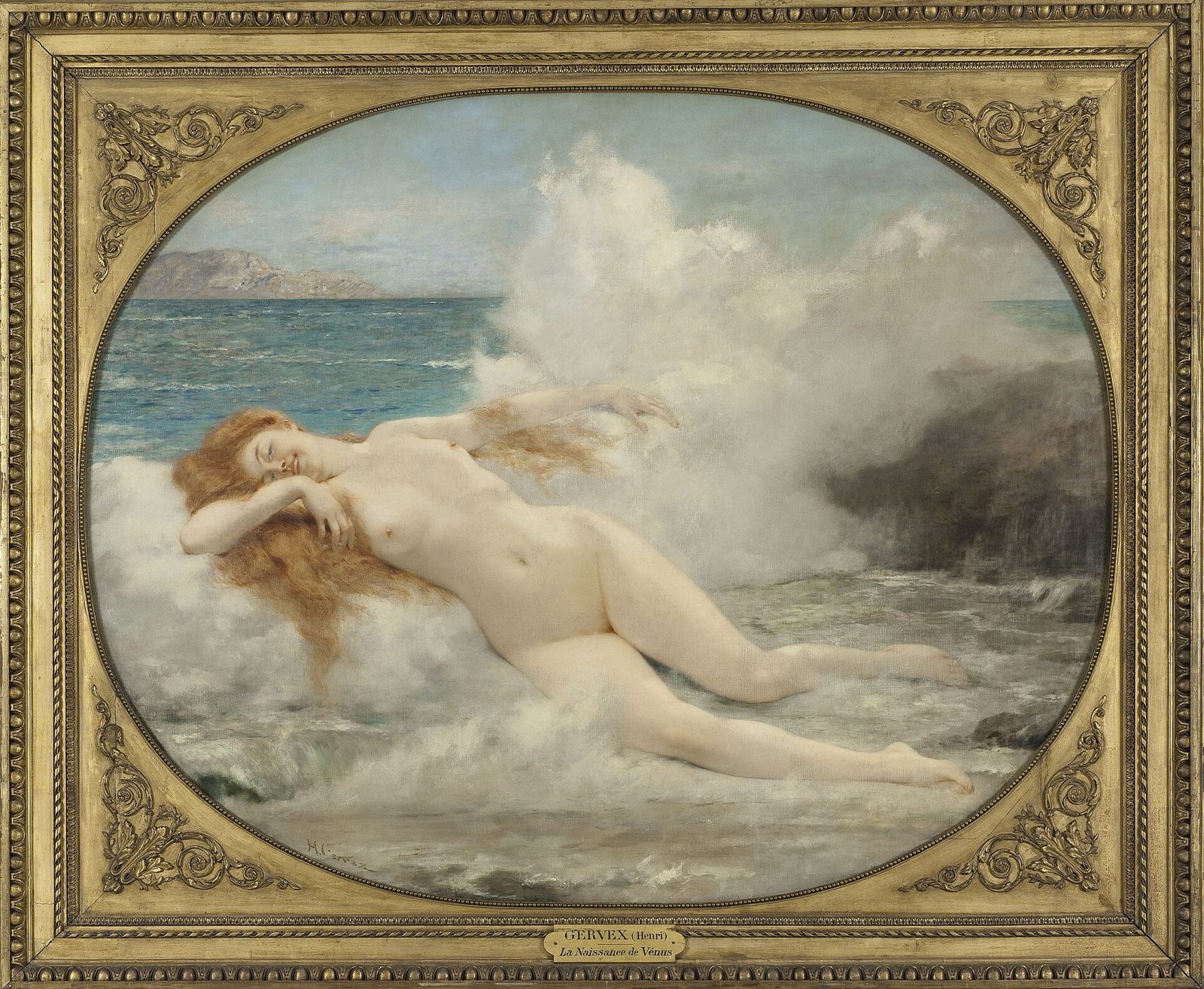
🎧 This work has audio narration — listen in the appThe goddess Venus emerges from the waves, her nude form gracefully reclining on the shore, partially shrouded by foamy surf. Her long hair cascades into the water, merging with the deep blue sea, while her serene expression, eyes closed and head resting on her arm, evokes a sense of tranquility amidst the dynamic backdrop of crashing waves and distant land.
This portrayal captures the moment of her birth, a theme rooted in ancient mythology, where Venus, also known as Aphrodite, is depicted as fully grown and emerging from the sea. The soft skin tones and delicate brushwork enhance the ethereal quality of the figure, emphasizing both her beauty and the fluidity of the water. The balance of the composition, with Venus centrally placed against the tumultuous ocean, invites viewers to contemplate the harmony between the divine and nature.
Created in 1907 by Henri Gervex, this painting reflects the artist's mastery of color and form, showcasing his ability to blend classical themes with a modern sensibility. Gervex's work was recognized for its vigorous and original talent, and "The Birth of Venus" stands as one of his most celebrated pieces.
Henri Gervex was a prominent French painter born on December 10, 1852, in Montmartre. He trained under notable artists like Alexandre Cabanel and Eugène Fromentin, honing his skills in both classical and modern styles. Gervex's early works, primarily mythological, often sparked controversy, most notably with his painting "Rolla," which was rejected by the Salon for its provocative depiction of a nude. This scandal, however, propelled him to fame, leading to significant exhibitions and acclaim.
His relationship with the courtesan Valtesse de La Bigne not only influenced his art but also inspired Émile Zola's character in "Nana." Gervex's oeuvre evolved to include modern life representations, achieving success with works like "Dr Péan at the Salpétrière." He received numerous commissions for public buildings and was awarded the Legion of Honour for his contributions to art.
Gervex's legacy includes a diverse body of work, from portraits to grand historical scenes, and he played a vital role in the artistic community of his time, mentoring future artists. He passed away on June 7, 1929, leaving behind a significant mark on the art world, celebrated for both his technical skill and his bold explorations of contemporary themes.
Commissioned by the Société nationale des beaux-arts, this painting quickly became a centerpiece of Gervex's career, showcasing his vigorous talent as both a draftsman and colorist. Upon its acquisition by the City of Paris, it was hailed as one of his most beautiful and complete works, solidifying his reputation. The painting has been part of the Petit Palais collection in Paris ever since, where it continues to draw admiration. Gervex's journey to this point was marked by controversy and acclaim, particularly after his earlier work 'Rolla' stirred scandal at the Salon, propelling him into the spotlight.
The soft skin tones of Venus are achieved through delicate layering, allowing the light to reflect off her form in a way that feels almost lifelike. His brushwork is fluid, capturing the movement of the foamy waves as they envelop her, creating a dynamic contrast with her serene pose. The deep blues of the ocean are rich and vibrant, contrasting beautifully with the pale hues of Venus's skin, drawing the viewer's eye directly to her. The composition is carefully balanced, with Venus at the center, her figure harmonizing with the tumultuous backdrop of the sea. This central placement not only emphasizes her importance but also invites contemplation on the relationship between the divine and the natural world.
The painting 'Rolla' caused a scandal when it was rejected by the Salon for immorality due to its depiction of a naked prostitute, but this controversy only increased its fame, leading to a successful private exhibition that launched Gervex's career.
Valtesse de La Bigne, a famous courtesan and Gervex's long-time lover, inspired several of his works, including 'The Civil Marriage,' and her character influenced Émile Zola's creation of the heroine in his novel 'Nana'.
Later in his career, Gervex was commissioned to create significant works, including portraits for Czar Nicholas II and decorations for public buildings in Paris, showcasing his established reputation as an artist.