Proudhon and His Children
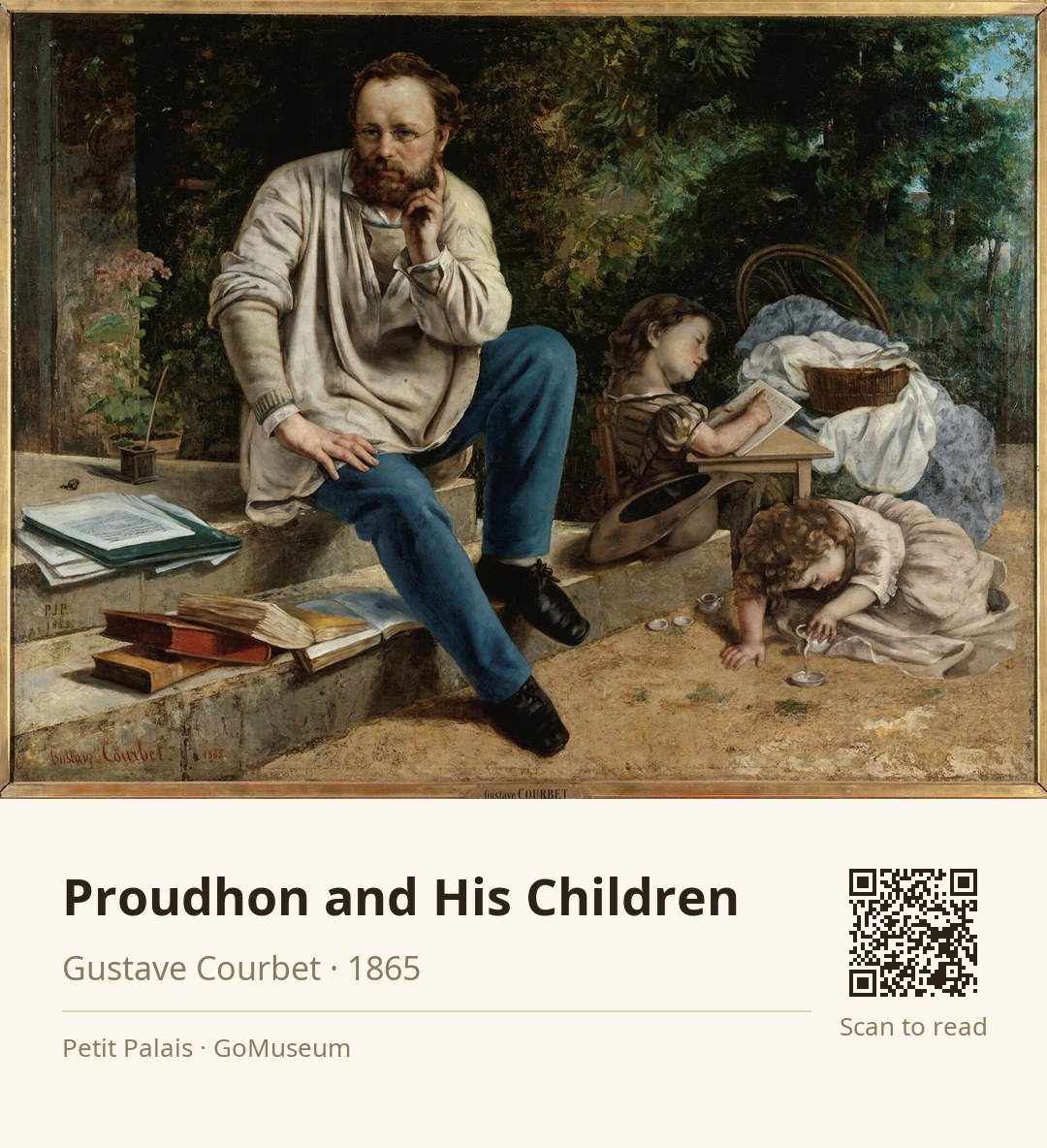
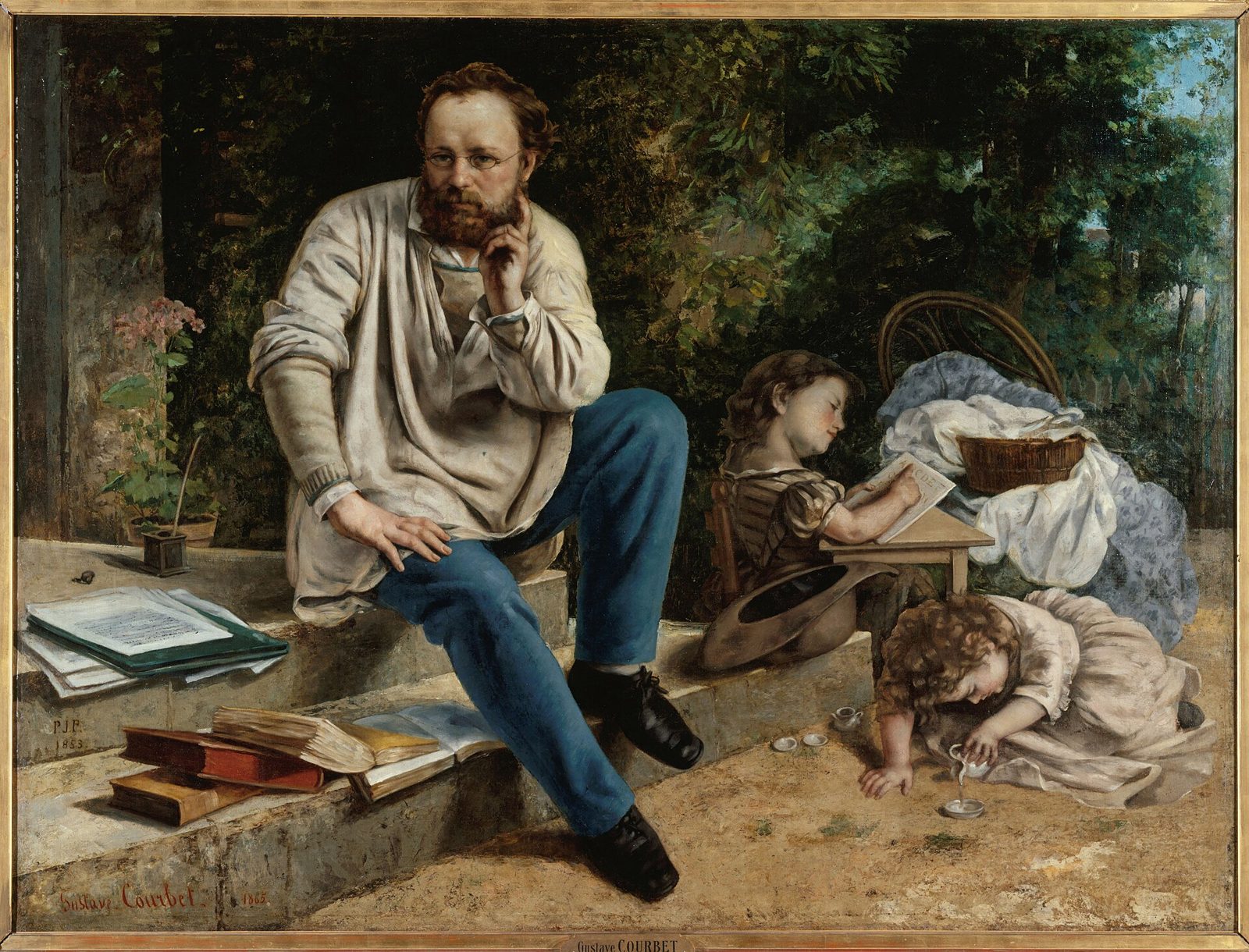
🎧 This work has audio narration — listen in the appPierre-Joseph Proudhon sits pensively on stone steps, his chin resting on his hand, surrounded by his two daughters. The earthy palette of greens and browns envelops them, while books and papers lie scattered nearby, hinting at the intellectual life of the philosopher. To his left, one daughter is absorbed in her writing, while the other plays on the ground, capturing a moment of familial intimacy.
This portrayal is not merely a family scene; it reflects Courbet's deep respect for Proudhon, who was a significant figure in the Realist movement. The philosopher’s contemplative pose suggests a moment of quiet reflection, perhaps on the ideas he championed about society and property. The presence of the children, engaged in their own activities, emphasizes the personal side of a man often known for his political writings. The lush greenery in the background enhances this domestic setting, contrasting with the weight of Proudhon’s philosophical legacy.
Courbet painted this work in 1865, shortly after Proudhon’s death, as a tribute to his friend. The artist had initially envisioned a series of portraits of Proudhon, capturing different aspects of his life. This particular piece, which underwent revisions before its completion, ultimately became a significant representation of both the man and his familial ties.
Gustave Courbet, born on June 10, 1819, in Ornans, France, was a pioneering painter who championed the Realism movement in 19th-century art. Rejecting the conventions of academic painting and the idealism of Romanticism, he focused on depicting the world as he observed it, often portraying unidealized peasants and workers in monumental compositions. His early works gained recognition, notably "After Dinner at Ornans," which won him a gold medal at the Salon of 1849, allowing him to exhibit without jury approval.
Courbet's commitment to realism was revolutionary; he believed that art should stem from personal experience rather than historical or mythological themes. His bold approach often sparked controversy, challenging societal norms and addressing social issues, which resonated with later movements like Impressionism and Cubism. Despite facing criticism and imprisonment for his political involvement during the Paris Commune, Courbet continued to create until his death on December 31, 1877, in Switzerland.
His legacy endures as a transformative figure in art history, whose unflinching depictions of everyday life laid the groundwork for modern artistic expression. Today, Courbet is celebrated for his vigorous and uncompromising work, which continues to engage audiences with its raw honesty and depth.
Initially, Courbet envisioned a series of portraits that would capture different facets of Proudhon's life, but this particular work stands out as a poignant family scene. Interestingly, the painting underwent revisions before its completion; a letter from Courbet reveals that he originally intended to include Proudhon's wife, Euphrasia, in the composition. Instead, he opted for a more intimate portrayal of Proudhon with his daughters, reflecting the personal side of a man often associated with political discourse. The painting was first shown at Courbet's major exhibition in 1867 and later changed hands several times before being acquired by the city of Paris in 1900, where it now resides in the Petit Palais.
In 'Proudhon and His Children,' Courbet employs oil paint on canvas to create a rich, textured surface that brings the scene to life. The earthy palette of greens and browns not only grounds the figures in their domestic environment but also evokes a sense of warmth and intimacy. Courbet's brushwork is deliberate yet spontaneous, capturing the naturalism that defines his Realist approach. The arrangement of the figures is carefully balanced; Proudhon’s contemplative pose anchors the composition, while the lively activities of his daughters add a dynamic element. The use of light subtly highlights the philosopher's features, drawing your attention to his thoughtful expression, while the surrounding greenery envelops the scene, enhancing the feeling of a private moment shared within the family. This combination of technique and choice of color creates an emotional resonance that elevates the painting beyond a mere portrait.
One curious detail about 'Proudhon and His Children' is the inscription 'PJP 1853' traced into the stone of the last step. This suggests a personal connection to the year 1853, possibly indicating a significant moment in Proudhon's life or a date of importance to the family, adding another layer of intimacy to the painting.
Courbet intended to create a series of portraits of Proudhon, capturing different aspects of his life, knowing that his friend was ill.
After Debrousse's death, the painting was auctioned in April 1900, where it was subsequently bought by the city of Paris.