Christ Taking Leave of His Mother
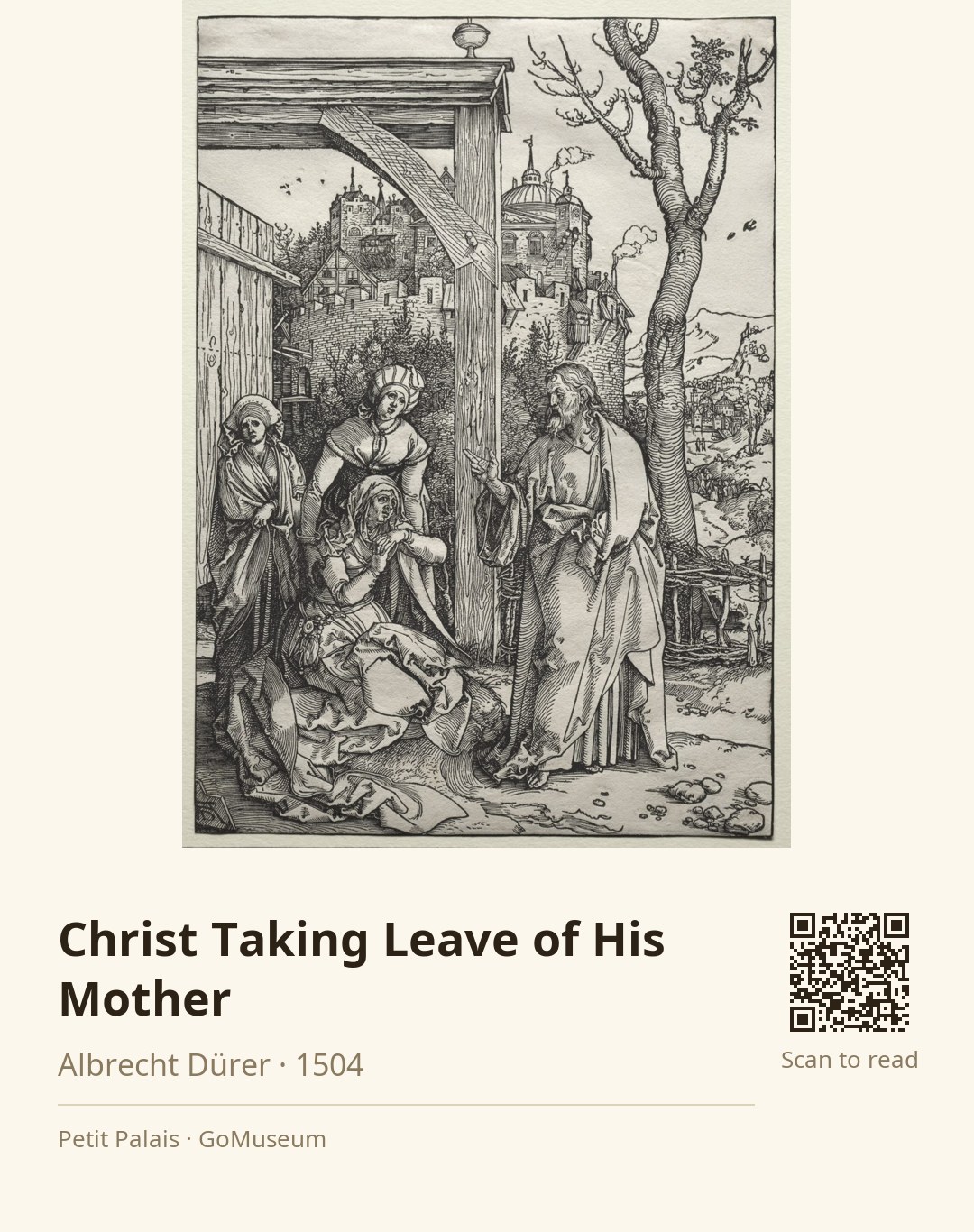
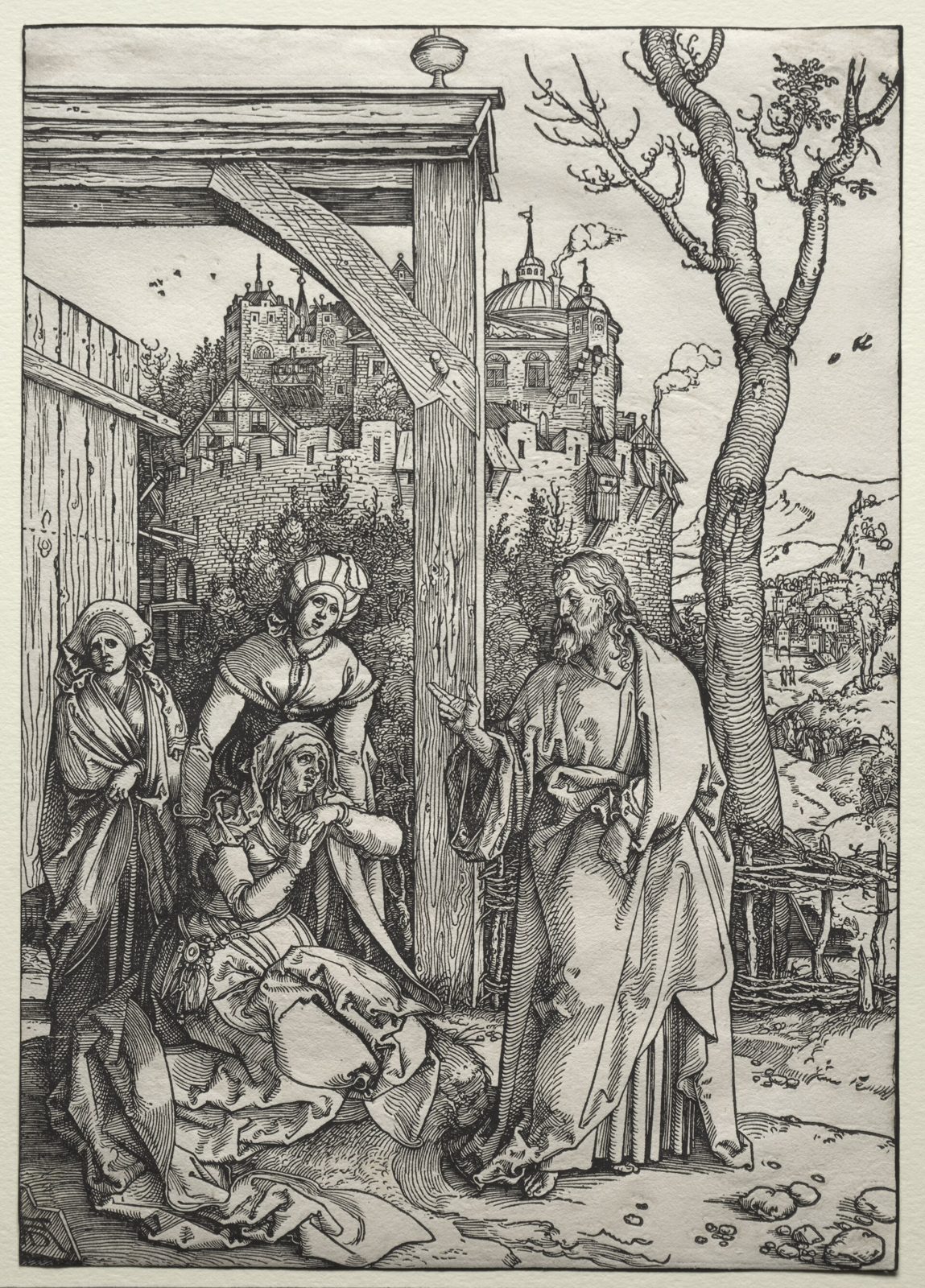
🎧 This work has audio narration — listen in the appThe bearded figure at the center of Albrecht Dürer’s "Christ Taking Leave of His Mother" extends his hand towards a seated woman, her clasped hands revealing a deep sense of distress. Nearby, two other women observe the poignant moment, one adorned with a headscarf and the other in a distinctive hat, each contributing to the emotional weight of this farewell scene.
This moment captures the tension between duty and maternal love, as Christ prepares to leave for his crucifixion, a theme that resonates deeply within Christian narratives. Dürer’s meticulous attention to detail, from the flowing robes to the intricate textures of the wooden structure and the bare tree, enhances the emotional gravity of the moment, inviting viewers to reflect on the universal experience of parting. The background, with its detailed cityscape and rolling hills, situates this intimate scene within a broader world, suggesting the weight of Christ’s sacrifice not just for his mother, but for humanity.
Created in 1504, this work exemplifies Dürer’s ability to blend emotional depth with technical precision, marking him as a pivotal figure in the Northern Renaissance.
Albrecht Dürer, born on May 21, 1471, in Nuremberg, was a pivotal figure of the German Renaissance, renowned for his contributions as a painter, printmaker, and theorist. His artistic journey began early, showing exceptional talent in drawing, which led him to apprentice under Michael Wolgemut. By his twenties, Dürer gained recognition across Europe, particularly for his innovative woodcuts that transformed the medium. His engravings, characterized by meticulous detail and tonal range, further established his reputation.
Dürer's interactions with leading Italian artists, including Raphael and Leonardo da Vinci, enriched his work, allowing him to integrate classical motifs and the human form into Northern art. His theoretical writings on perspective and proportions reflect his deep engagement with the principles of mathematics in art. Dürer's legacy is marked by his ability to bridge the gap between Northern and Southern European artistic traditions, making him a central figure in art history. His works, including iconic pieces like "Melencolia I" and "Knight, Death, and the Devil," continue to influence artists and captivate audiences today. Dürer passed away on April 6, 1528, leaving behind a vast and impactful body of work.
Dürer’s technique in 'Christ Taking Leave of His Mother' showcases his mastery of line and texture, particularly evident in the flowing robes and the intricate details of the figures’ expressions. The brushwork is delicate yet deliberate, allowing for a nuanced portrayal of emotion. Dürer employed a careful layering of tones, which adds depth to the figures and creates a sense of three-dimensionality. The composition is structured to draw the viewer's eye towards the central gesture of Christ, emphasizing the moment of farewell. The background, with its detailed cityscape and rolling hills, not only situates the scene but also serves to contrast the intimate emotional exchange with the broader world, enhancing the painting's narrative impact. This careful balance between detail and emotional resonance is what makes Dürer’s work so compelling.
Dürer's connections with prominent Italian artists helped him incorporate classical motifs and techniques into his own art, significantly impacting the Northern Renaissance.