Joachim and the Angel
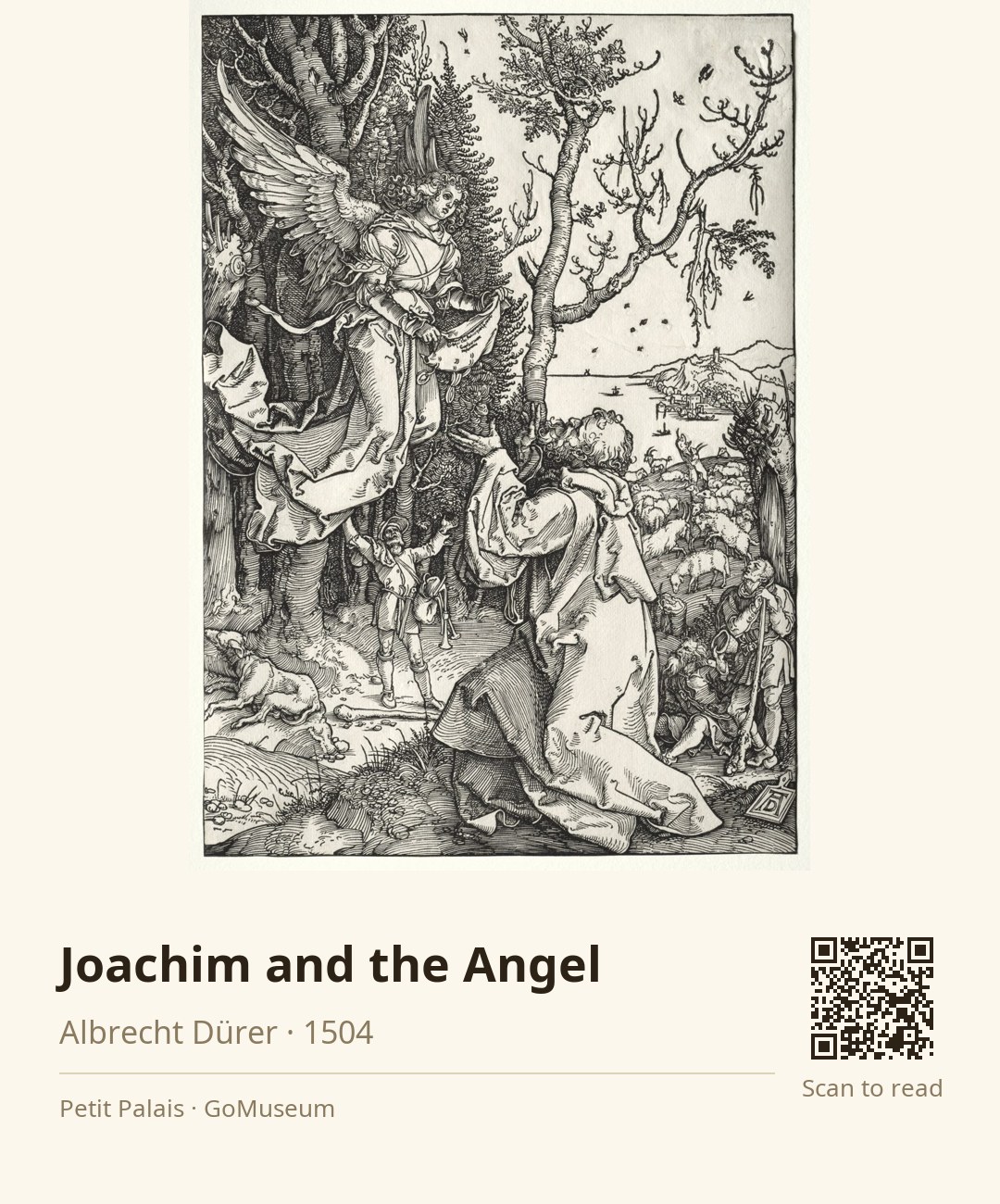
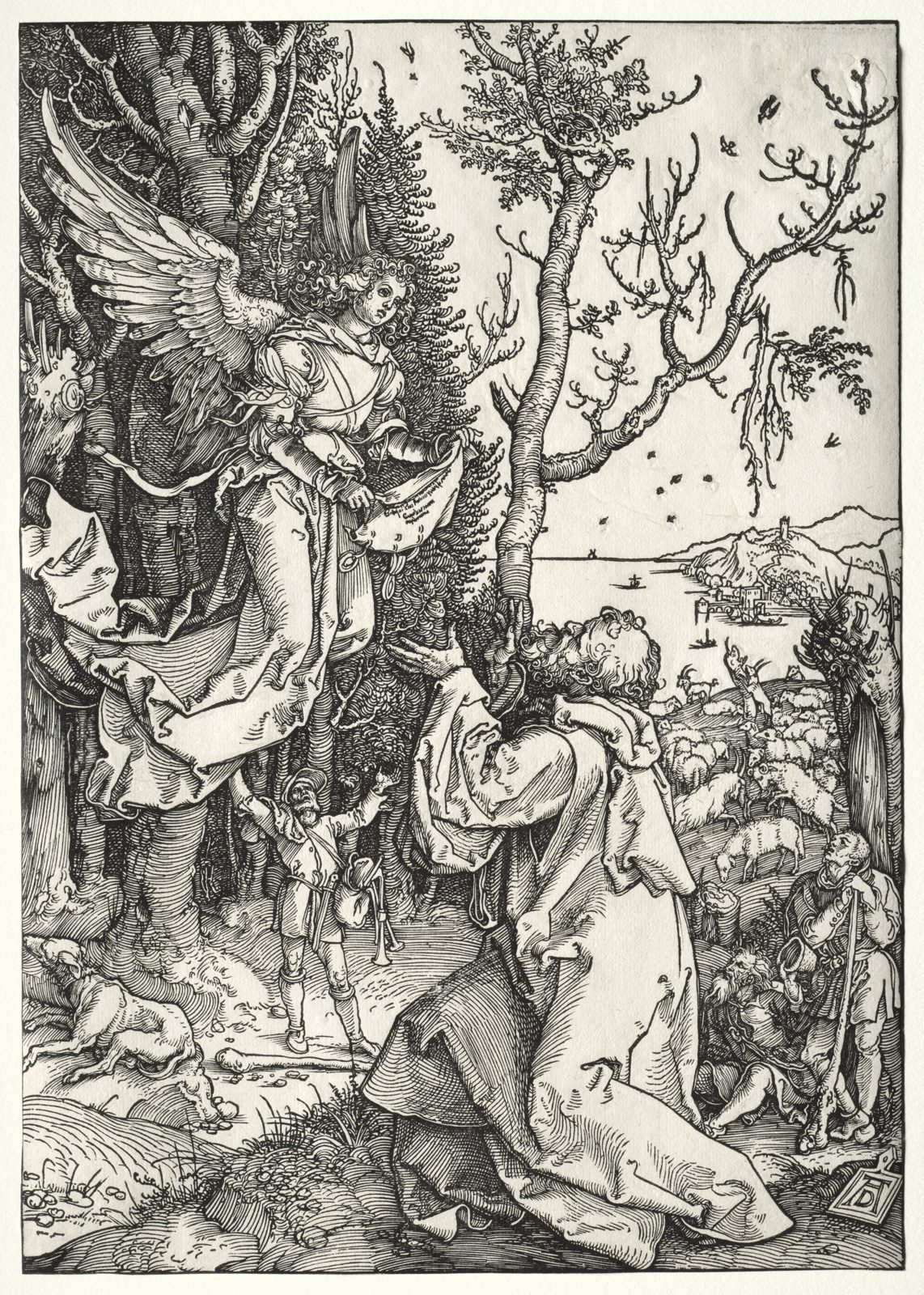
🎧 This work has audio narration — listen in the appA bearded man kneels in reverence, reaching out to a serene angel hovering above him, draped in flowing robes. Nearby, a dog lies at rest while a flock of sheep grazes peacefully in the background, tended by a shepherd. This scene, set against a richly detailed forest landscape with twisting trees and distant hills, captures a moment of divine intervention, suggesting a profound connection between the earthly and the celestial.
The angel's calm expression contrasts with the man's earnest gesture, highlighting the emotional weight of their encounter. Dürer masterfully employs intricate lines and shading, bringing texture to the foliage and depth to the figures, which enhances the sense of realism and spirituality in the work. This careful attention to detail reflects Dürer’s innovative approach to printmaking and drawing, as he sought to merge the Gothic traditions of Northern Europe with the classical influences he encountered during his studies in Italy.
Created in 1504, "Joachim and the Angel" exemplifies Dürer's ability to convey complex narratives through visual art, drawing on biblical themes to explore human emotion and divine presence. This piece is part of a broader body of work that established Dürer as a pivotal figure in the Northern Renaissance, influencing generations of artists that followed.
Albrecht Dürer, born on May 21, 1471, in Nuremberg, was a pivotal figure of the German Renaissance, renowned for his contributions as a painter, printmaker, and theorist. His artistic journey began early, showing exceptional talent in drawing, which led him to apprentice under Michael Wolgemut. By his twenties, Dürer gained recognition across Europe, particularly for his innovative woodcuts that transformed the medium. His engravings, characterized by meticulous detail and tonal range, further established his reputation.
Dürer's interactions with leading Italian artists, including Raphael and Leonardo da Vinci, enriched his work, allowing him to integrate classical motifs and the human form into Northern art. His theoretical writings on perspective and proportions reflect his deep engagement with the principles of mathematics in art. Dürer's legacy is marked by his ability to bridge the gap between Northern and Southern European artistic traditions, making him a central figure in art history. His works, including iconic pieces like "Melencolia I" and "Knight, Death, and the Devil," continue to influence artists and captivate audiences today. Dürer passed away on April 6, 1528, leaving behind a vast and impactful body of work.
Dürer's connections with prominent Italian artists exposed him to classical motifs and techniques, which he integrated into his own style, helping to bridge Northern Gothic and Italian Renaissance art.