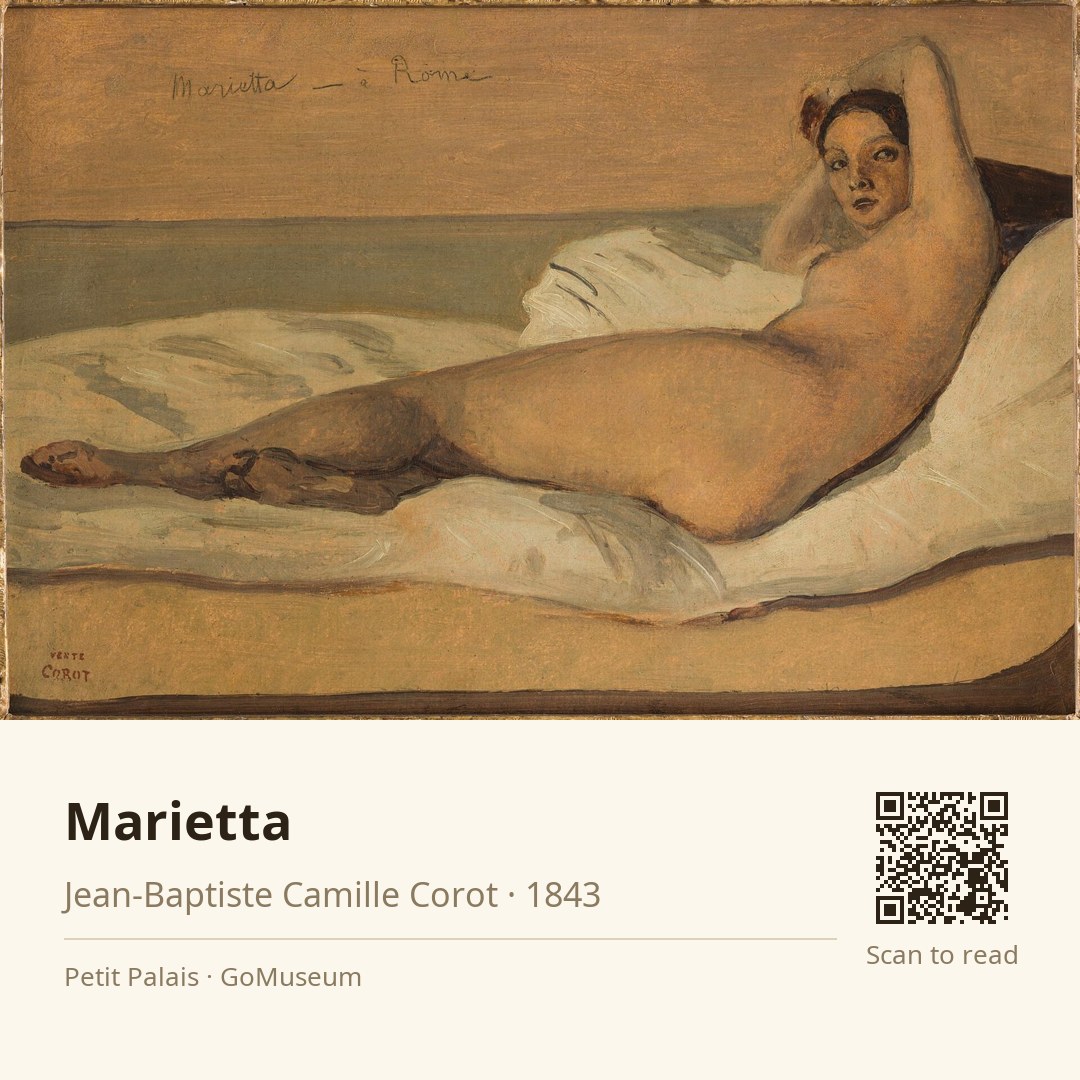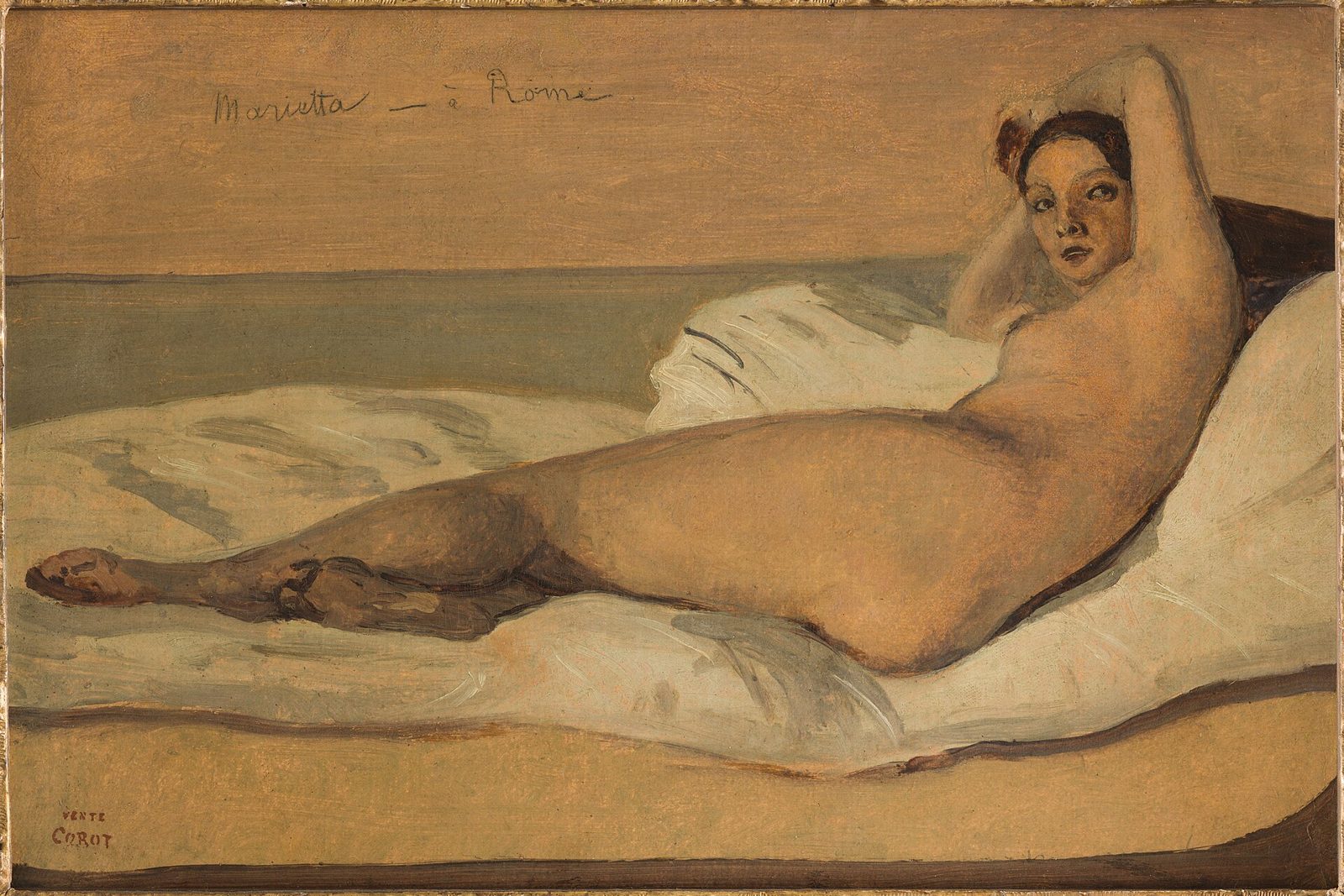
Marietta reclines gracefully, her arms raised behind her head, inviting you into a moment of serene intimacy. The soft, white bedding contrasts beautifully with her warm skin tones, while her direct gaze connects with you, creating a sense of engagement that transcends the canvas. The subtle brushwork enhances the smoothness of her form, emphasizing the gentle transitions between light and shadow that define her figure.
This portrayal of Marietta, a model in the studio of Jean-Achille Benouville, echoes the classical tradition of the odalisque, reminiscent of Ingres’ works. The inscription at the top, “Marietta - à Rome,” anchors the painting in a specific time and place, reflecting Corot's fascination with the female form and the beauty of the human body. The muted earthy tones of the background suggest a tranquil environment, allowing Marietta to be the focal point of the composition.
Created in 1843, this oil painting on canvas showcases Corot's evolving style, which bridges the gap between Neoclassicism and the emerging Impressionist movement.
Jean-Baptiste-Camille Corot, born on July 16, 1796, in Paris, was a pivotal French landscape and portrait painter whose work bridged the Neo-Classical tradition and the emerging Impressionist movement. Coming from a well-off bourgeois family, he was able to pursue art without financial constraints after receiving a yearly allowance following his sister's death in 1822. Initially uninterested in art, Corot's passion ignited during nature walks with a family friend, leading him to study under Achille Etna Michallon, who encouraged outdoor painting.
Corot's early career was marked by a struggle between commercial obligations and his artistic aspirations, but he eventually dedicated himself fully to painting. He became known for his serene landscapes, often capturing the essence of light and atmosphere, which would later influence Impressionists. Despite being regarded as an amateur for much of his life, he gained recognition around 1850 and became a founding figure of the Barbizon School, emphasizing realism in nature. Corot's legacy endures as a bridge between classical ideals and modern artistic expression, making him a significant figure in art history. He passed away on February 22, 1875, leaving behind a vast and influential body of work.
Corot's technique in 'Marietta' is a masterclass in the use of oil paint, showcasing his ability to create soft, smooth transitions that enhance the figure's form. The brushwork is delicate, allowing for a lifelike quality that draws the viewer in. The muted earthy tones of the background serve to elevate Marietta as the focal point, while the gentle handling of light creates a sense of depth and dimension. The diagonal positioning of the figure across the canvas adds dynamism, inviting the viewer to engage with the composition. Corot's choice of scale, relatively small for a nude, creates an intimate atmosphere, making the viewer feel almost as if they are sharing a private moment with the subject.
The relatively small scale of the painting fosters an intimate atmosphere, allowing viewers to feel as though they are sharing a private moment with Marietta.
Being born into a financially secure bourgeois family, Corot was able to pursue his passion for art without the burden of financial constraints, which was uncommon for many artists of his time.
Corot's early artistic development was influenced by Achille Etna Michallon, a protégé of Jacques-Louis David, who taught him the principles of the Neoclassical tradition.