Portrait of Juliette Courbet
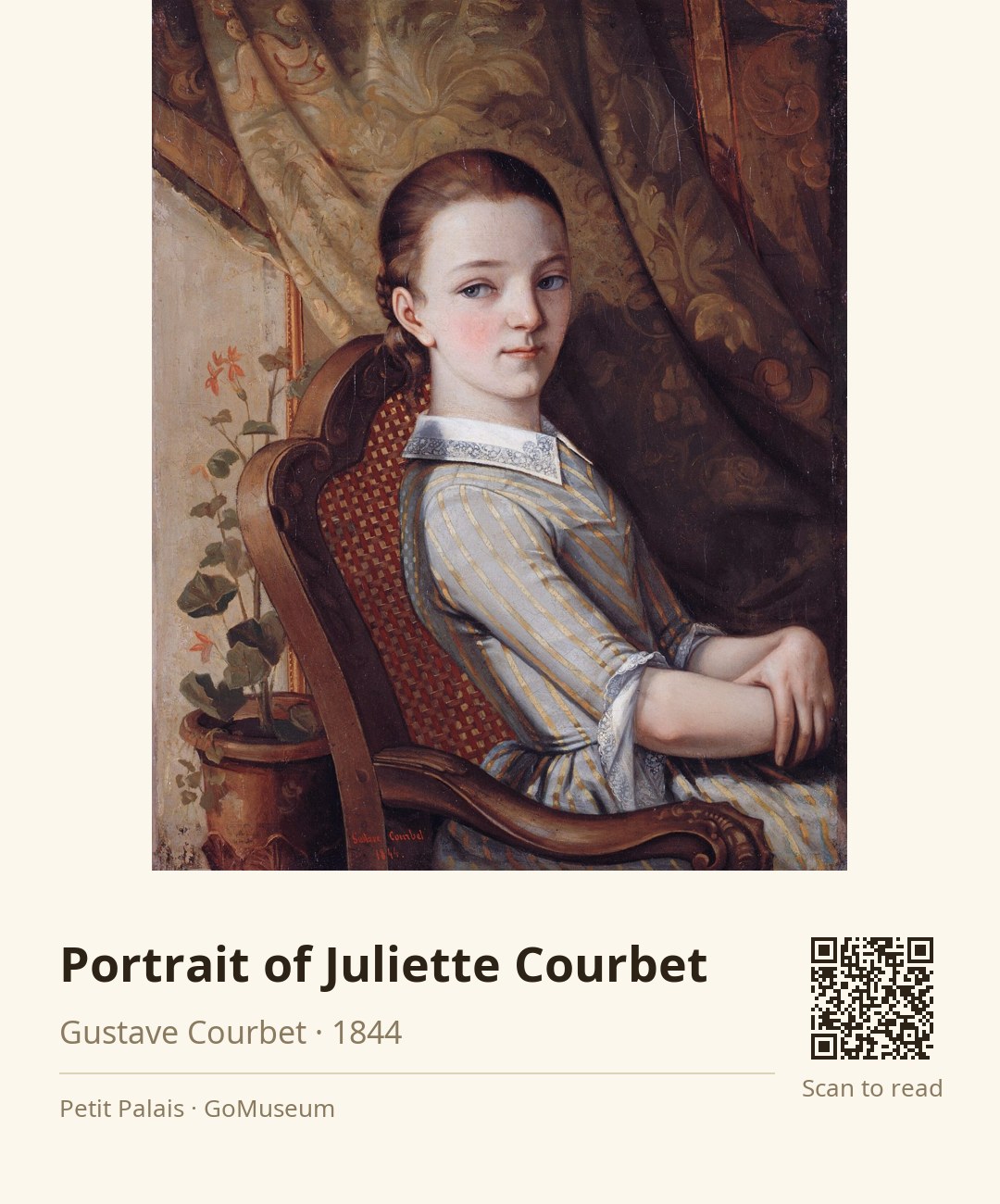
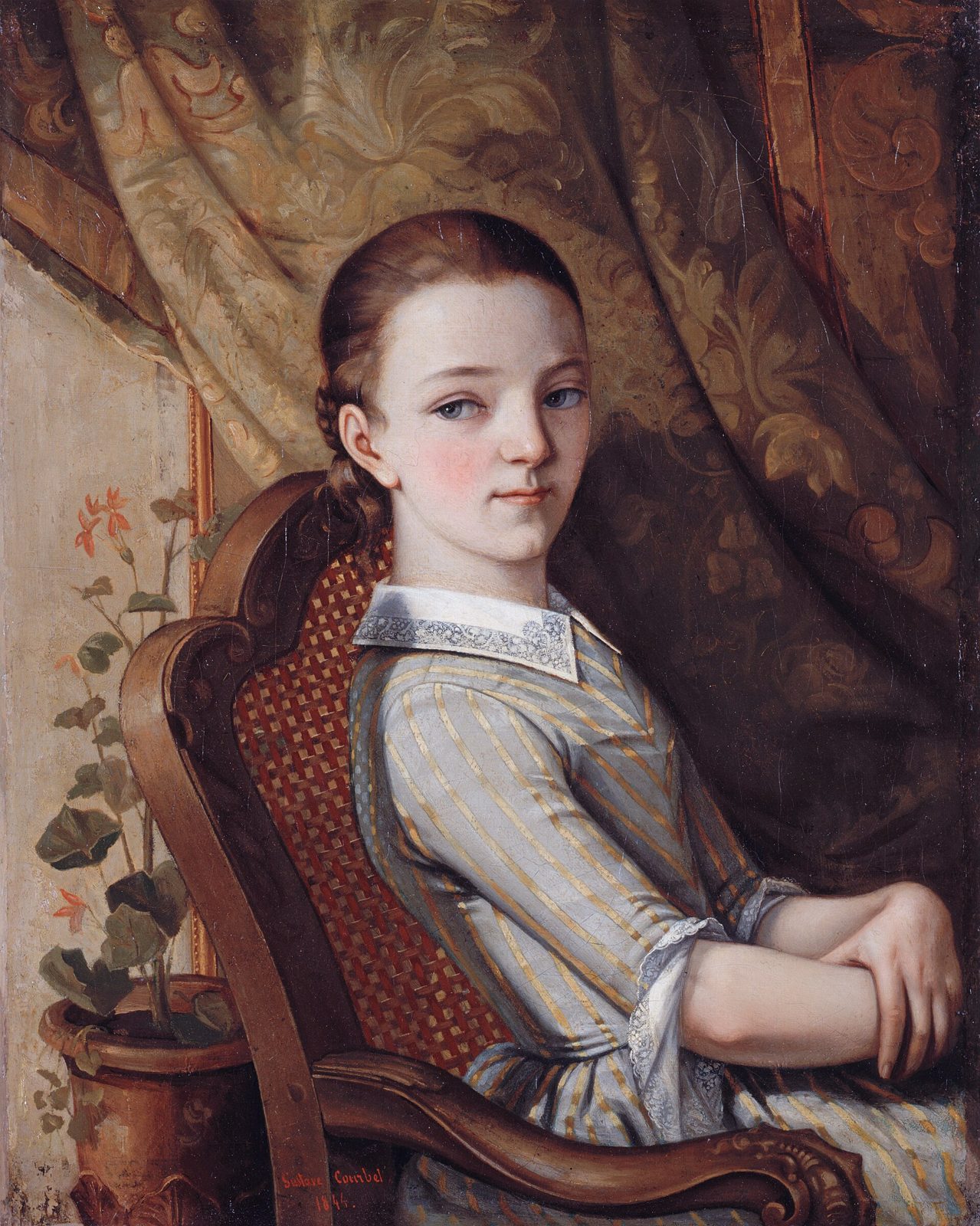
🎧 This work has audio narration — listen in the appJuliette Courbet sits gracefully in a wooden chair, her blue and gold striped dress contrasting beautifully with the rich drapery behind her. The delicate lace collar and cuffs frame her youthful face, while her arms rest gently in her lap, exuding a sense of calm and poise. To her left, a potted plant with small red flowers adds a touch of life and color, drawing the viewer’s eye into the intimate setting.
This portrait, painted by her brother Gustave Courbet in 1844, captures not just a moment in time but also the close bond between the artist and his sister. The meticulous attention to the textures of her dress and the intricate patterns of the background drapery reflect Courbet's commitment to realism, emphasizing the beauty of everyday life and the people within it. Juliette's direct gaze invites you into her world, creating a connection that transcends the canvas.
Gustave Courbet, a leading figure of the Realism movement, sought to portray life as he saw it, often challenging the conventions of his time. His work was characterized by a focus on ordinary subjects, and this portrait exemplifies his ability to elevate personal relationships into the realm of fine art. Painted in oil on canvas, "Portrait of Juliette Courbet" remains a testament to the artist's early exploration of familial themes and the human experience.
Gustave Courbet, born on June 10, 1819, in Ornans, France, was a pioneering painter who championed the Realism movement in 19th-century art. Rejecting the conventions of academic painting and the idealism of Romanticism, he focused on depicting the world as he observed it, often portraying unidealized peasants and workers in monumental compositions. His early works gained recognition, notably "After Dinner at Ornans," which won him a gold medal at the Salon of 1849, allowing him to exhibit without jury approval.
Courbet's commitment to realism was revolutionary; he believed that art should stem from personal experience rather than historical or mythological themes. His bold approach often sparked controversy, challenging societal norms and addressing social issues, which resonated with later movements like Impressionism and Cubism. Despite facing criticism and imprisonment for his political involvement during the Paris Commune, Courbet continued to create until his death on December 31, 1877, in Switzerland.
His legacy endures as a transformative figure in art history, whose unflinching depictions of everyday life laid the groundwork for modern artistic expression. Today, Courbet is celebrated for his vigorous and uncompromising work, which continues to engage audiences with its raw honesty and depth.
Gustave Courbet painted the 'Portrait of Juliette Courbet' in 1844, capturing his younger sister in a moment of serene elegance. The painting reflects not only familial affection but also Courbet's early exploration of realism, a movement he would come to define. At the time, Courbet was establishing his reputation, having gained some recognition for his earlier works. The reception of this portrait was likely warm, as it showcased his ability to portray intimate relationships with authenticity, a hallmark of his style.
The oil paint is applied with a meticulous hand, allowing for rich textures that breathe life into Juliette's dress and the drapery behind her. The blue and gold stripes of her gown are not just colors; they are a celebration of fabric, rendered with such precision that you can almost feel the weight of the material. The brushwork is deliberate, with smooth transitions that create a sense of depth and dimension. The potted plant to her left, with its vibrant red flowers, is painted with a lively touch, contrasting beautifully against the more subdued tones of the background. This choice of color palette enhances the intimacy of the scene, inviting the viewer into a private moment. Courbet's composition, with Juliette's direct gaze and the gentle curve of her seated posture, draws you in, making you feel as if you are part of the conversation.
Gustave Courbet's choice to immortalize his sister in such a detailed and affectionate manner reflects not only his artistic vision but also the strong bond they shared as siblings. This personal connection adds an extra layer of depth to the painting, making it more than just a portrait; it becomes a cherished family heirloom.
Courbet's sisters, Zoé, Zélie, and Juliette, served as his first models for his drawings and paintings.
The potted plant with vibrant red flowers adds a lively contrast to the subdued background, enhancing the overall intimacy of the scene.
Courbet was imprisoned for six months in 1871 because of his participation in the Paris Commune.