Henry IV Receiving the Spanish Ambassador
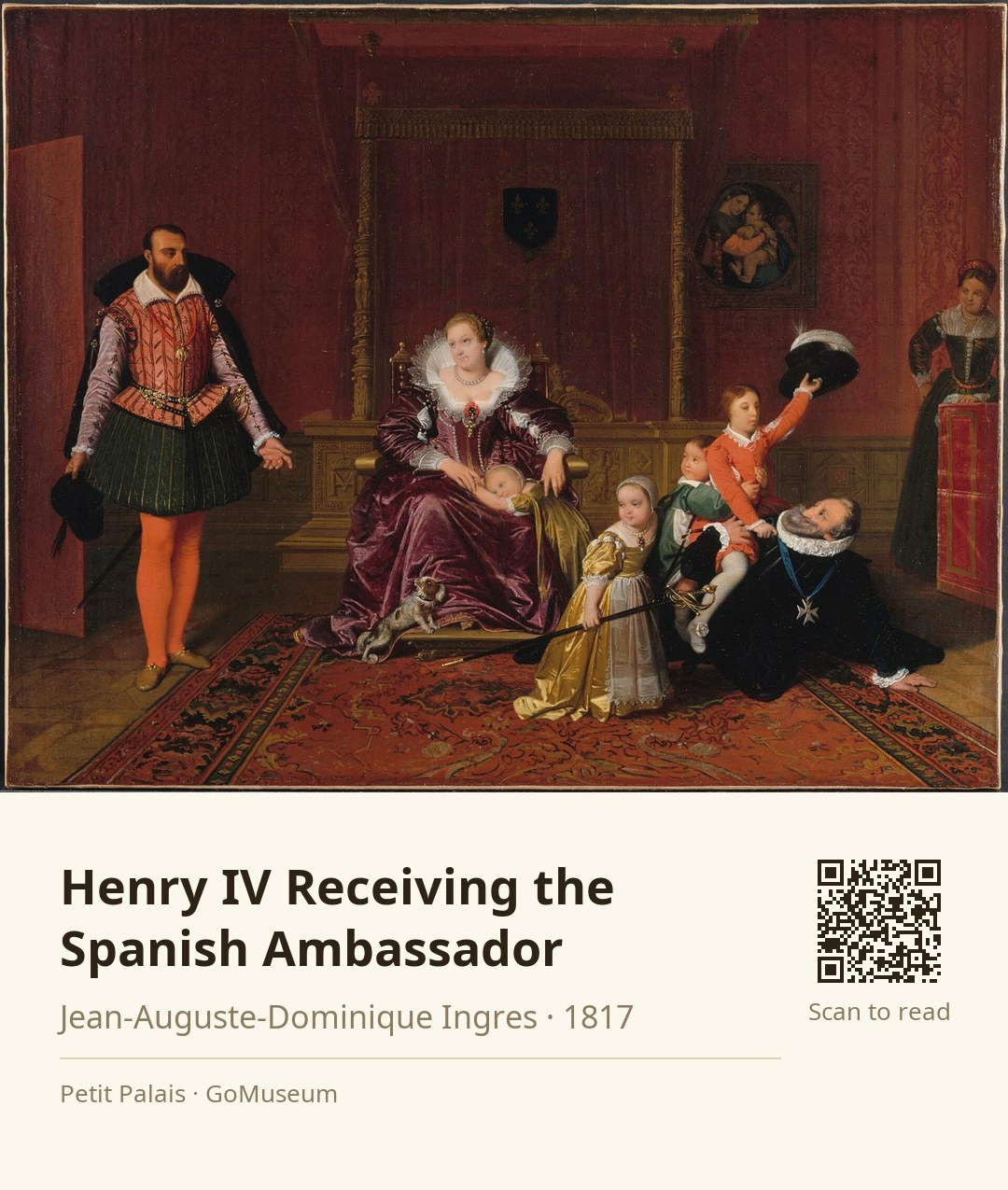
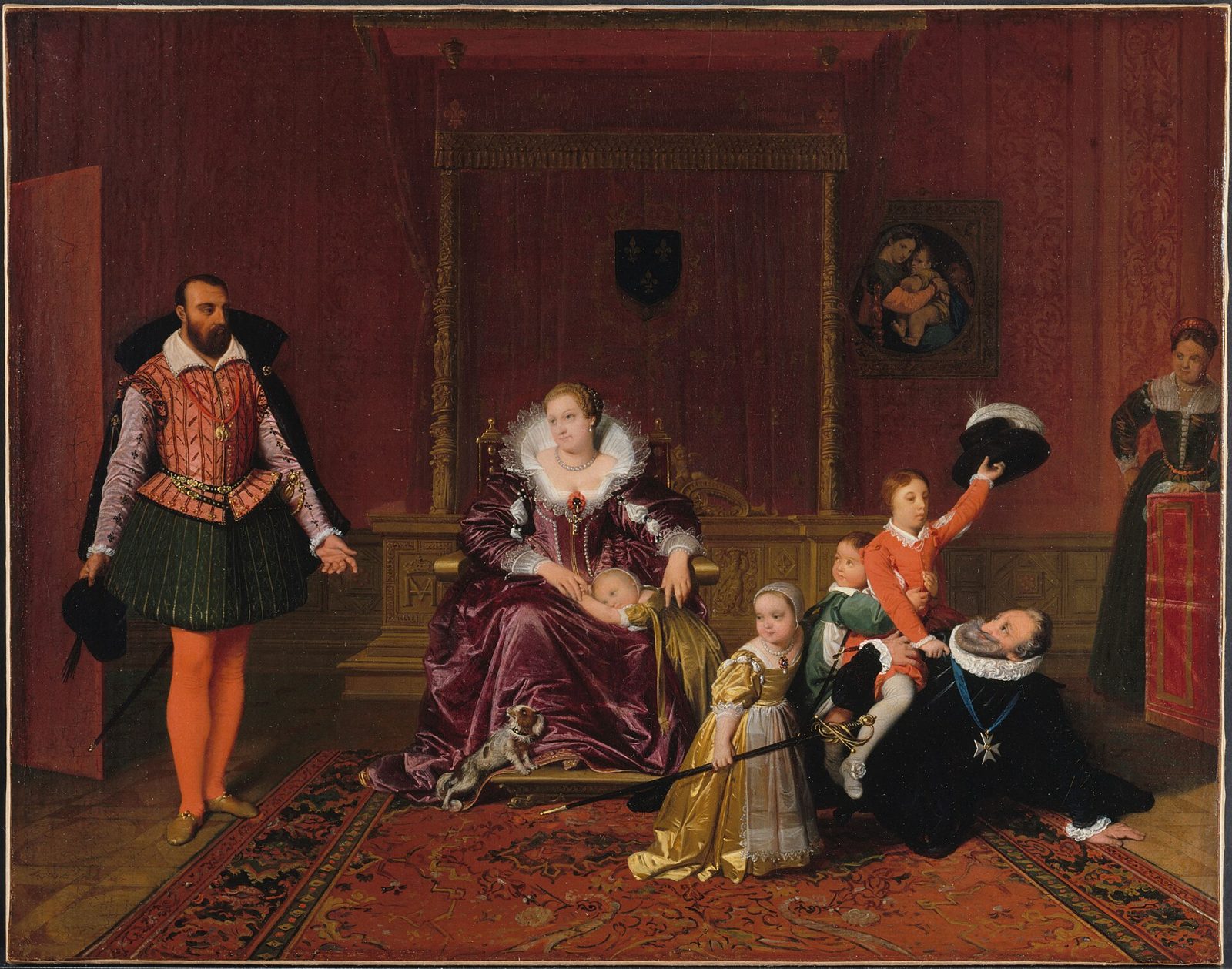
🎧 This work has audio narration — listen in the appThe regal scene unfolds with Marie de' Medici, elegantly seated in a sumptuous purple gown, cradling a baby in her lap. To her side, a man in vibrant attire, complete with orange stockings, stands with a hat in hand, while a small dog frolics at her feet, adding a playful touch to the grandeur. Children, dressed in bright colors, surround the pair, one brandishing a sword, another raising a hat, and a third nestled on a man's knee, creating a lively tableau that captures a moment of familial warmth amidst royal duties.
This portrayal of Henry IV receiving the Spanish ambassador is rich with symbolism, reflecting the intertwining of power and family. The presence of Marie de' Medici at the center not only highlights her importance but also suggests the political alliances forged through marriage and kinship. The ornate interior, with its red walls and an image of the Madonna and Child in the background, reinforces the notion of divine right and the sanctity of the royal family, while the children's playful antics contrast with the serious nature of the ambassadorial visit, illustrating the duality of public and private life in the court.
Painted by Jean-Auguste-Dominique Ingres in 1817, this work exemplifies the Troubadour style, which sought to evoke a sense of nostalgia for a romanticized past. Ingres, who was deeply influenced by classical traditions, aimed to create a narrative that celebrated both history and familial bonds.
Jean-Auguste-Dominique Ingres was a pivotal figure in French Neoclassicism, born on August 29, 1780, in Montauban. He was the son of a versatile artist, which nurtured his early artistic inclinations. Ingres studied under Jacques-Louis David in Paris, where he developed a commitment to academic traditions, aspiring to elevate history painting above all genres. His early career was marked by struggles, as critics dismissed his style as archaic, yet he persevered, achieving recognition with works like "The Vow of Louis XIII" in 1824.
His portraits, characterized by expressive distortions, became his most celebrated contributions, influencing modern artists such as Matisse and Picasso. Ingres's time in Italy, from 1806 to 1824, was crucial; he immersed himself in the study of Renaissance masters, which shaped his distinctive style. Despite facing criticism for his meticulous approach, he remained steadfast in his vision of beauty, emphasizing drawing over color.
Later in life, he returned to Paris, where he continued to create significant works, including "The Turkish Bath." Ingres's legacy endures as a bridge between classical traditions and modern art, embodying the tension between adherence to established norms and the evolving landscape of artistic expression. He passed away on January 14, 1867, leaving behind a profound impact on the art world.
In 'Henry IV Receiving the Spanish Ambassador', Ingres employs oil paint on canvas to create a vivid tableau that bursts with life. The brushwork is meticulous, showcasing Ingres's mastery of detail, particularly in the luxurious textures of the purple gown worn by Marie de' Medici. The colors are rich and saturated, with the deep reds of the walls contrasting beautifully against the softer hues of the children's clothing. Ingres's composition is carefully balanced; the central figure of Marie anchors the scene, while the playful children and the kneeling man create a dynamic rhythm that draws the eye across the canvas. The scale of the painting, relatively modest at 39.5 by 50 cm, invites intimacy, allowing viewers to feel as if they are part of this royal moment. Each element, from the ornate carpet to the background Madonna and Child, is deliberately chosen to enhance the narrative of power intertwined with familial love.
Ingres opposed the Romantic style, aiming instead to uphold academic traditions in his art.
Ingres's unique approach to form and space positioned him as a precursor to modern art, influencing notable artists like Henri Matisse and Pablo Picasso.