 Image: François de Dijon · Guilhem Vellut from Paris, France · bynyalcin · Martin Robson from Brighton, UK · Martin Robson from Brighton, UK
Gloria Victis
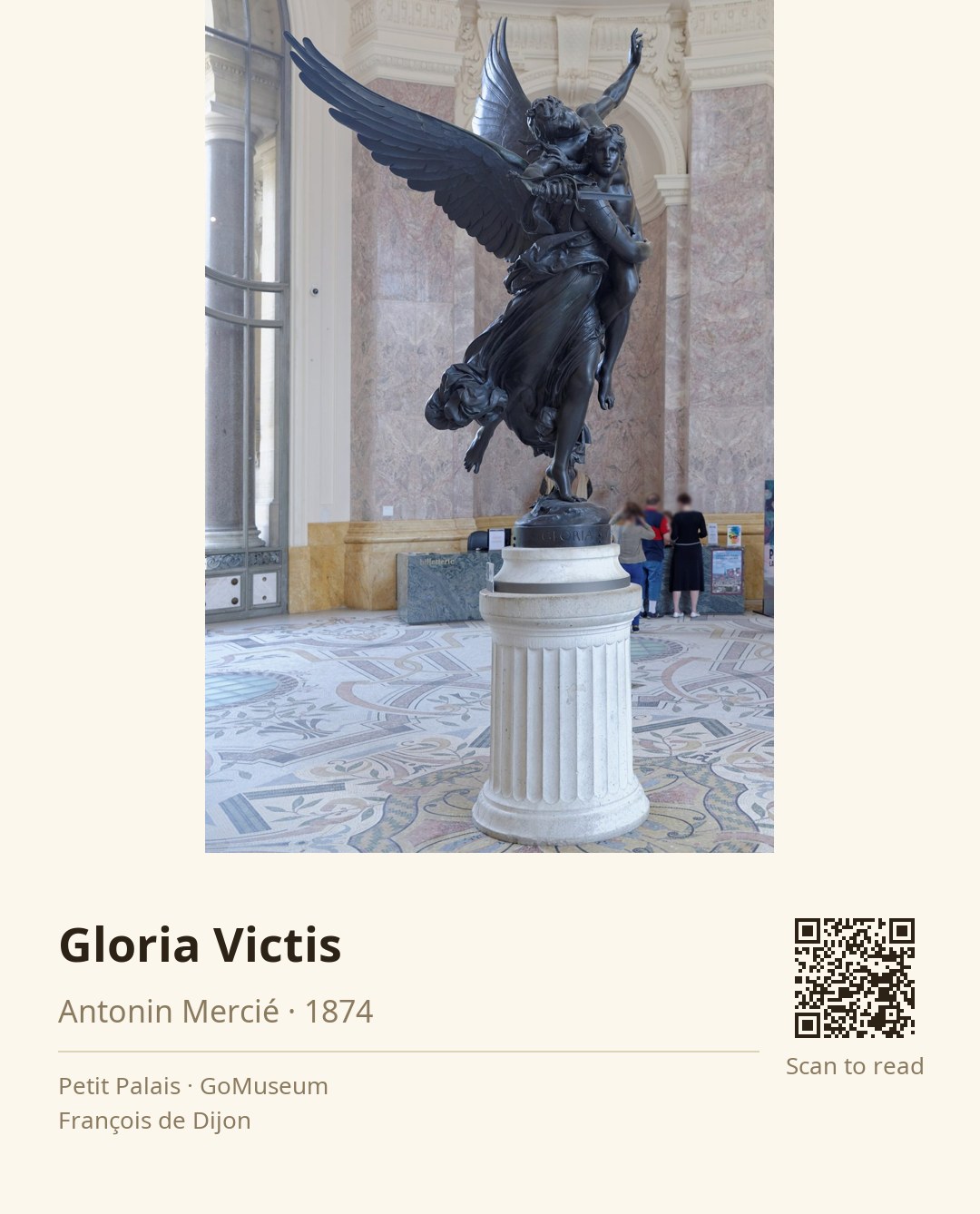
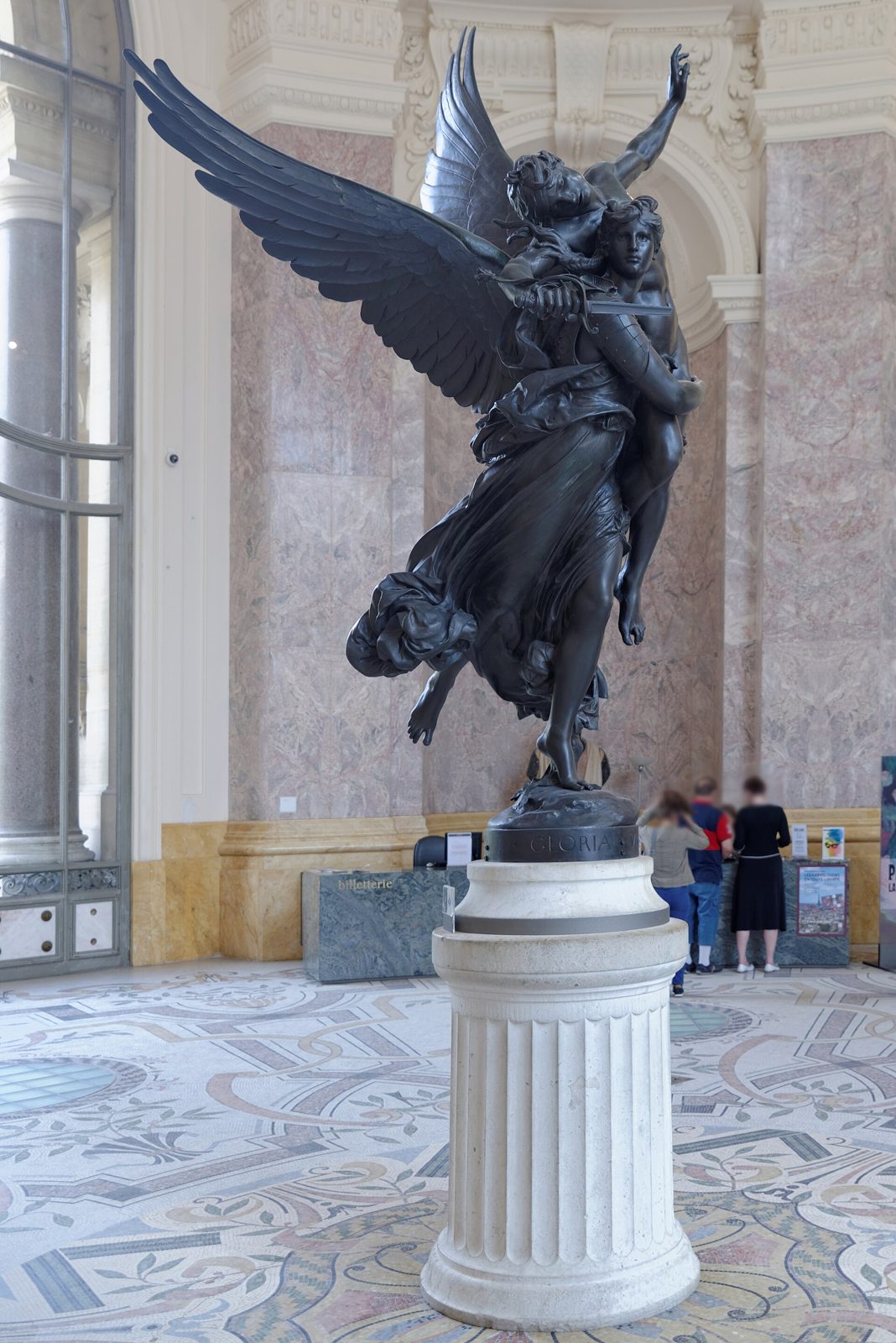
🎧 This work has audio narration — listen in the appThe winged figure in "Gloria Victis" soars above a fallen soldier, embodying the poignant intersection of defeat and honor. The outstretched wings of the angel, along with the soldier's broken sword, create a powerful visual narrative of loss and remembrance. This dynamic pose, with the soldier’s arms raised and his body positioned almost like a Christ figure, evokes a sense of resurrection and hope, suggesting that even in defeat, there is a path to glory.
Created by Antonin Mercié in 1874, this sculpture was a direct response to France's defeat in the Franco-Prussian War, aiming to honor the fallen soldiers, particularly Mercié's friend, Henri Regnault. The original plaster version won a medal at the Paris Salon, and the bronze casts that followed were produced by the renowned foundry of Ferdinand Barbedienne. The inscription "GLORIA" at the base reinforces the theme of immortalizing those who have suffered in battle.
Mercié's work sparked a mix of admiration and criticism, with some viewing it as a celebration of defeat rather than victory. The sculpture's neoclassical style and its allegorical representation of Fame carrying the defeated soldier stirred debate among contemporaries, reflecting the complex emotions of a nation grappling with its recent loss. "Gloria Victis" remains a significant piece in the narrative of French art and history, marking a moment of collective mourning and resilience.
Marius Jean Antonin Mercié was a prominent French sculptor, medallist, and painter born on October 30, 1845, in Toulouse. He studied at the École des Beaux-Arts in Paris, where he was influenced by notable mentors like Alexandre Falguière. His talent was recognized early when he won the Grand Prix de Rome at just 23. Mercié gained fame for works such as "David" and "Gloria Victis," both of which showcased his ability to blend classical themes with contemporary patriotism, earning him accolades at the Paris Salon.
His "David," a striking bronze statue, draws comparisons to Donatello's work, while "Gloria Victis" became a symbol of French resilience. Throughout his career, Mercié created numerous monuments, including those honoring historical figures like Louis-Philippe and Adolphe Thiers. He also contributed to the art world as a professor at the École des Beaux-Arts and was elected to the Académie française in 1891.
Mercié's legacy is marked by his ability to capture the human spirit in bronze and marble, leaving a lasting impact on French sculpture. He passed away in Paris on December 12, 1916, but his works continue to be celebrated in museums and public spaces, reflecting his significant place in art history.
Crafted from bronze, 'Gloria Victis' showcases Antonin Mercié's mastery in sculpting. The figures are not just cast but meticulously detailed, with flowing garments that capture movement and emotion. The angel's wings, outstretched and dynamic, contrast with the soldier's stillness, creating a visual tension that draws you in. You can almost feel the weight of the soldier's broken sword, a poignant reminder of his sacrifice. The surface of the bronze, with its rich patina, adds depth, inviting you to explore the textures that tell a story of both defeat and honor.
Commissioned in the wake of the Franco-Prussian War, 'Gloria Victis' was first unveiled in plaster at the 1874 Paris Salon, where it won a medal and garnered significant attention. Mercié, deeply affected by the loss of his friend Henri Regnault, poured his grief into this work. The original plaster was later cast in bronze by the esteemed foundry of Ferdinand Barbedienne. The sculpture's journey didn't stop there; it was acquired by the City of Paris and exhibited in various locations, including the Square Montholon and later the Petit Palais. Its reception was mixed; while many admired its emotional depth, critics like Jean Baffier lambasted it for glorifying defeat. Over the years, numerous replicas have been created, each continuing the conversation about loss and remembrance.
The sculpture has inspired numerous replicas, which contribute to ongoing discussions about loss and remembrance.
It won a medal at the 1874 Paris Salon, highlighting its initial acclaim.