Young Woman Playing the Mandore
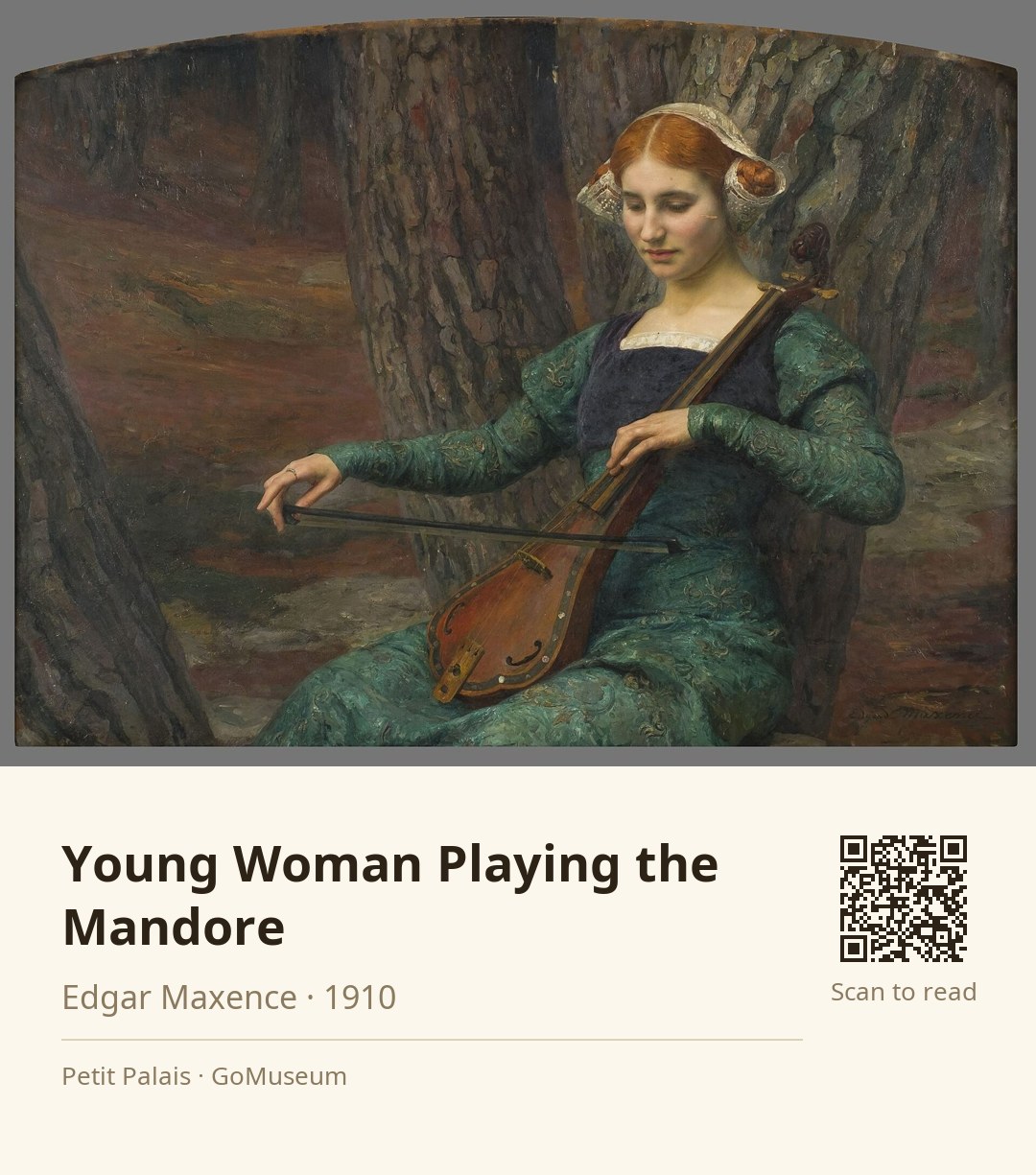
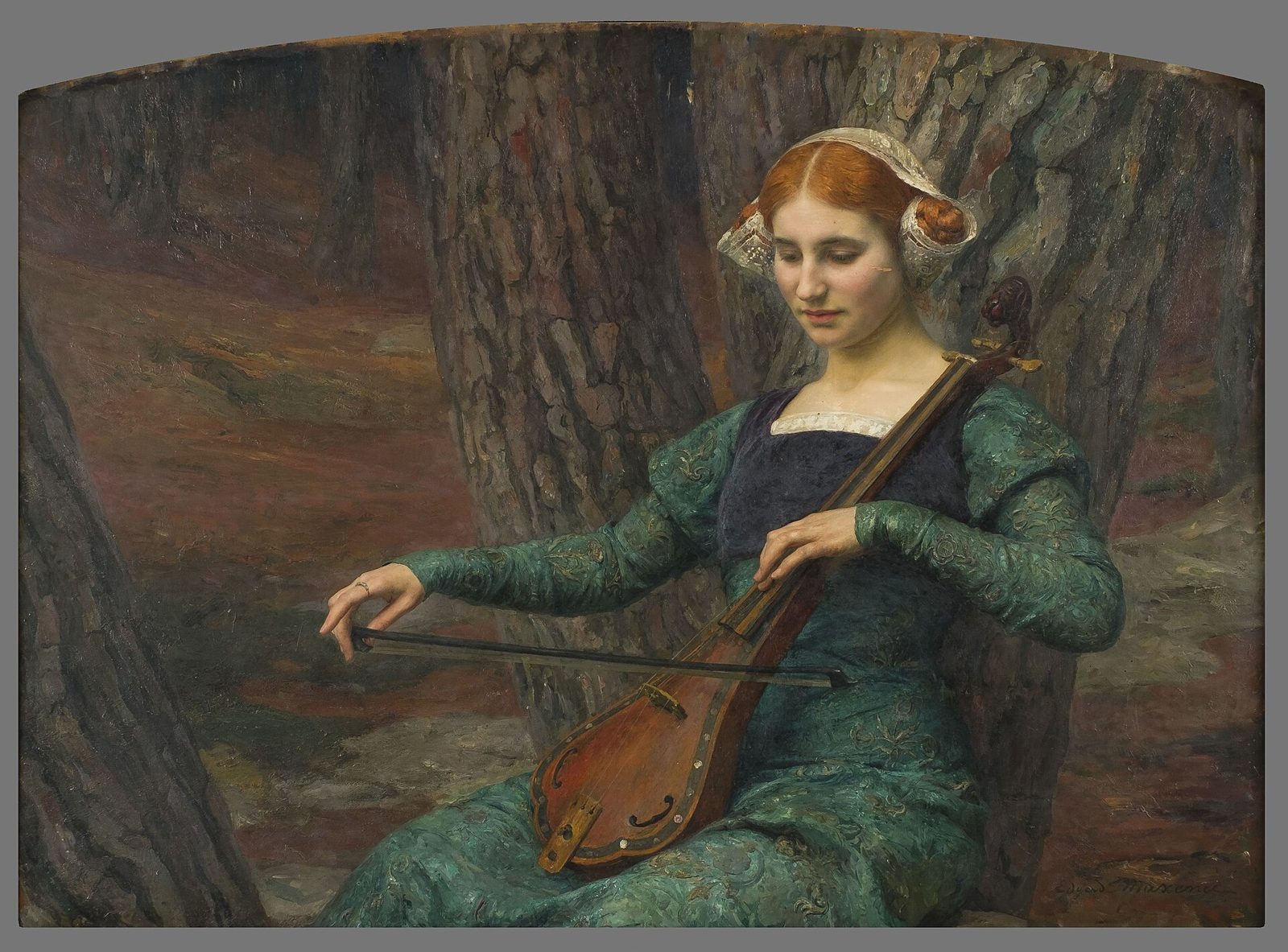
🎧 This work has audio narration — listen in the appA young woman, dressed in a richly detailed green Renaissance gown, sits gracefully against a tree trunk, her red hair adorned with a delicate lace headpiece. In her hands, she holds a mandore, a stringed instrument, poised elegantly as she plays, surrounded by the serene beauty of a forest. The tall trees in the background, with their textured bark, and the earthy tones of the forest floor create a tranquil atmosphere that draws you into her solitude.
The intricate patterns of her dress and the soft brushwork evoke a sense of harmony between the figure and nature, emphasizing the theme of solitude as she immerses herself in music. This painting, titled "Young Woman Playing the Mandore," serves as an allegory of solitude, capturing a moment of introspection and connection with the natural world. Created in 1910 by Edgar Maxence, the work reflects the artist's fascination with medieval and mythical subjects, blending realism with a symbolic aesthetic.
Signed by the artist, the painting was exhibited at the Salon in Paris the same year it was completed.
Edgard Maxence was a French Symbolist painter born on September 17, 1871, in Nantes. He studied under renowned artists Elie Delaunay and Gustave Moreau at the École des Beaux-Arts in Paris, where he became part of a vibrant community that included notable contemporaries like Henri Matisse and Georges Rouault. Maxence's artistic journey began with his exhibitions at the Salon des Artistes Français from 1894 to 1939, where he gained recognition for his unique blend of medieval themes and hermetic imagery.
His technique was characterized by a thick application of paint and a purity of line, often utilizing tempera and oil mixed with wax. Maxence's works, such as "Femme à l'Orchidée" and "L'âme de la forêt," reflect his fascination with mystical and idealized scenes, earning him accolades, including a gold medal at the 1900 Exposition Universelle. He was also involved in significant religious art, notably painting the vaulted ceiling of the Basilica of the Rosary in Lourdes.
Maxence's legacy in art history is marked by his contributions to the Symbolist movement, and his works are housed in prestigious institutions like the Musée d'Orsay and the Musée des Beaux-Arts. He was honored as a Knight of the Legion of Honor in 1900 and later became an officer in 1927, solidifying his status as a prominent figure in French art until his death on July 31, 1954.
Maxence's technique in 'Young Woman Playing the Mandore' showcases a masterful blend of realism and symbolism. The oil paint is applied with a soft, almost velvety touch, allowing the intricate details of the woman's gown to shimmer with life. The dress's rich green hues are layered to create depth, while the delicate lace headpiece contrasts beautifully against her fiery red hair. The composition draws your eye to the figure, framed by the towering trees, which are rendered with a textured brushwork that evokes the roughness of nature. This careful balance between the detailed foreground and the serene background enhances the painting's tranquil atmosphere, inviting you into a moment of introspection.
The serene forest setting in 'Young Woman Playing the Mandore' aligns with Maxence's recurring themes of nature and solitude, reflecting his symbolic approach to landscapes that often serve as backdrops for introspective moments in his art.