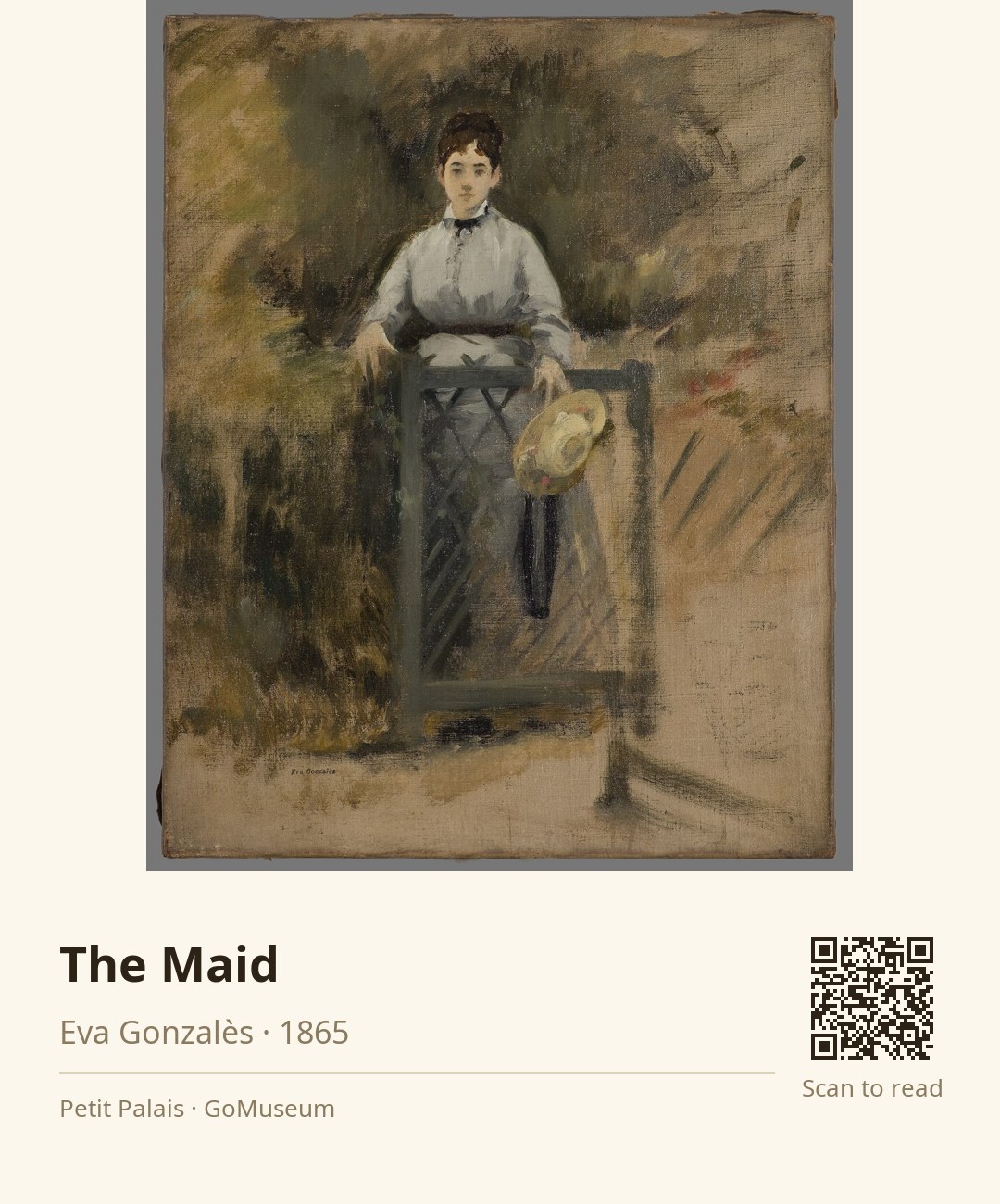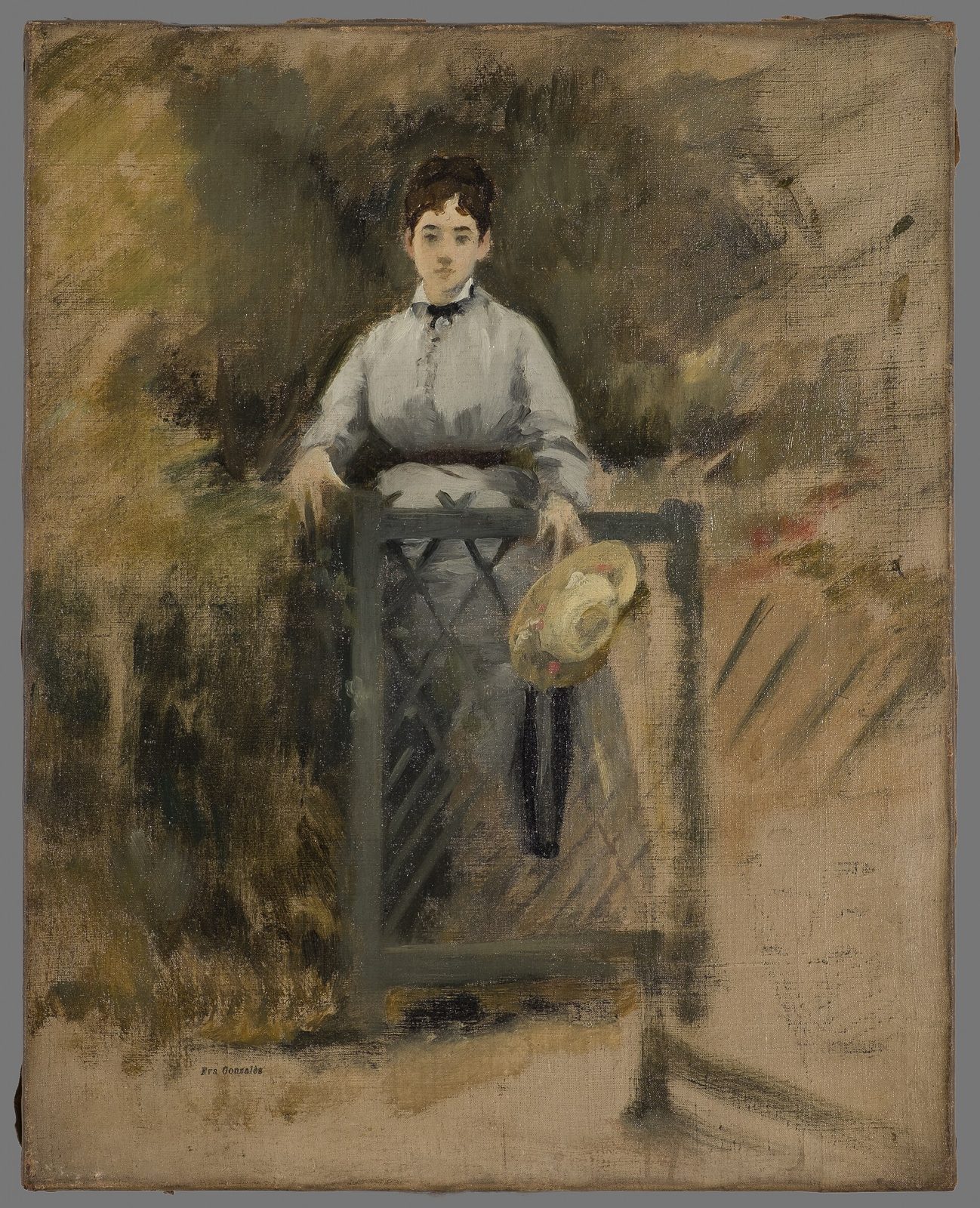
A young woman stands poised behind a garden gate, her light blouse contrasting with the dark ribbon at her neck, while her hands rest gently on the gate itself. A straw hat adorned with floral decorations hangs from the gate, adding a touch of whimsy to the scene. The impressionistic background, a blend of greens and browns, evokes a lush garden, creating a serene atmosphere that draws you into her world.
This composition captures a moment of stillness, where the woman’s direct gaze invites connection, suggesting a narrative that remains tantalizingly out of reach. The loose brushwork and muted palette enhance the intimacy of the scene, emphasizing the soft textures of her clothing and the natural surroundings. Gonzalès' technique reflects her training under Édouard Manet, yet here she carves out her own space, merging personal expression with the broader Impressionist movement.
Painted in 1865, "The Maid" showcases Gonzalès' early exploration of figure painting, a genre where she would later excel.
Eva Gonzalès was a pioneering French Impressionist painter born in Paris on April 19, 1847. Raised in an artistic environment, she was introduced to the cultural elite through her father, a writer. At sixteen, she began her formal art training, first with Charles Chaplin and later under Édouard Manet, who became a significant influence on her work. Gonzalès was the only formal student of Manet, and their relationship was both personal and professional, with her often serving as his model.
Her paintings, characterized by a blend of technical skill and an intuitive approach, earned her praise from critics like Émile Zola. Despite being part of the Impressionist movement, she did not exhibit in their exhibitions, yet her style aligned closely with theirs. Works such as "A Loge in the Théâtre des Italiens" showcased her unique perspective, blending feminine sensibility with bold themes.
Gonzalès married Henri Guérard in 1879 and had a son shortly before her untimely death in childbirth in 1883. Her legacy, though overshadowed during her lifetime, has gained recognition, with her works now celebrated in major collections, affirming her place in art history as one of the most notable female Impressionists of the 19th century.
In 'The Maid', Gonzalès employs oil paint on canvas, creating a rich texture that invites you to feel the softness of the woman's blouse and the roughness of the garden gate. The loose brushwork is a hallmark of Impressionism, allowing for a sense of spontaneity and movement. Each stroke seems to breathe life into the scene, while the muted palette of greens and browns enhances the serene atmosphere. The verticality of the gate not only frames the woman but also adds a structural element that draws your eye directly to her. The way she leans against the gate, with her hands gently resting, creates an intimate connection, as if she is inviting you into her world. The impressionistic background, with its suggestion of foliage, serves to further isolate her figure, making her the focal point of this quiet moment. Gonzalès' technique reflects her mastery of light and form, capturing not just the appearance of her subject but also the emotion behind it.
Interestingly, Gonzalès was not only a painter but also served as a model for several prominent artists of her time, including her mentor, Édouard Manet. This dual role in the art world often led to her being perceived as merely a decorative figure rather than a serious artist in her own right. However, her ability to navigate these complexities and assert her identity as a painter is a testament to her strength and talent.
Eva Gonzalès grew up in a culturally rich environment, as her father was a writer and president of the Société des gens de lettres, which introduced her to influential literary and artistic circles from a young age.
Although she was his only formal student and modeled for him, critics often viewed her more as a decorative figure rather than a serious artist, overshadowing her own contributions and style.
Despite her technical skill and positive reviews, she struggled against the perception of female artists at the time, often being labeled with a 'feminine technique' that limited her recognition compared to her male counterparts.