 Image: Romainbehar · Guilhem Vellut from Paris, France · Romainbehar · Romainbehar
Reclining Bacchante
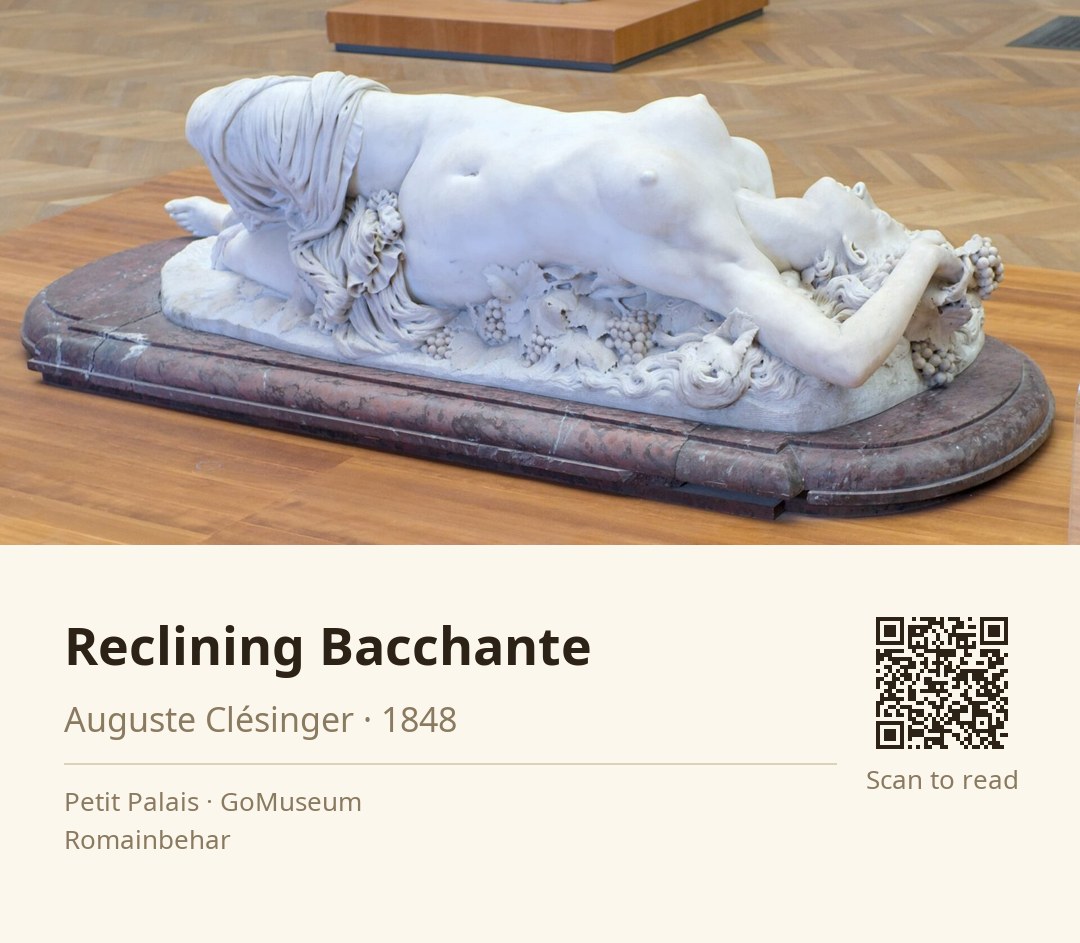
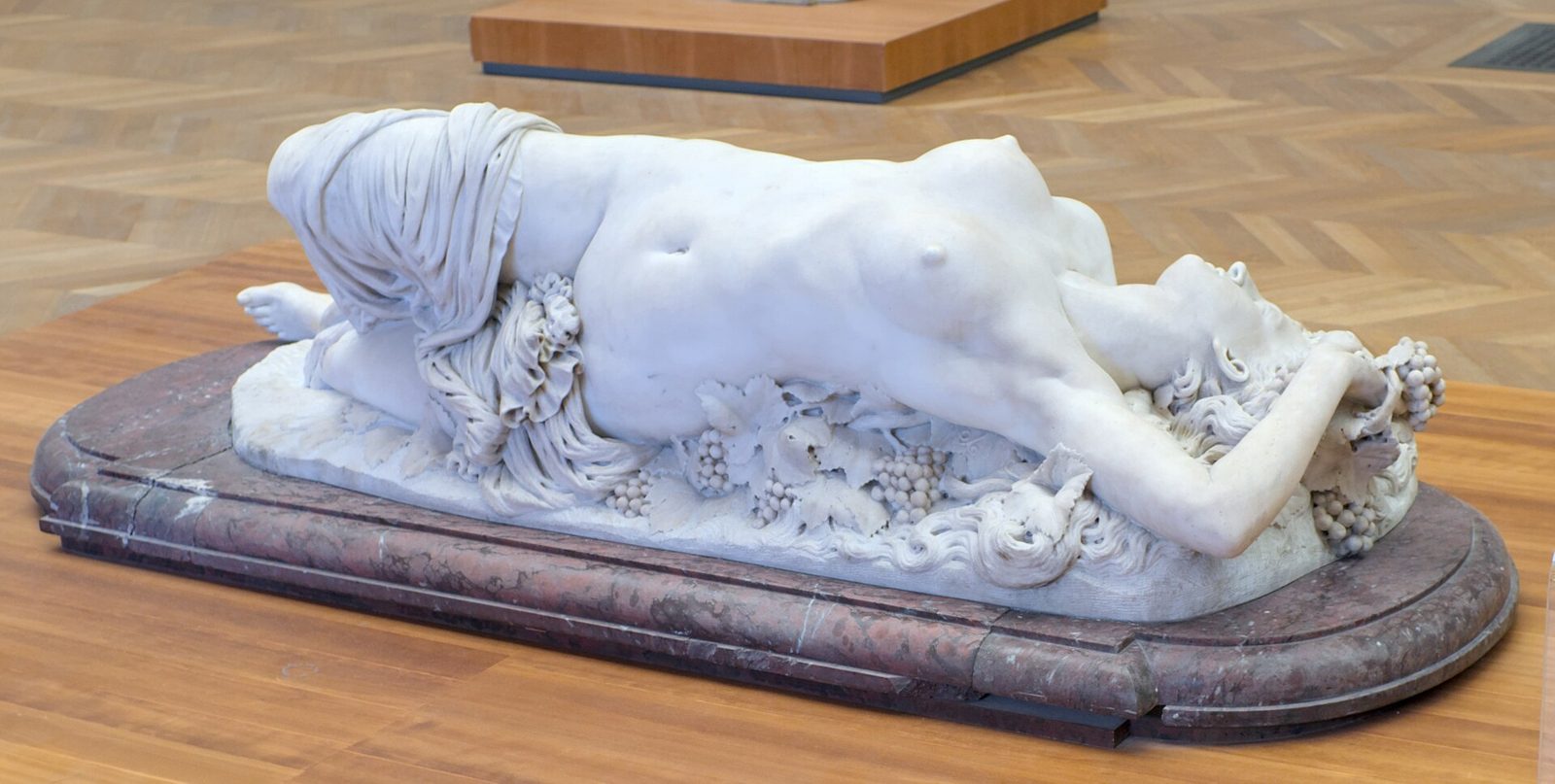
🎧 This work has audio narration — listen in the appThe reclining figure of a Bacchante, draped modestly yet suggestively, invites you to explore themes of nature and abundance. Her smooth, white marble skin contrasts with the intricate grapevines and clusters of grapes that encircle her, emphasizing her connection to Bacchus, the Roman god of wine and revelry. The way her right arm bends gracefully near her face adds a sense of intimacy, suggesting both vulnerability and sensuality.
Clésinger's masterful attention to detail in the drapery and the natural elements showcases his skill in capturing texture and form, bringing the figure to life. This sculpture, created in 1848, was a response to the scandal surrounding his earlier work, "Woman Bitten by a Serpent." By crafting the Bacchante, Clésinger aimed to assert his artistic integrity against accusations of merely molding from life. The Bacchante was presented at the Salon of 1848, where it received a first-class medal, further solidifying Clésinger's reputation.
The work reflects the artist's ongoing exploration of the female form and its representation in the context of pleasure and nature. Clésinger was awarded the title of Chevalier of the Légion d’honneur in 1849, marking a significant recognition of his contributions to the art world.
Jean-Baptiste Auguste Clésinger was a prominent French sculptor and painter born on October 22, 1814, in Besançon. Trained by his sculptor father, he made his debut at the Paris Salon in 1843 and gained fame with his provocative work, "Woman Bitten by a Serpent," in 1847, which showcased his model and muse, Apollonie Sabatier. This piece stirred controversy for its erotic undertones and was lauded for its beauty by critics like Théophile Gautier.
Clésinger's career flourished as he created notable busts and statues, including works of Rachel Félix and Louise of Savoy. His marriage to Solange Dudevant, daughter of the writer George Sand, intertwined his life with notable literary figures, including Frédéric Chopin, for whom he crafted a death mask and a tombstone. Despite personal struggles, including the tragic loss of his daughter and a tumultuous marriage, Clésinger's artistic contributions were recognized with honors, including the Légion d'honneur.
He became the artistic director of the Société générale de photosculpture in 1867, further cementing his legacy in the art world. Clésinger passed away on January 5, 1883, in Paris and was buried in Père Lachaise Cemetery, leaving behind a significant mark on 19th-century sculpture and romantic art.
Crafted from smooth, white marble, the Bacchante showcases Clésinger's exceptional skill in sculpture. The drapery around her lower body is not just a simple covering; it flows and folds with a lifelike quality, capturing the essence of movement and softness. Look closely at the intricate grapevines and clusters of grapes that surround her, each detail carved with precision, enhancing the sense of abundance. The polished oval base adds a touch of elegance, grounding the figure while allowing her to appear as if she could spring to life at any moment.
The Bacchante was created in 1848, a pivotal year for Clésinger following the scandal of his earlier work, Woman Bitten by a Serpent. This earlier piece had drawn harsh criticism, with accusations suggesting it was merely a life-cast of his model, Apollonie Sabatier. In response, Clésinger sculpted the Bacchante, a slightly larger variant, to assert his artistic integrity. The sculpture debuted at the Salon of 1848, where it was met with acclaim, earning a first-class medal. Critics praised its lifelike quality, with Henri Blaze de Bury noting the figure's intoxicating beauty. Following this success, Clésinger was honored with the title of Chevalier of the Légion d’honneur in 1849, marking a significant recognition of his artistic contributions.
Clésinger created another marble sculpture of Apollonie Sabatier in 1847, which is now housed at the Musée d'Orsay.
Clésinger had a close connection with Chopin, as he created Chopin's death mask and a cast of his hands after the composer's death.
The polished oval base enhances the elegance of the Bacchante, helping to ground the figure while also giving it a sense of liveliness.