Portrait of the Marquise Landolfo-Carcano
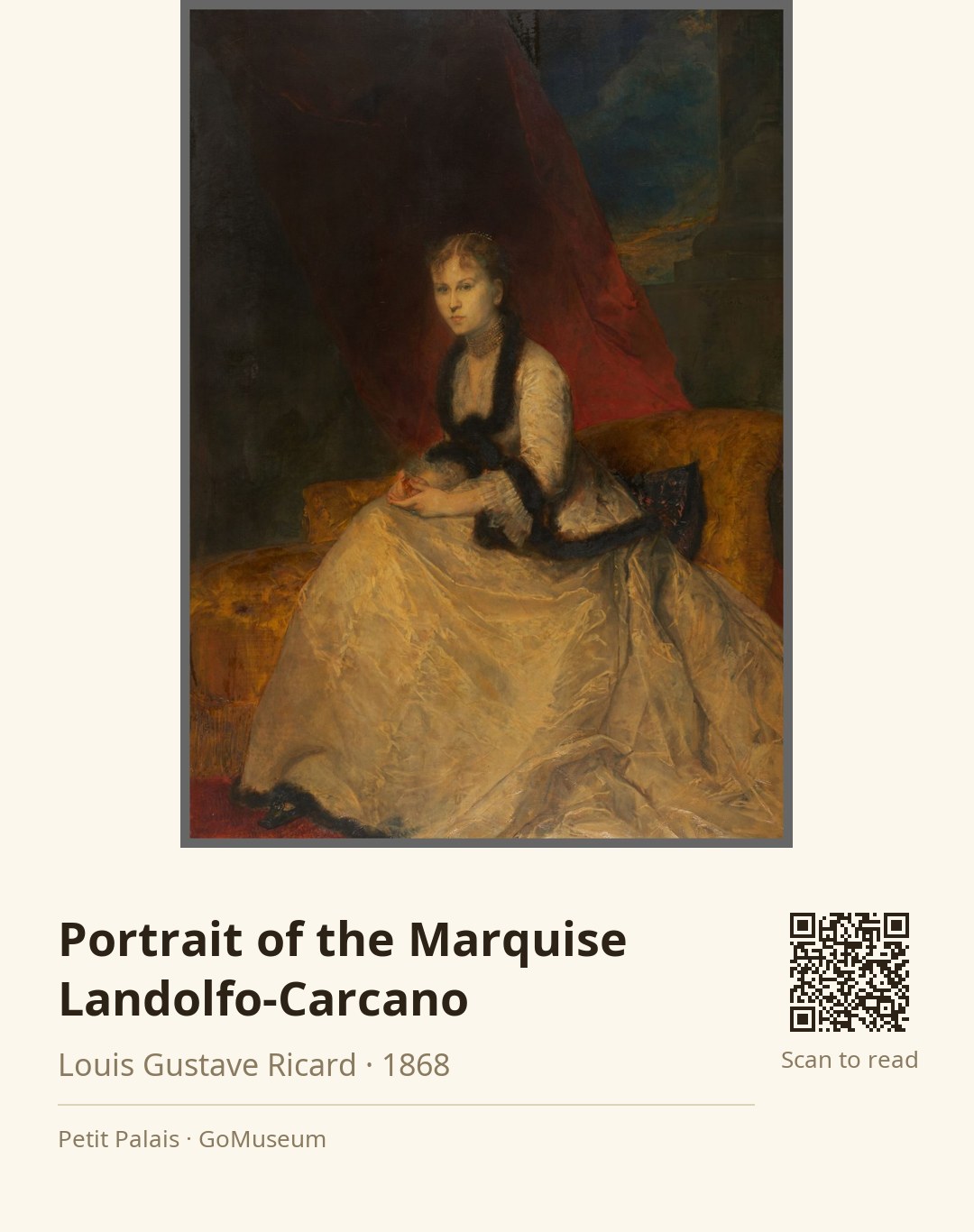
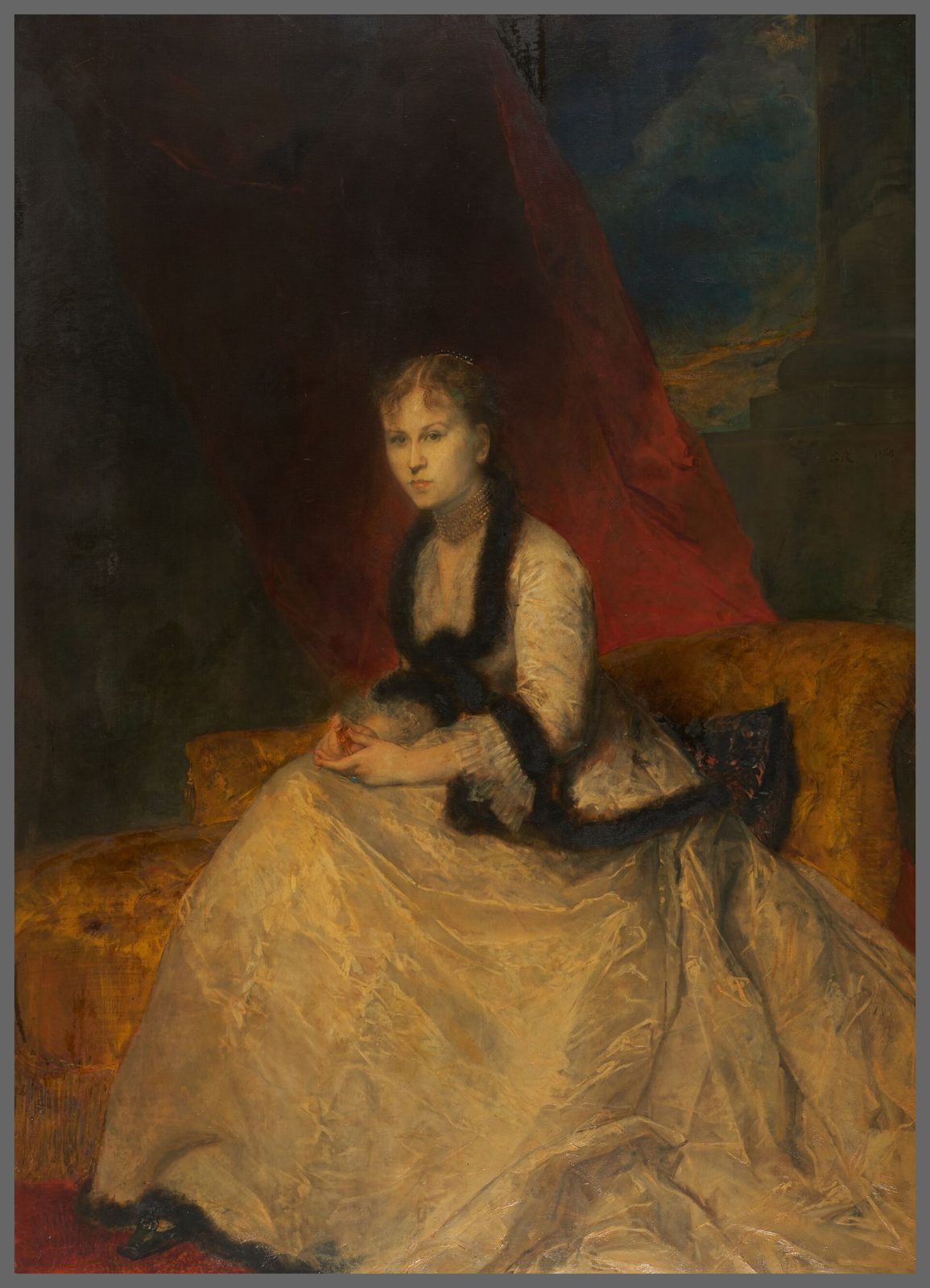
🎧 This work has audio narration — listen in the appAdèle Caussin, the Marquise Landolfo-Carcano, sits gracefully in this striking portrait, her light-colored dress adorned with dark fur trim and a high collar. Her hands are gently clasped in her lap, and her poised gaze meets the viewer directly, creating an intimate connection. Behind her, the rich, dark red drapery contrasts beautifully with the softer tones of her attire, while a plush, golden-brown sofa enhances the opulent atmosphere of the scene.
This careful arrangement of colors and textures not only highlights the marquise's elegance but also reflects the social status and refinement of the subject. The smooth brushwork captures the delicate details of her attire and the softness of her features, showcasing Ricard’s skill as a portraitist. The composition, with the figure slightly off-center, invites the viewer into her world, suggesting a moment of stillness and contemplation.
Louis Gustave Ricard, a French painter active in the mid-19th century, specialized in portraits and was known for his ability to convey the personality of his subjects. He studied at the École nationale supérieure des beaux-arts in Paris and exhibited widely, earning recognition for his work. Ricard's portraits often featured a select clientele, reflecting his discerning taste and the intimate nature of his artistic practice. In 1868, he completed this portrait of the Marquise Landolfo-Carcano, capturing not just her likeness but also the essence of her character.
Louis Gustave Ricard was a French painter born on September 1, 1823, in Marseille, and he passed away on January 23, 1873, in Paris. Coming from a well-off family, he had the opportunity to pursue art education, studying at the École supérieure d'art et de design in Marseille and later at the École nationale supérieure des beaux-arts in Paris. Influenced by the Old Masters, he became known for his exquisite portraits, earning accolades at various Salons, including a first-class medal for his work in 1852.
Ricard's artistic journey included travels to Italy and the Netherlands, where he honed his skills. Despite his talent, he grew disillusioned with official competitions after being repeatedly denied the Legion of Honor, prompting him to focus on private commissions. His selective nature led him to paint only those he found aesthetically pleasing, often portraying fellow artists.
In his later years, Ricard experimented with lighting and expression, creating works that conveyed a sense of melancholy and introspection. His portrait of Paul de Musset exemplifies this shift. He lived in England during the Franco-Prussian War and died unexpectedly while dining with a friend. Ricard's legacy endures, with a retrospective held shortly after his death, highlighting his significant contributions to portraiture in the 19th century.
Completed in 1868, 'Portrait of the Marquise Landolfo-Carcano' was created by Louis Gustave Ricard, a prominent portraitist of the mid-19th century. The marquise, Adèle Caussin, commissioned this work, likely to capture her status and elegance in a time when portraiture was a vital means of social expression. Ricard's reputation was on the rise, having already garnered attention at the Salon, where he exhibited frequently. This particular portrait was well-received, contributing to Ricard's growing acclaim.
Ricard's technique in this portrait is a masterclass in smooth brushwork and meticulous paint handling. The delicate textures of the marquise's light-colored dress and the dark fur trim are rendered with such precision that they almost seem to invite touch. The use of color is particularly striking; the rich, dark red drapery behind her creates a dramatic contrast that enhances her lighter attire, drawing the viewer's eye directly to her figure. The slightly off-center composition adds depth, creating an intimate atmosphere that feels almost conversational. Ricard's choice to capture the marquise's direct gaze establishes a connection with the viewer, making the moment feel alive. The scale of the painting, quite large at 182 by 131 centimeters, further amplifies its presence, allowing the viewer to feel enveloped in the marquise's world. This careful orchestration of elements showcases Ricard's skill in not just portraying a person but in evoking a sense of character and narrative.
Interestingly, Ricard was known for his selective approach to clients. He often turned down potential subjects if he found their features unappealing, a practice that speaks to his commitment to artistic integrity and personal taste. This selectivity not only shaped his clientele but also ensured that each portrait he created was imbued with a sense of genuine connection and admiration for the subject.
Ricard's family is believed to have originally come from Florence, Italy, and their surname was spelled 'Ricoardi'.
Ricard's selectivity in choosing clients indicates his commitment to artistic integrity and personal taste, ensuring that he only painted subjects he found appealing.