Young Ladies Beside the Seine
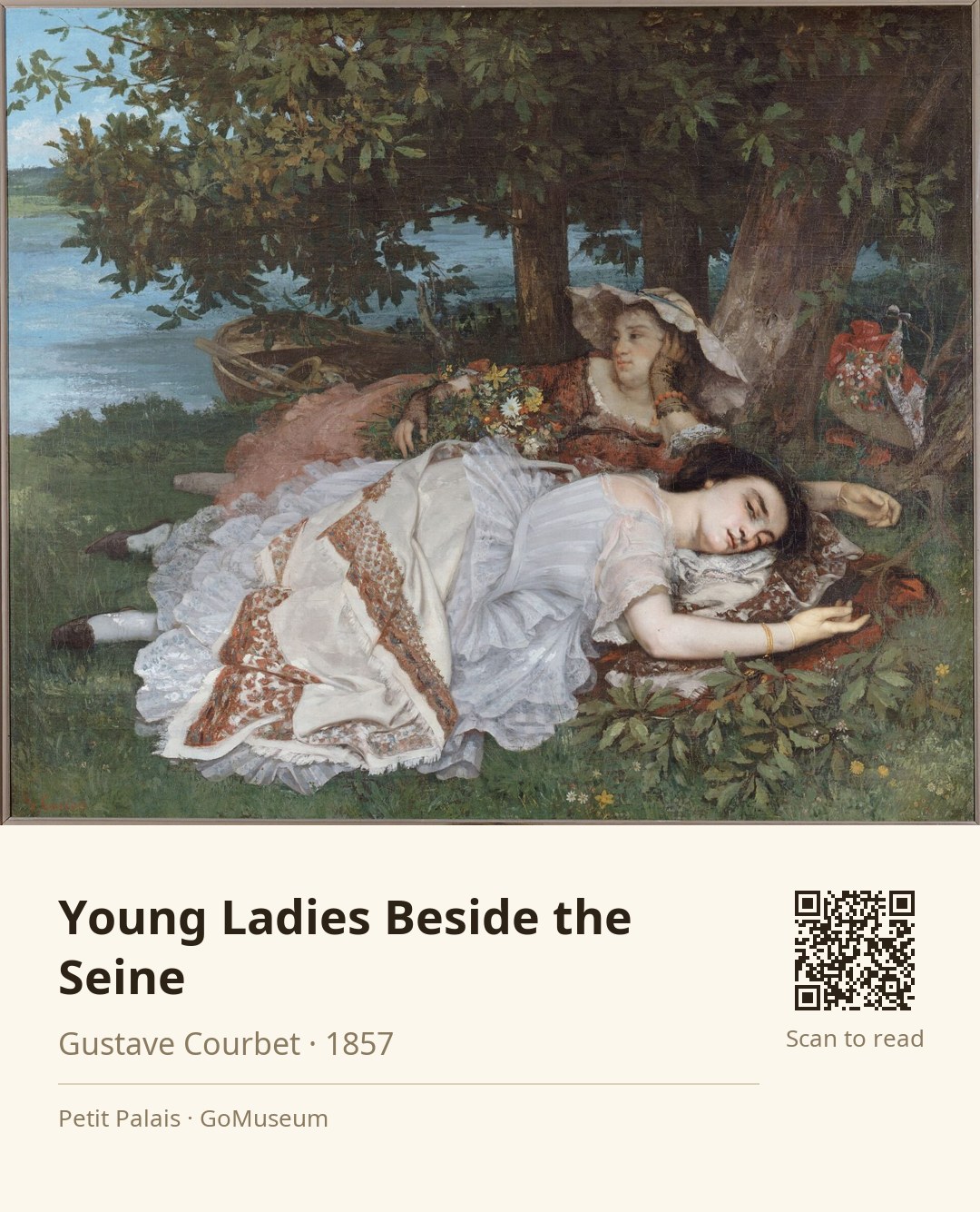
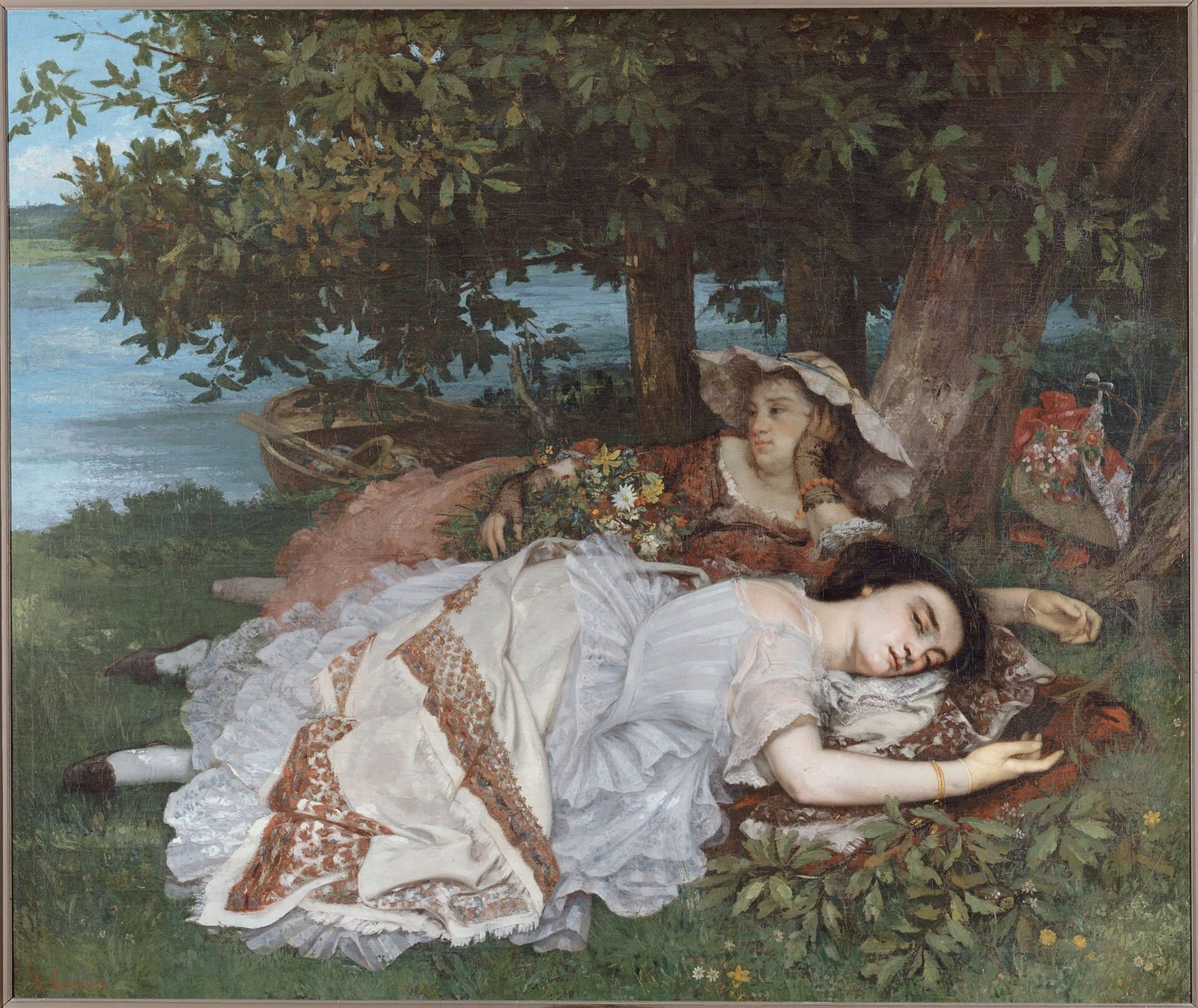
🎧 This work has audio narration — listen in the appA woman in a white dress lies peacefully on the grass, her head resting on her arm, while another woman in a pink dress gazes into the distance, holding a bouquet of wildflowers. The lush greenery surrounding them and the soft hues of the Seine create a serene summer scene that invites you into a moment of tranquility.
This depiction of two young ladies enjoying a leisurely day by the river captures a slice of urban life in 19th-century France. The contrast between the relaxed poses of the women and the vibrant natural setting emphasizes a sense of freedom and femininity, reflecting the changing social dynamics of the time. Courbet's choice of subject matter was bold for its era, as it moved away from traditional historical or mythological themes to focus on the everyday lives of women, which was a significant departure in the art world.
Created between late 1856 and early 1857, "Young Ladies Beside the Seine" was exhibited at the Paris Salon on June 15, 1857, where it sparked controversy for its modern subject and frank portrayal of women. The painting was later acquired by Courbet's friend Étienne Baudry and eventually passed to the French state in 1906.
Gustave Courbet, born on June 10, 1819, in Ornans, France, was a pioneering painter who championed the Realism movement in 19th-century art. Rejecting the conventions of academic painting and the idealism of Romanticism, he focused on depicting the world as he observed it, often portraying unidealized peasants and workers in monumental compositions. His early works gained recognition, notably "After Dinner at Ornans," which won him a gold medal at the Salon of 1849, allowing him to exhibit without jury approval.
Courbet's commitment to realism was revolutionary; he believed that art should stem from personal experience rather than historical or mythological themes. His bold approach often sparked controversy, challenging societal norms and addressing social issues, which resonated with later movements like Impressionism and Cubism. Despite facing criticism and imprisonment for his political involvement during the Paris Commune, Courbet continued to create until his death on December 31, 1877, in Switzerland.
His legacy endures as a transformative figure in art history, whose unflinching depictions of everyday life laid the groundwork for modern artistic expression. Today, Courbet is celebrated for his vigorous and uncompromising work, which continues to engage audiences with its raw honesty and depth.
Gustave Courbet's 'Young Ladies Beside the Seine' was created between late 1856 and early 1857, a time when the artist was challenging the norms of the art world. This painting was presented to the Paris Salon jury, which accepted it for exhibition on June 15, 1857, alongside five other works by Courbet. The reception was anything but quiet; it sparked a scandal due to its modern subject matter and the candid portrayal of women, which was a stark departure from the historical and mythological themes favored by the academy. After the Salon, the painting was purchased by Courbet's friend and patron, Étienne Baudry. Following Baudry's death, it was bequeathed to Courbet's sister, Juliette, who ultimately donated it to the French state in 1906. Today, it resides in the Petit Palais in Paris, a testament to its enduring significance in the art world.
The brushwork is both detailed and expressive, capturing the textures of the women's dresses and the lush greenery around them. The use of oil paint allows for rich, vibrant colors that breathe life into the scene. The composition is strikingly modern for its time, with the large scale of the canvas emphasizing the intimacy of the moment. The positioning of the women—one reclining peacefully while the other gazes into the distance—creates a narrative tension, inviting viewers to ponder their thoughts. The careful handling of light and color enhances the serene atmosphere, making the viewer feel as if they could step into this tranquil summer day by the Seine.
The painting is said to echo Courbet's earlier work, 'Young Ladies of the Village,' created in 1851.
Yes, there is a smaller sketch version of the painting, measuring 96.5 by 130 cm, held in the National Gallery in London.
There are various small preparatory canvases depicting portraits of both women from the final canvas, located in museums such as the National Gallery in Prague and the National Gallery of Australia.