The Virgin With Angels
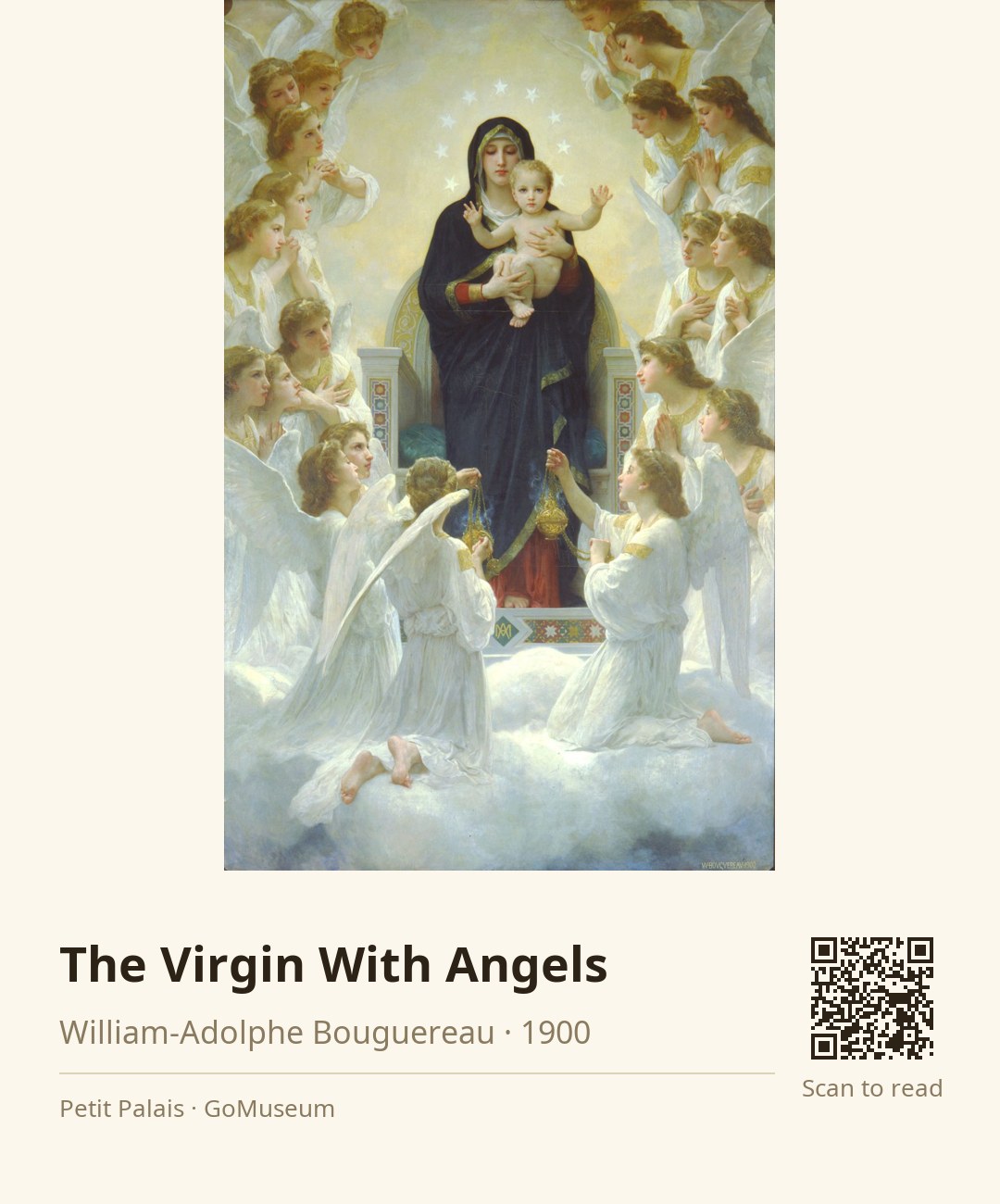
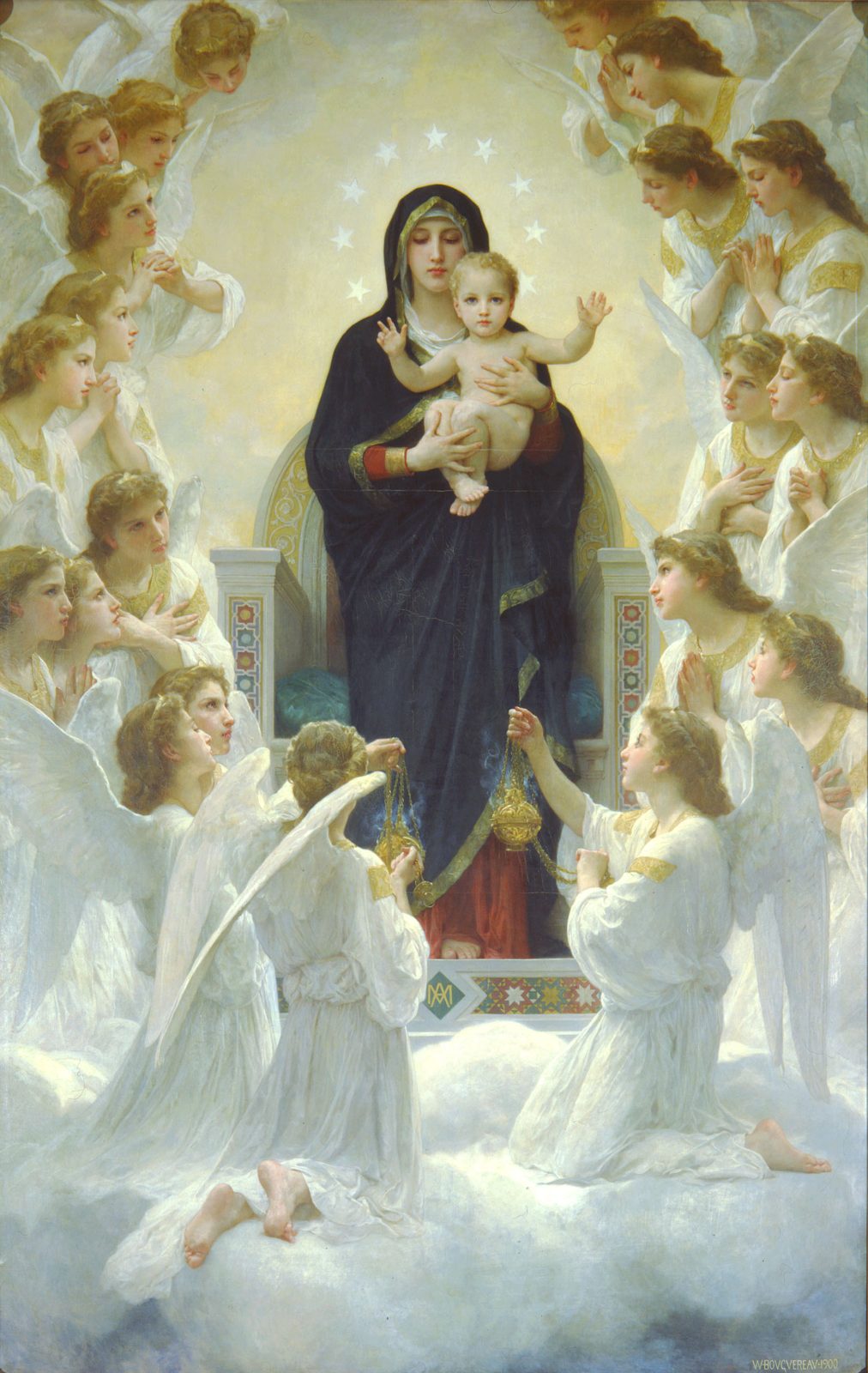
🎧 This work has audio narration — listen in the appA radiant Virgin Mary cradles the Christ Child at the center of Bouguereau's "The Virgin With Angels," surrounded by a host of adoring angels. The Virgin, draped in a dark robe, wears a halo of stars, while the child, lifting one hand in a gesture of blessing, is unclothed, emphasizing his purity and innocence. The angels, with delicate wings and flowing white garments, create a harmonious circle, some holding incense burners, enhancing the sacred atmosphere.
This composition reflects Bouguereau's mastery of academic art, where the ethereal quality of the scene is underscored by the soft palette of whites, golds, and blues. The intricate detailing on the angels' garments and wings draws the viewer's eye, creating a sense of balance and serenity. The setting, with clouds beneath the figures and a glowing background, evokes a heavenly realm, inviting contemplation of the divine.
Painted in 1900, this work exemplifies Bouguereau's continued dedication to religious themes, a hallmark of his career that resonated deeply with audiences of his time.
William-Adolphe Bouguereau was a prominent French academic painter born on November 30, 1825, in La Rochelle. He grew up in a family of merchants and developed a passion for art at a young age. Bouguereau studied at the École des Beaux-Arts and won the prestigious Prix de Rome in 1850, which allowed him to immerse himself in the classical art of Italy. His work, characterized by realistic depictions of mythological themes and the female form, gained immense popularity in France and the United States during his lifetime.
Despite his success, he faced criticism from the Impressionist movement, which deemed his style overly traditional. By the early 20th century, changing tastes led to a decline in his popularity, but a revival in the 1980s rekindled interest in his work. Bouguereau completed 822 known paintings, many of which remain lost. His legacy as a master of academic painting endures, particularly for his sensitive portrayals of women and children, marking him as a significant figure in art history. He passed away on August 19, 1905, leaving behind a complex legacy that continues to provoke discussion and admiration.
This work was part of his ongoing exploration of religious themes, which resonated deeply with the public of the late 19th century. Bouguereau, a celebrated figure in the academic art scene, showcased this painting at the prestigious Paris Salon, where it was met with acclaim, further solidifying his reputation. The painting is now housed at the Petit Palais in Paris, a fitting home for such a revered piece. Its provenance traces back to Charles Vincens-Bouguereau, hinting at a personal connection to the artist's legacy. Bouguereau's popularity in both France and the United States during his lifetime was immense, though his style would later face criticism from the rising Impressionist movement, which sought to break away from traditional academic norms.
In "The Virgin With Angels," Bouguereau employs a meticulous oil painting technique that highlights his mastery of realism. The brushwork is incredibly fine, allowing for intricate details in the angels' flowing garments and delicate wings. The use of a soft palette—dominated by whites, golds, and blues—creates an ethereal quality that enhances the divine atmosphere of the scene. Bouguereau's choice to depict the Virgin Mary in a dark robe against a luminous background draws the viewer's eye directly to her and the Christ Child, emphasizing their centrality in the composition. The symmetrical arrangement of the angels around them not only adds balance but also conveys a sense of harmony and reverence.
A curious tidbit about Bouguereau's career is that despite his immense popularity during his lifetime, he faced significant backlash from the avant-garde artists of his day. The Impressionists, in particular, derided his meticulous style and adherence to traditional techniques. Yet, in a twist of fate, it was the very artists who dismissed him that would later inspire a resurgence of interest in his work, as collectors and art enthusiasts began to appreciate the craftsmanship and emotional depth of his paintings once again.
Bouguereau enjoyed significant popularity in both France and the United States, with American collectors particularly drawn to his work.
After Bouguereau's death, the locations of many of his 822 known paintings became unknown.