a whisper of love
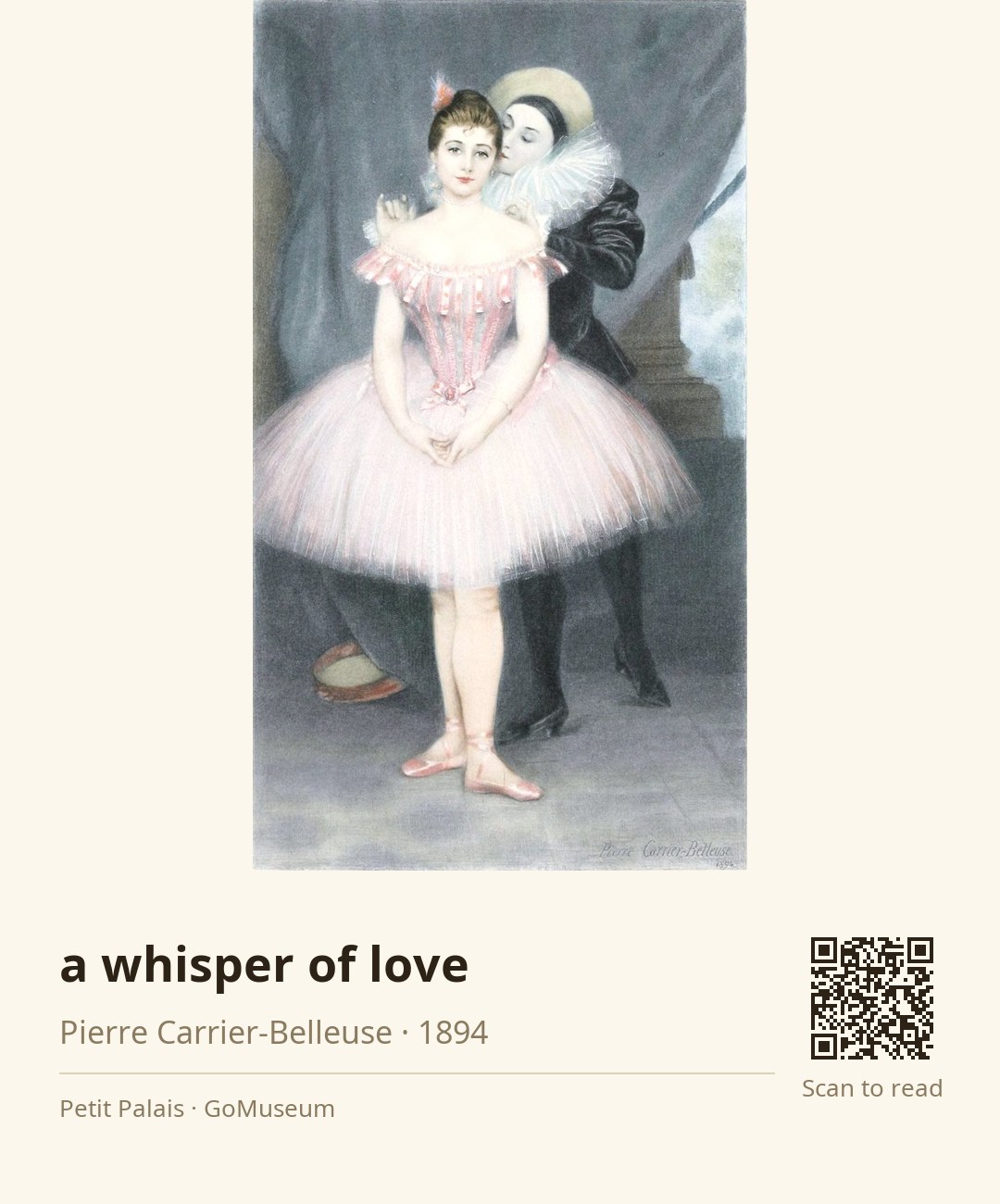
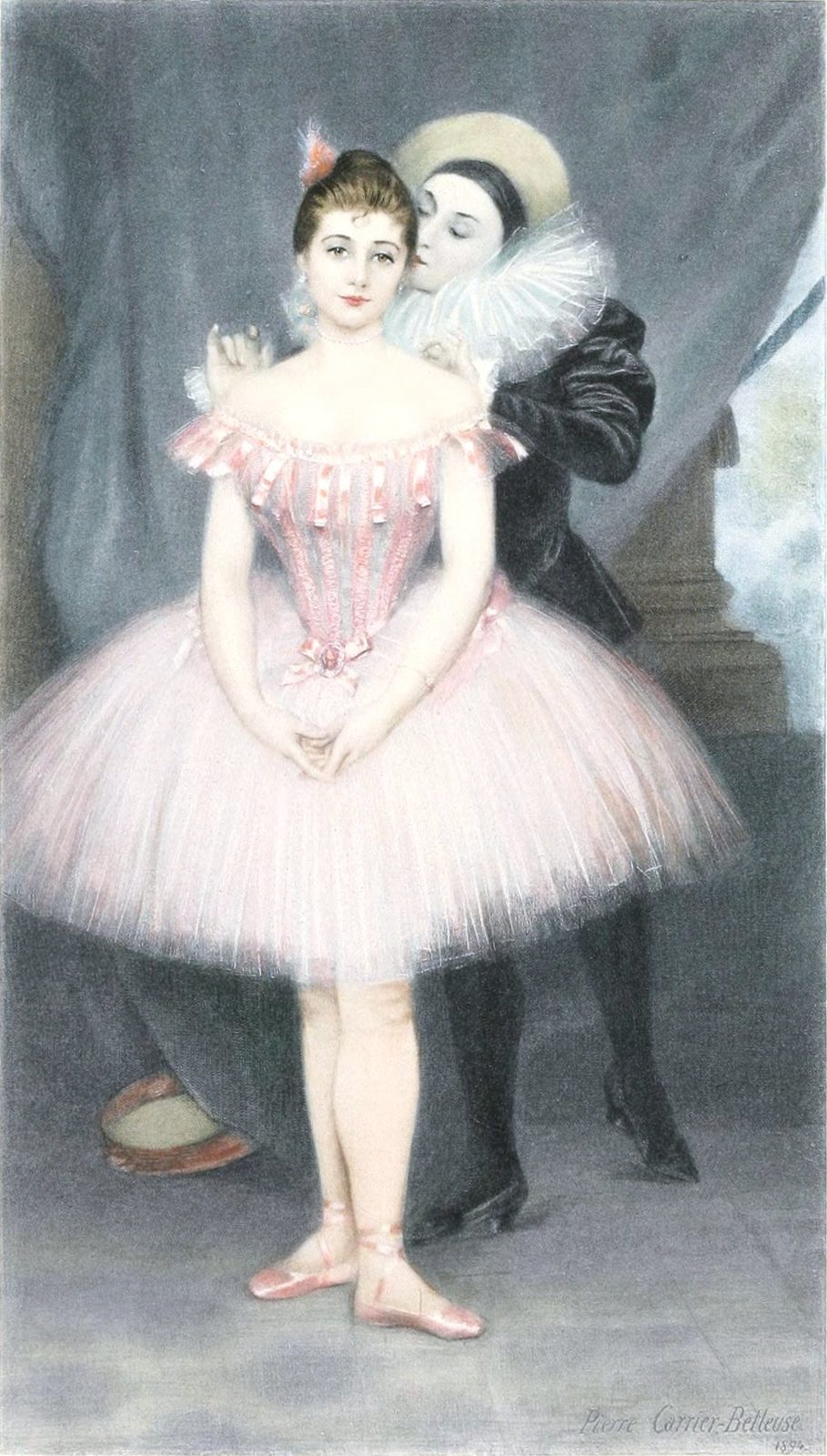
🎧 This work has audio narration — listen in the appThe ballerina in a pink tutu stands poised in the foreground, her hands clasped delicately as she gazes directly at you, inviting an intimate connection. The soft ruffles of her costume and the feathered headpiece add a touch of elegance, while the figure behind her, dressed as a mime in a black outfit with a white ruffled collar, is seen adjusting her attire, hinting at the behind-the-scenes world of performance.
This interaction between the two figures captures a moment of vulnerability and support, reflecting the often unseen dynamics of artistic collaboration. The muted gray background, with its draped fabric and architectural hints, creates a serene atmosphere that allows the viewer to focus on the emotional exchange taking place. Carrier-Belleuse, known for his ballet scenes, often infused his works with a sense of intimacy, revealing the personal stories of dancers beyond the stage.
In 1894, he created "A Whisper of Love," a pastel work that showcases his mastery in capturing the delicate beauty of ballet and the relationships that flourish within it.
Pierre-Gérard Carrier-Belleuse was a French painter born on January 28, 1851, in Paris. He was the son of sculptor Albert-Ernest Carrier-Belleuse and received his early education in art from his father before studying at the École des Beaux-Arts under Alexandre Cabanel. His career began with a notable exhibition at the Salon of 1875, and he gained recognition for his pastel works, particularly ballet scenes and portraits of dancers, which often appeared in Le Figaro Illustré.
Carrier-Belleuse's artistic journey was marked by significant achievements, including a silver medal at the 1889 Exposition Universelle. He played a pivotal role in creating the Panthéon de la Guerre, a monumental panorama depicting nearly 5,000 wartime figures, showcasing his commitment to capturing the essence of his time. His works are primarily held in private collections, reflecting a legacy that emphasizes the beauty of movement and emotion.
Carrier-Belleuse's influence extended beyond painting, as he taught at the Académie Julian and contributed to the artistic community in France. He passed away on January 29, 1932, leaving behind a rich body of work that continues to resonate in the art world, particularly in the realms of ballet and portraiture.
In 1894, Pierre Carrier-Belleuse created 'A Whisper of Love,' a pastel work that quickly became emblematic of his dedication to capturing the delicate beauty of ballet. This piece was likely inspired by his close ties to the Parisian ballet scene, where he often painted dancers from the Opéra. The work was exhibited at the Salon, a prestigious venue for artists, where it garnered attention for its intimate portrayal of the relationship between performers. Carrier-Belleuse's reputation was already on the rise, having won a silver medal at the 1889 Exposition Universelle.
Carrier-Belleuse's technique in 'A Whisper of Love' is strikingly intimate, achieved through the use of soft pastels that lend a delicate quality to the ballerina's pink tutu and the muted gray background. The artist's choice of pastel as a medium allows for a smooth blending of colors, creating an ethereal atmosphere that enhances the emotional weight of the scene. The brushwork is subtle, with gentle strokes that define the ruffles of the tutu and the mime's attire, while the figures are rendered with a sense of immediacy and warmth. The composition draws you in, with the ballerina's direct gaze establishing a connection that feels personal. The positioning of the mime behind her adds depth, suggesting a narrative of support and collaboration, which is central to the world of performance.
Carrier-Belleuse collaborated on the Panthéon de la Guerre, the largest painting in the world at the time, featuring nearly 5,000 portraits of wartime figures.
Yes, Pierre Carrier-Belleuse was the brother of Louis-Robert Carrier-Belleuse, who was also a painter.