Lyricism in the Forest
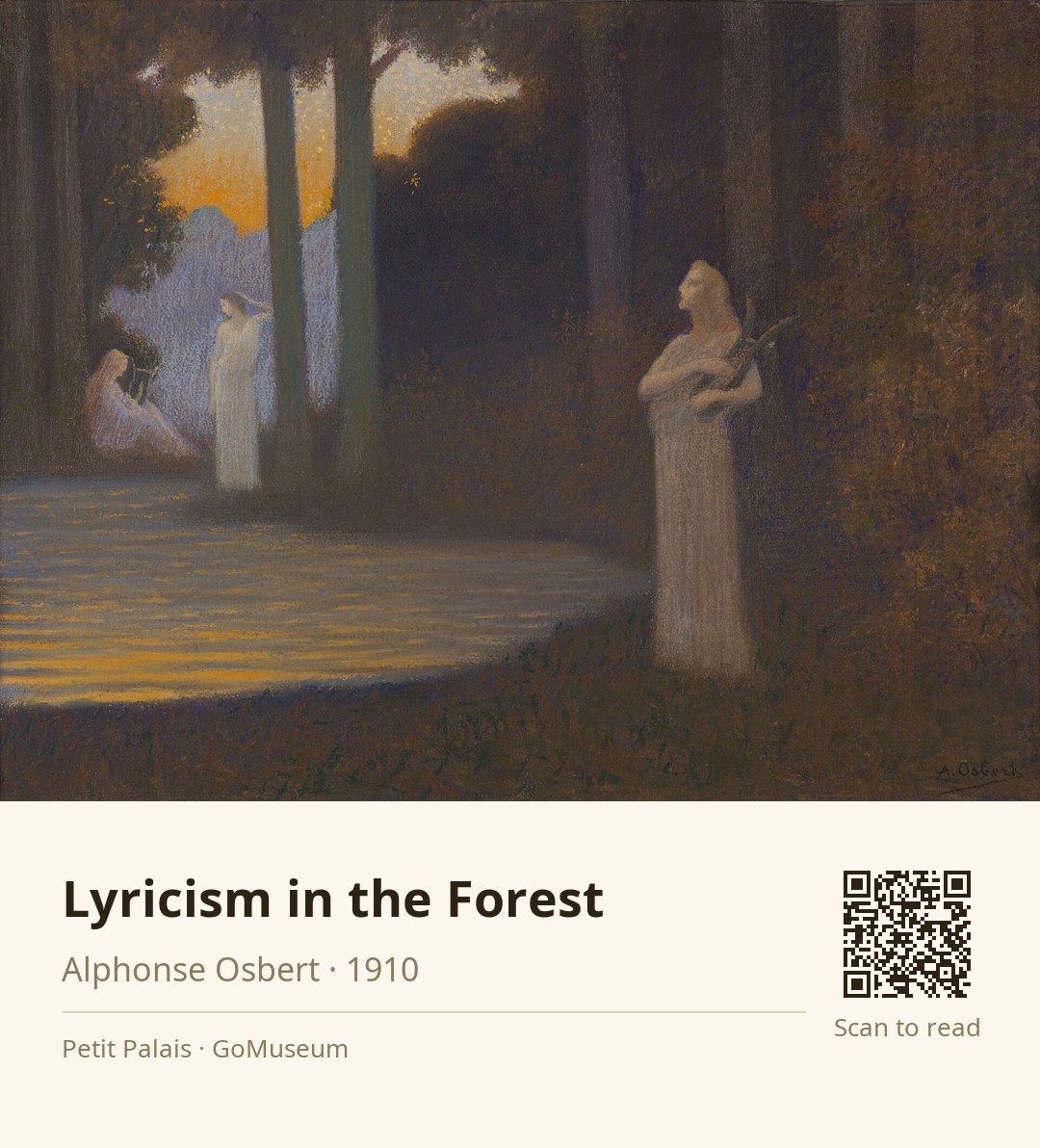
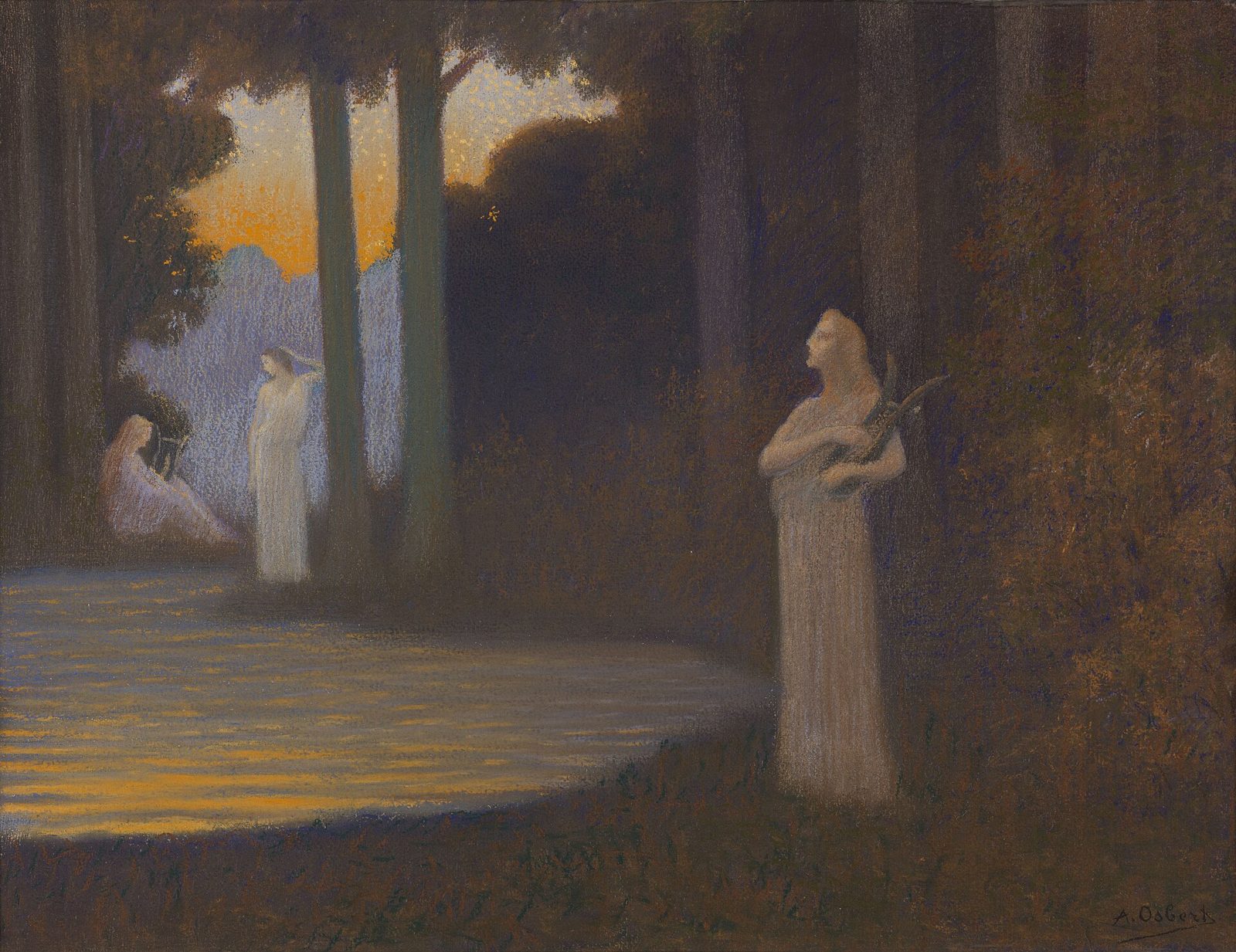
🎧 This work has audio narration — listen in the appA figure in a flowing white gown stands gracefully in the foreground of "Lyricism in the Forest," cradling a stringed instrument, while two others play a lyre nearby, all enveloped in a soft, ethereal light. The tall trees surrounding them rise majestically, their silhouettes contrasting with a sky that transitions from warm orange to deep blue, capturing the fleeting beauty of dusk.
This enchanting scene invites you into a dreamlike world where music and nature intertwine, reflecting Osbert's fascination with the mystical and the poetic. The muted earth tones, punctuated by highlights of orange and blue, create an atmosphere that feels both serene and otherworldly, embodying the Symbolist movement's emphasis on emotion and imagination over realism. Osbert's technique, influenced by Post-Impressionism, allows for a soft diffusion of light that enhances the lyrical quality of the composition, guiding your eye from the foreground to the illuminated figures in the middle distance.
Alphonse Osbert, a prominent French Symbolist painter, created this work in 1910, showcasing his signature style that often features ghostly Muses in mysterious landscapes. His artistic journey was marked by a shift from naturalism to a more poetic visual language, which he developed after studying at the École des Beaux-Arts and engaging with influential contemporaries.
Alphonse Osbert, born on March 23, 1857, in Paris, was a notable French Symbolist painter whose career spanned the late 19th and early 20th centuries. Educated at the École des Beaux-Arts, he initially embraced naturalism, influenced by Spanish masters and his academic mentors. However, by the late 1880s, Osbert's style evolved under the sway of Post-Impressionism and Symbolism, leading him to adopt a Pointillist technique reminiscent of Seurat and Signac.
Osbert's work is characterized by ethereal Muses set against mysterious landscapes, often illuminated by a haunting blue light. His artistic vision was shaped by his associations with figures like Joséphin Péladan and Pierre Puvis de Chavannes, marking him as a significant contributor to the Symbolist movement. Throughout his career, he received numerous commissions, including murals for the Centre Thermal des Dômes in Vichy and the Church of Saint-Louis.
Despite a relatively static style after 1900, Osbert's reputation flourished, earning him recognition and accolades, including the title of Chevalier of the Légion d'honneur in 1934. He passed away on August 11, 1939, in his Paris studio, leaving behind a legacy preserved in institutions like the Musée d'Orsay, which houses a substantial collection of his works. His contributions to Symbolism solidified his place in art history as a master of poetic visual language.
Created in 1910, 'Lyricism in the Forest' emerged during a vibrant period for Alphonse Osbert, a key figure in the French Symbolist movement. This pastel work was exhibited at the Société nationale des beaux-arts, where it garnered attention for its ethereal quality and emotional depth. The painting reflects Osbert's artistic evolution, moving away from naturalism towards a more poetic expression, influenced by his studies at the École des Beaux-Arts and interactions with contemporaries like Pierre Puvis de Chavannes.
The soft, diffuse brushwork creates a dreamlike atmosphere, allowing colors to blend seamlessly. The muted earth tones, punctuated by vibrant highlights of orange and blue, evoke the transition from day to night, enhancing the mystical quality of the scene. The composition is carefully orchestrated, guiding the viewer's eye from the foreground figure to the illuminated musicians, framed by the towering trees. This layering not only adds depth but also invites contemplation, as if the viewer is stepping into a serene, otherworldly realm. The choice of pastel as a medium allows for a delicate interplay of light and texture, capturing the fleeting beauty of dusk in a way that feels both intimate and expansive.
Later in his career, Osbert created commissioned murals for notable locations such as the Centre Thermal des Dômes in Vichy and the Church Of Saint-Louis in Vichy.
Osbert was associated with Joséphin Péladan and the Kabbalistic Order of the Rose-Cross during the 1890s, which influenced his Symbolist style.