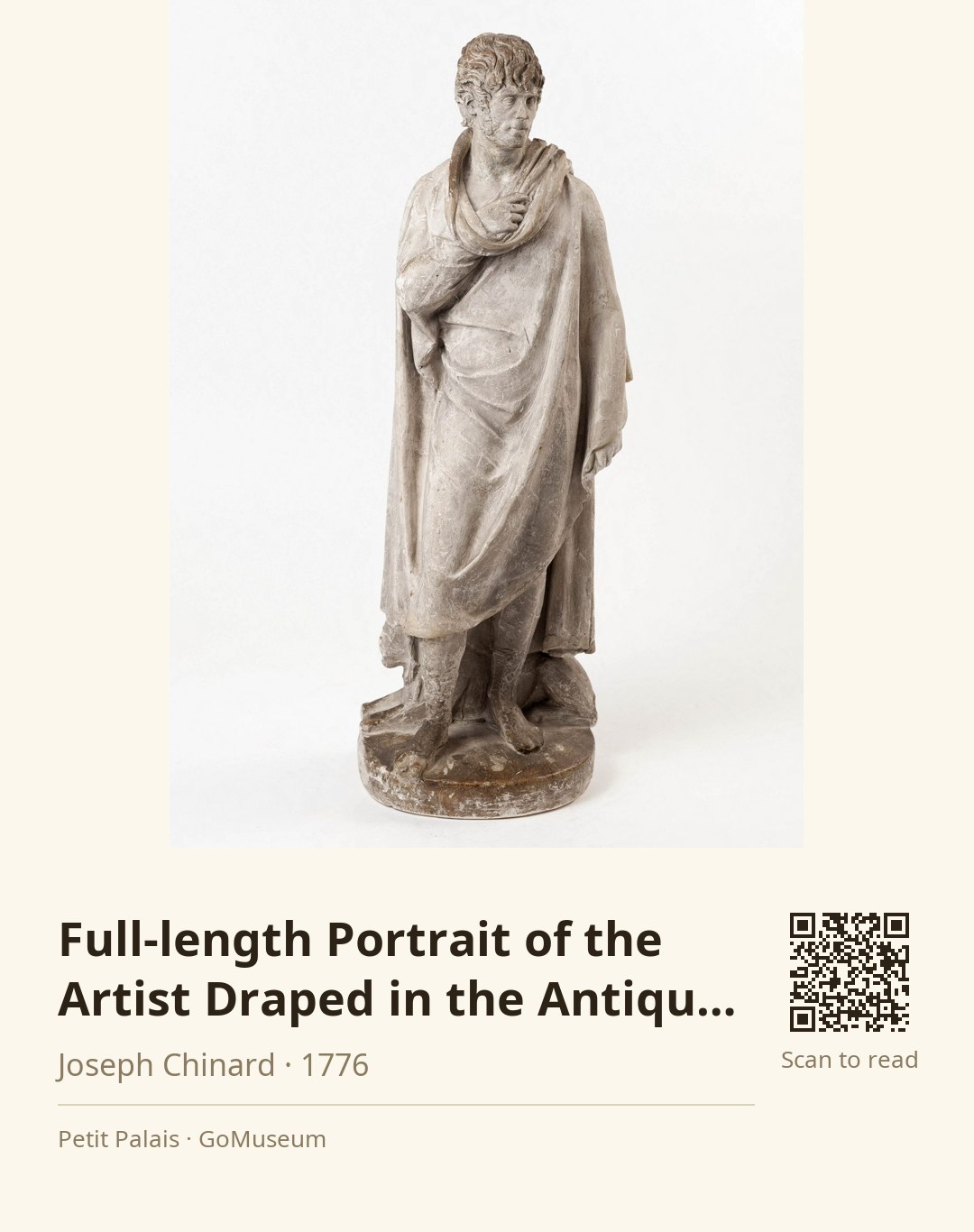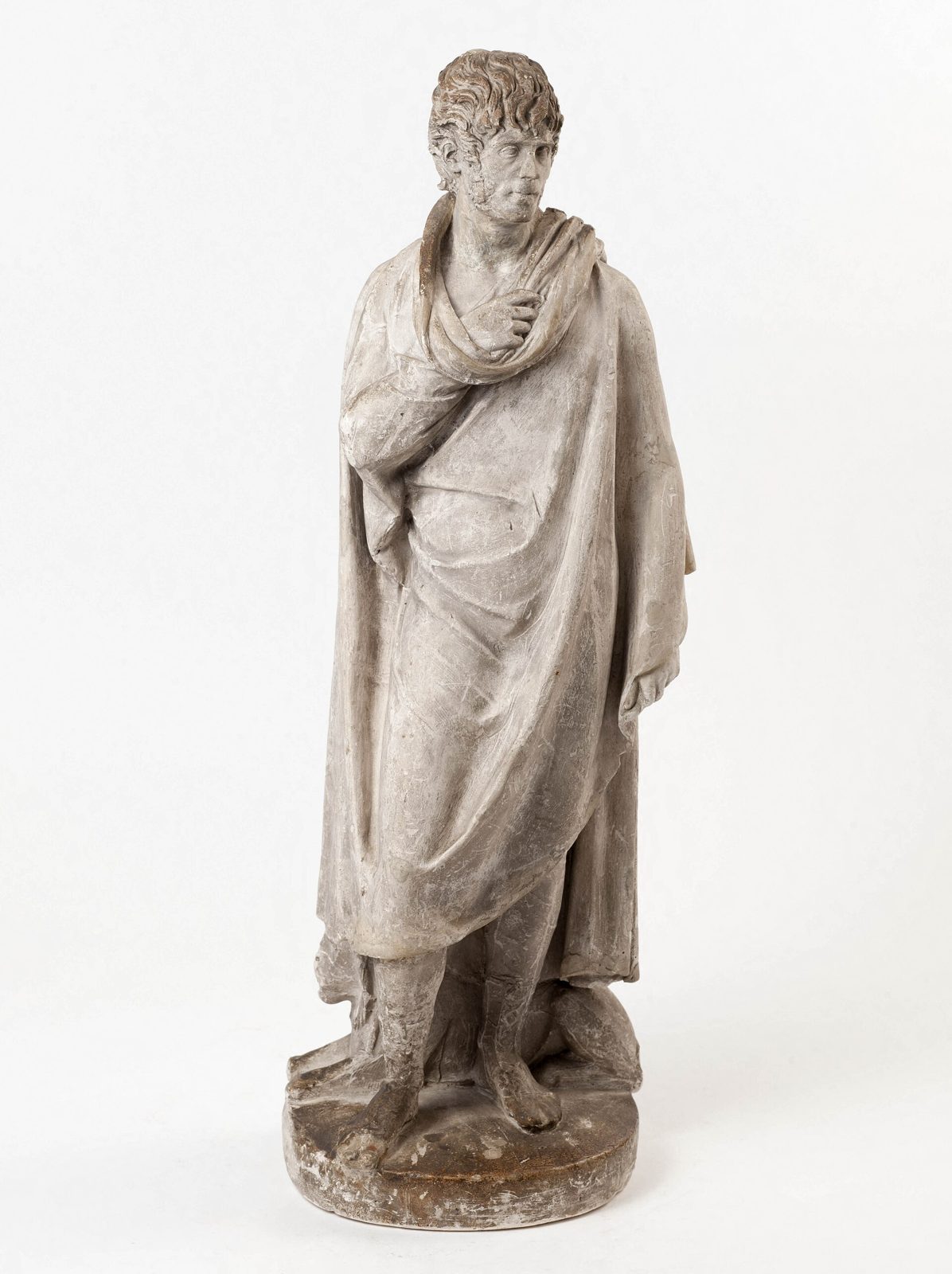
Full-length Portrait of the Artist Draped in the Antique Style
🎧 This work has audio narration — listen in the appThe flowing garment draped over the figure in Joseph Chinard's sculpture evokes the grandeur of ancient Rome, while the artist's own hand rests gently on the fabric, suggesting a moment of contemplation. Curly hair frames the face, adding a touch of realism to this Neoclassical work, where the figure stands barefoot on a circular base, embodying both elegance and strength.
Chinard's choice to depict himself in this manner reflects a deep connection to the ideals of antiquity, emphasizing not just the physical form but also the philosophical underpinnings of art during the 18th century. The textured surface of the sculpture, with its signs of wear, speaks to the passage of time and the enduring nature of artistic expression. This piece, created in 1776, was a period when Chinard was honing his craft, influenced by his studies in Rome, where he sought to blend naturalism with the classical forms he admired.
Born in Lyon in 1756, Chinard's journey as a sculptor was marked by significant achievements, including a prestigious award from the Accademia di San Luca in Rome. His works, often infused with sentiment and realism, reflect the cultural shifts of his time, and he remains a notable figure in the Neoclassical movement.
Joseph Chinard was a French sculptor born in Lyon on February 12, 1756, and he passed away in the same city on June 20, 1813. Trained initially as a painter, he shifted his focus to sculpture, developing a Neoclassical style marked by naturalism and emotional depth. His early career flourished in Lyon, where he garnered attention for his work, leading to a significant patronage that enabled him to study in Rome from 1784 to 1787. There, he won a prestigious award from the Accademia di San Luca for his terracotta piece, "Perseus and Andromeda."
Chinard's life was deeply intertwined with the tumultuous events of the French Revolution. His revolutionary ideals sometimes put him at odds with authorities, resulting in his imprisonment in Castel Sant'Angelo for two months in 1792. Despite these challenges, he continued to create, producing notable works such as the marble bust of Madame de Verninac and the bust of Mme Récamier, which remains in the J. Paul Getty Museum.
Though much of his public work was lost during the Revolution, Chinard's intimate family allegories and realistic sculptures captured the essence of human emotion. His legacy was revived in the early 20th century, with a retrospective at the Musée des Arts Décoratifs in Paris. Today, his works are housed in esteemed collections, including the Louvre and the Metropolitan Museum of Art, securing his place in the annals of art history as a significant figure in the evolution of Neoclassical sculpture.
The flowing garment draped over the figure showcases the artist's skill in carving intricate folds and textures, creating a sense of movement that seems to breathe life into the stone. You can see how the surface has been meticulously polished in some areas, while other parts retain a rougher texture, hinting at the artist's hand and the labor involved. This contrast not only highlights the drapery but also emphasizes the figure's form, making it feel both monumental and intimate.
One intriguing tidbit about Chinard is that during his second trip to Italy in 1791, he was arrested by the Pope's authorities due to his revolutionary ideas and artistic expressions. This incident sparked significant political interest, leading to a letter from prominent figures in France advocating for his release. His wife played a crucial role in rallying support, showcasing the personal stakes involved in his artistic and political life.
During his second trip to Italy in 1791, Chinard was arrested by the Pope's authorities because of his revolutionary ideas and artistic expressions.
Chinard's wife played a crucial role in rallying support for his release, demonstrating the personal stakes in his artistic and political life.