 Image: François de Dijon · bynyalcin · François de Dijon · François de Dijon · Sukkoria
La Femme au singe
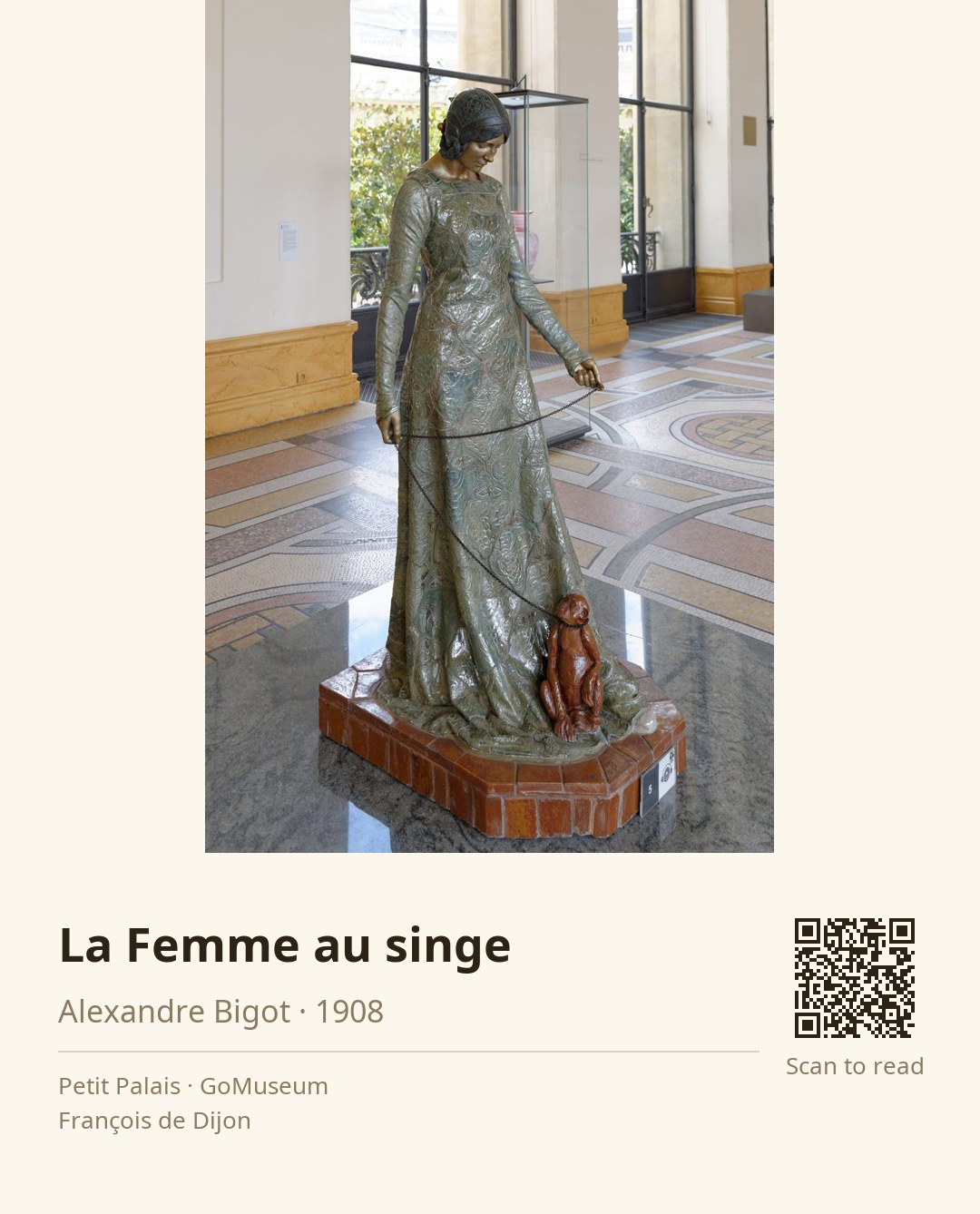
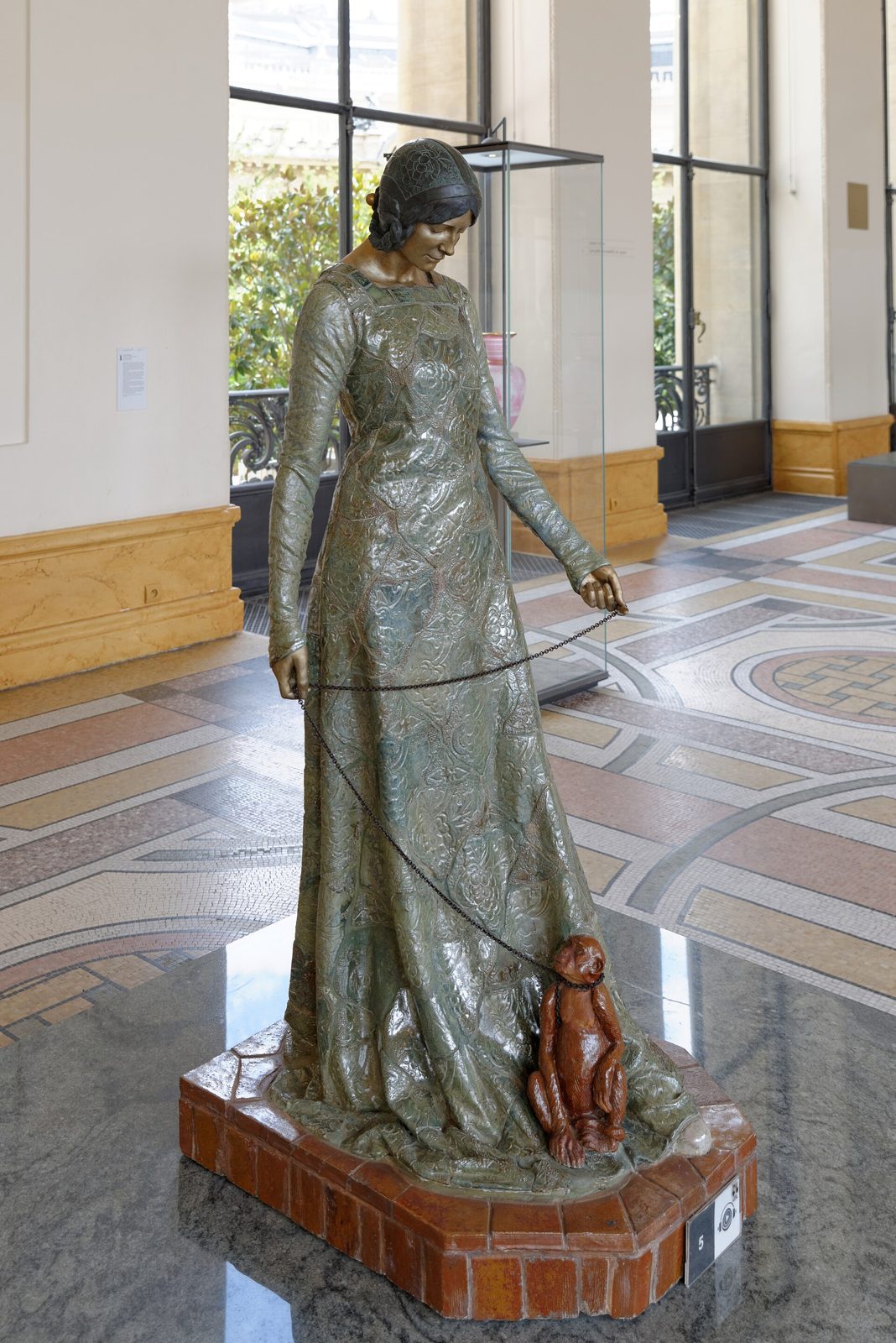
🎧 This work has audio narration — listen in the appThe woman in "La Femme au singe" stands poised, her long gown adorned with intricate floral patterns flowing elegantly around her. Each hand holds a delicate chain, leading down to a small monkey at her feet, gazing up at her with an inquisitive expression. The interplay of the woman's graceful posture and the monkey's curious demeanor creates a captivating dialogue between the two figures.
This sculpture, created by Camille Alaphilippe in 1908, embodies a moment of connection and companionship, suggesting a bond that transcends species. The detailed craftsmanship of the gown, with its textured surface and vibrant motifs, reflects the artistic trends of the early 20th century, where fashion and nature often intertwined in artistic expression. The polished appearance of the materials enhances the sculpture's elegance, inviting viewers to appreciate the meticulous attention to detail.
The setting, with its reddish-brown tiled base and patterned floor, suggests an indoor gallery, emphasizing the work's intended display in a refined environment. In 1908, Alaphilippe contributed to the rich tapestry of early modern sculpture, capturing a fleeting moment of beauty and connection.
Alexandre Bigot, born on November 5, 1862, in Mer, France, was a pioneering ceramicist known for his contributions to architectural ceramics during the Art Nouveau movement. Initially trained in physics and chemistry, he became captivated by ceramics after encountering Chinese porcelain at the 1889 Exposition Universelle in Paris. This sparked a career that combined his scientific knowledge with artistic creativity, allowing him to develop a wide range of vibrant glazes.
In 1897, Bigot founded his company, A. Bigot et Cie, which became a leading force in architectural ceramics. His work was characterized by intricate designs and innovative techniques, often collaborating with prominent architects like Hector Guimard and Jules Lavirotte. Bigot's ceramics adorned notable buildings, including Guimard's Castel Beranger, which epitomized the Art Nouveau style.
Despite his success, Bigot's firm closed in 1914 as the popularity of Art Nouveau waned. His legacy, however, remains significant in art history, marking a transition in the use of ceramics in architecture and influencing future generations of artists and designers. Bigot passed away on April 27, 1927, leaving behind a rich heritage of artistic innovation.
The gown's intricate floral patterns are not just painted but sculpted, giving a tactile quality that invites touch. The polished surfaces reflect light beautifully, while the textured elements of the gown and the monkey add depth and character. Each material contributes to the overall elegance, creating a harmonious balance between the smooth and the rough, the shiny and the matte.
The gown's floral patterns are sculpted rather than merely painted, providing a tactile quality that encourages viewers to engage with it physically.
The combination of polished surfaces that reflect light and textured elements in both the gown and the monkey enhances the sculpture's visual depth and character.