Massacre of the Innocents
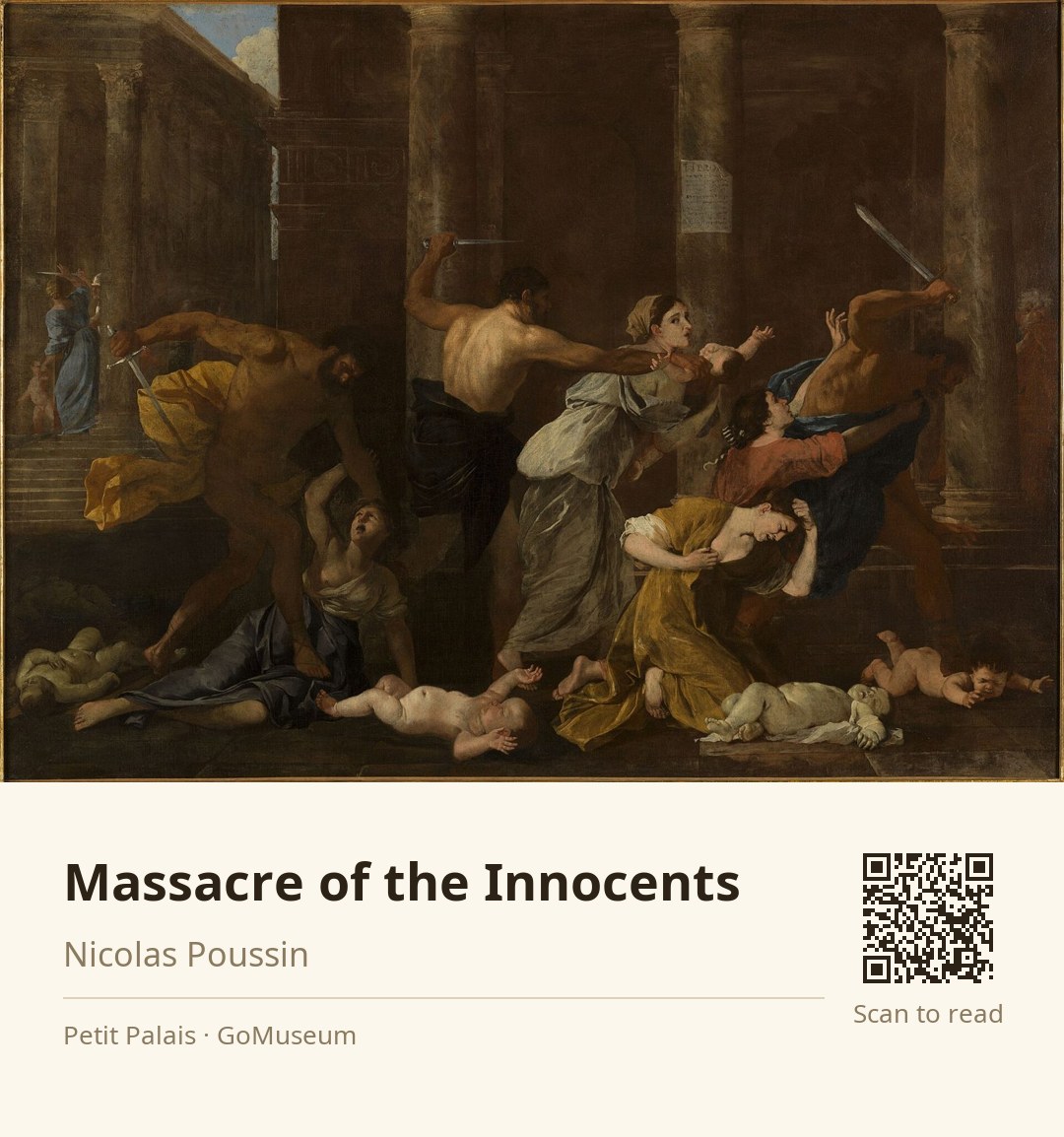
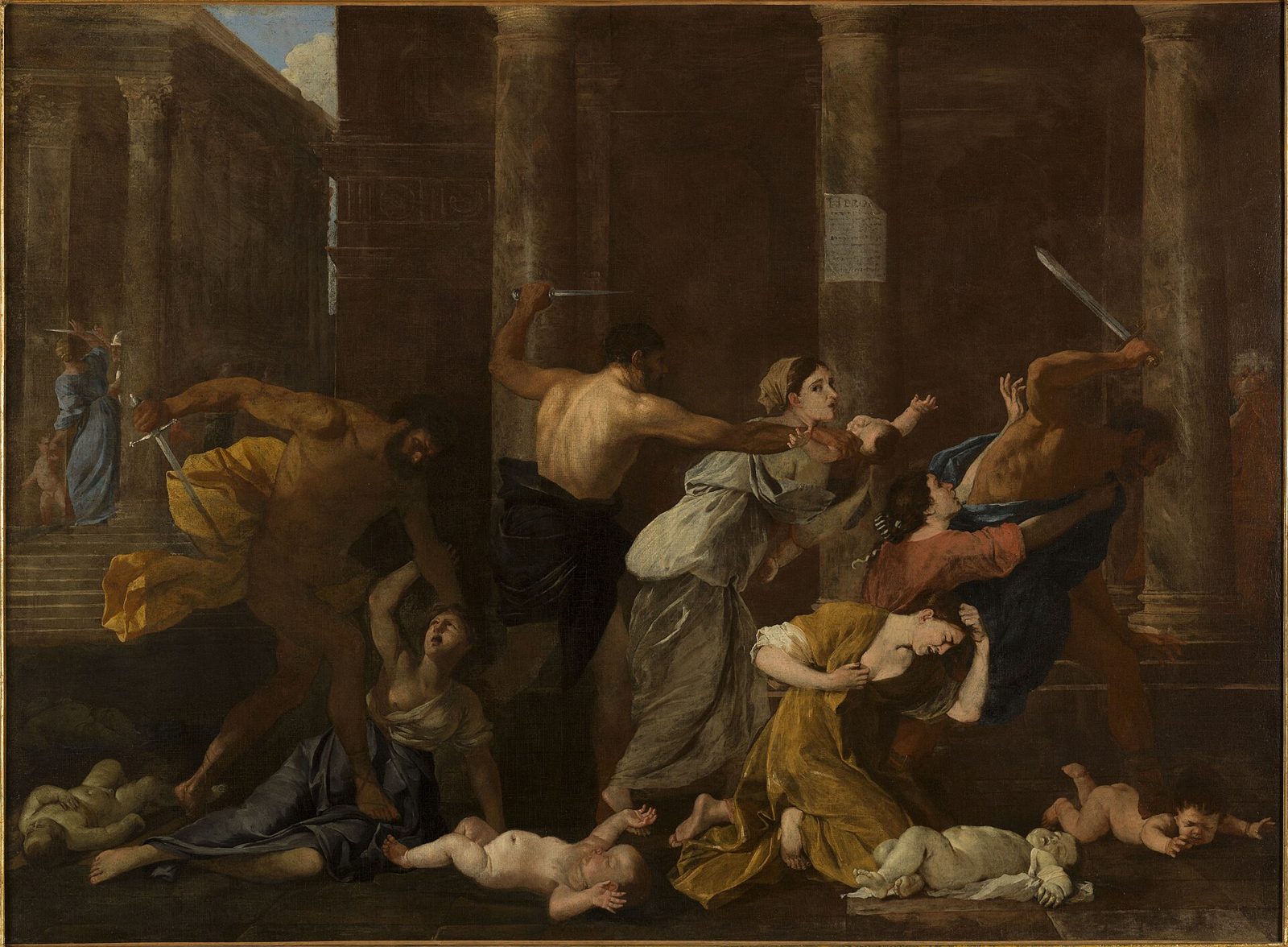
🎧 This work has audio narration — listen in the appA muscular man in a yellow garment lunges toward a woman on the ground, her desperate outstretched hand a stark contrast to the lifeless child nearby. To the right, another man brandishes a sword, while a woman clutches a child protectively, her anguish palpable.
The intensity of this moment is heightened by Poussin's use of a dark, muted palette, which envelops the figures in deep shadows, emphasizing their despair and the tragic nature of the event. The large stone columns and distant figures in the background create a sense of grandeur, contrasting sharply with the brutality unfolding in the foreground. Poussin’s meticulous attention to detail, from the expressions of anguish to the flowing drapery, reflects his classical training and desire to convey both emotion and narrative clarity.
Nicolas Poussin, a pivotal figure in 17th-century French Baroque painting, created this work during the second quarter of the century, drawing on themes of religious significance and moral gravity that would resonate throughout his career. His commitment to classical ideals and storytelling in art has left a lasting legacy, influencing generations of artists who followed.
Nicolas Poussin, born in June 1594 near Les Andelys, was a pivotal figure in the classical French Baroque movement, spending most of his career in Rome. His early life was marked by a passion for art that led him to Paris at eighteen, despite his parents' opposition. In Paris, he struggled initially, but his exposure to royal collections ignited his admiration for Italian masters, particularly Raphael. This influence shaped his distinctive style, characterized by clarity, order, and a preference for line over color.
Poussin's artistic journey took him to Rome in 1624, where he developed a reputation for his religious and mythological works, often commissioned by a select group of collectors. His notable pieces include "The Death of Germanicus" and "The Massacre of the Innocents." Although he briefly returned to France as First Painter to Louis XIII, he found the court's demands stifling and returned to Rome, where he continued to evolve, integrating landscapes into his compositions.
His legacy is profound; Poussin's emphasis on classical themes and structure influenced generations of artists, including Jacques-Louis David and Paul Cézanne. He remains a cornerstone of classical painting, with around 260 attributed works and nearly 400 drawings, solidifying his place in art history until his death in 1665.
Poussin's technique in 'Massacre of the Innocents' showcases his mastery of oil paint on canvas, allowing for rich textures and a nuanced color palette. The brushwork is deliberate, with each stroke contributing to the emotional weight of the scene. The figures are rendered with a clarity that draws on his classical training, where anatomy and drapery are meticulously detailed. The dark, muted colors create a somber atmosphere, enhancing the horror of the depicted event. Poussin's composition is dynamic, with diagonal lines guiding the viewer's eye through the chaos, while the large stone columns in the background lend a sense of grandeur that contrasts with the tragedy unfolding in the foreground. This juxtaposition amplifies the emotional impact, making the viewer feel the weight of despair and violence. The careful arrangement of figures, their expressions, and the dramatic poses all work together to create a narrative that is both compelling and haunting.
Quentin Varin, a painter working in Andelys, noticed Poussin's early sketches and encouraged his artistic pursuits.
Poussin found the workload and court intrigues as First Painter to the King overwhelming, leading him to return to Rome after just over a year.