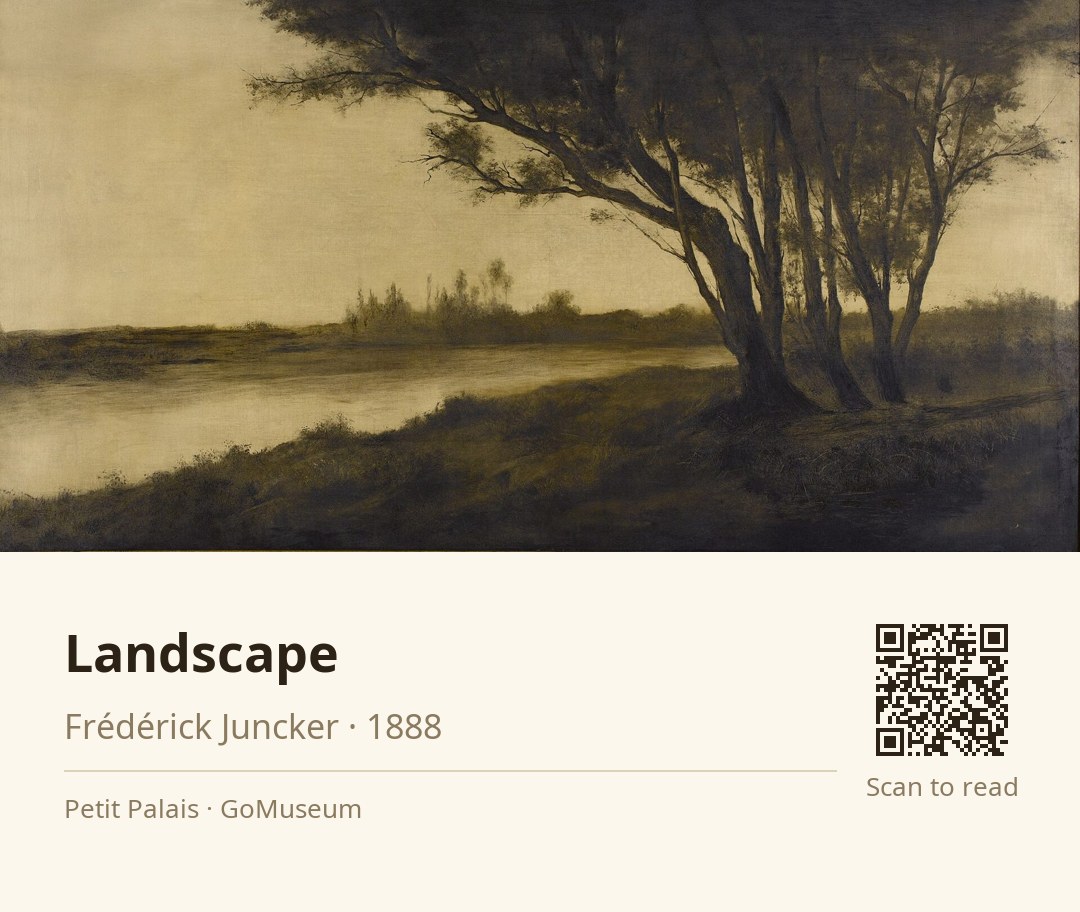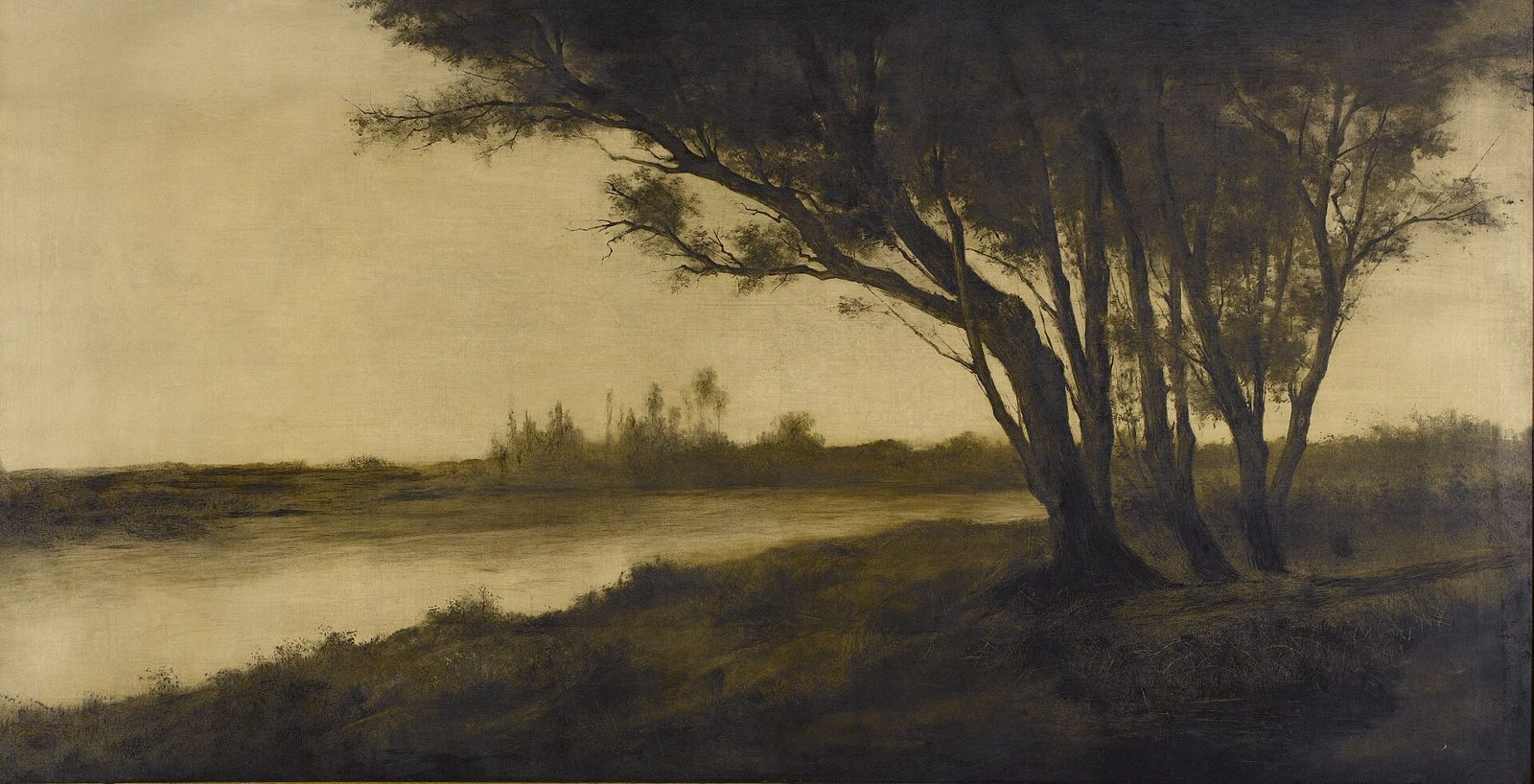
The river flowing through this serene landscape invites you into a tranquil world, where nature unfolds in muted tones. Tall trees with slender trunks rise on the right, their sparse foliage reaching for the sky, while dark, textured grass fills the foreground, grounding the scene in earthy detail.
This interplay of elements creates a contemplative atmosphere, drawing you into a moment of stillness. The muted browns and grays dominate the palette, evoking a somber yet peaceful mood that reflects Juncker's mastery of oil paint on canvas. The delicate brushwork captures the fine details of the trees and the subtle gradations in the sky, enhancing the depth and inviting a sense of introspection.
Frédérick Juncker, a French painter and poet, created this work in 1888, contributing to the 19th-century landscape tradition that sought to capture the essence of nature.
Frédérick Juncker, born on December 3, 1822, in Paris, was a notable French painter and poet whose artistic journey spanned over five decades. A student of Léon Cogniet, he began exhibiting his works at the Salon in 1848, continuing until 1903, showcasing his dedication to the craft. Juncker's life was marked by a deep commitment to his beliefs; as a Protestant, he served as the general secretary of the League Against Atheism, reflecting his engagement with social issues of his time. He married Caroline Elisabeth Quenout in 1849, and together they navigated the artistic and cultural landscape of 19th-century France. Juncker passed away on October 9, 1906, in Asnières, leaving behind a legacy that intertwines visual art and poetry, with notable publications such as "Le Culte" and "Vers l'abîme." His contributions to both painting and literature secure his place in the annals of French art history.
This artwork showcases Juncker's skillful use of oil paint on canvas, with a remarkable attention to detail. The brushwork is delicate yet purposeful, allowing for a rich texture that brings the grass and trees to life. The muted browns and grays dominate the palette, creating a somber yet peaceful atmosphere. Juncker employs subtle gradations in the sky, enhancing the depth and inviting the viewer into the serene landscape. The composition, with its central river and framing trees, draws the eye naturally through the scene, creating a sense of balance and harmony that reflects the tranquility of nature.
Interestingly, Juncker was not only a painter but also a poet, reflecting a dual passion for visual and literary arts. His involvement in the League against Atheism as a Protestant also highlights his commitment to social issues of his time, showing that his artistic pursuits were intertwined with his beliefs and activism.
In addition to painting, Frédérick Juncker was also a poet, showcasing his dual passion for both visual and literary arts.
Frédérick Juncker was involved in the League against Atheism, reflecting his commitment to social issues and his beliefs as a Protestant.
Frédérick Juncker participated in Salon exhibitions for 55 years, from 1848 until 1903.