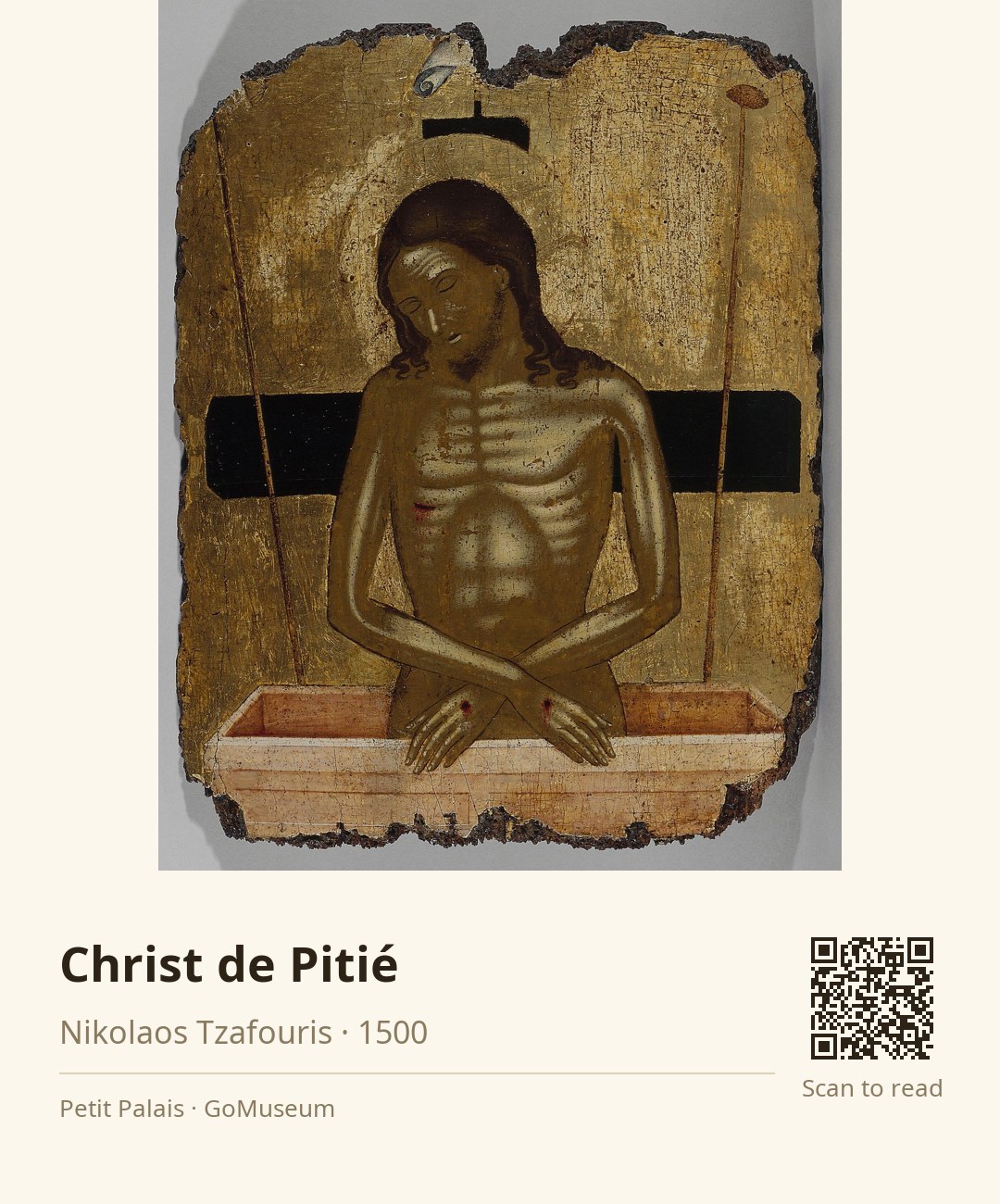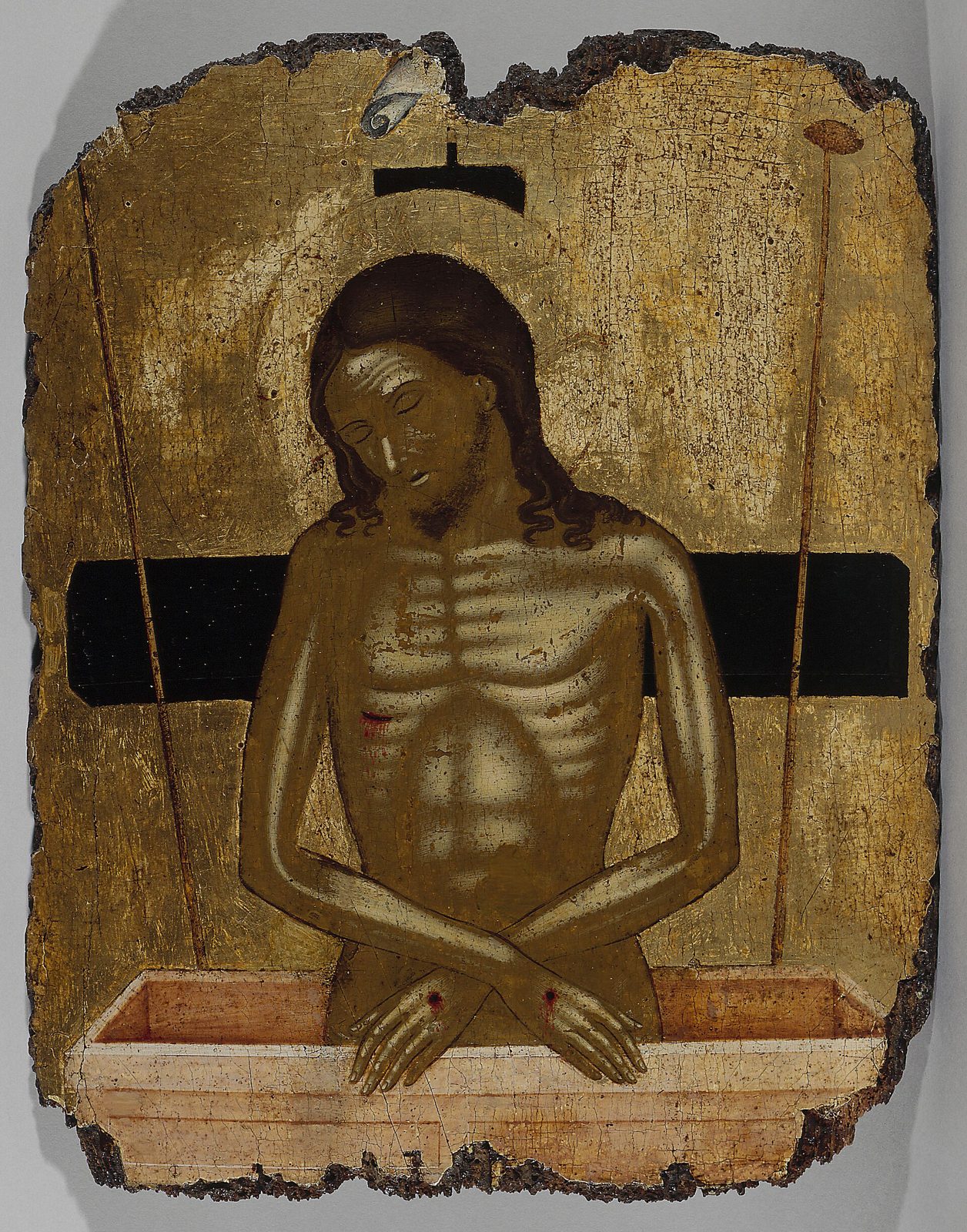
Christ de Pitié
🎧 This work has audio narration — listen in the appThe emaciated figure of Christ in this painting, Christ de Pitié, captures a moment of profound sorrow. His long hair frames a face with closed eyes, and the visible wounds on his hands tell a story of suffering and sacrifice. The crossed arms over his chest suggest a deep resignation, while the rectangular basin beneath him evokes the imagery of a tomb, enhancing the sense of loss.
This portrayal reflects the blend of Byzantine and Italian styles that Nikolaos Tzafouris mastered, a hallmark of the Cretan school he helped establish. The gold leaf background not only adds a luminous quality but also symbolizes divinity, contrasting with the muted flesh tones of Christ’s body. The black bar behind his head creates a stark separation, emphasizing his isolation in this moment of grief. Tzafouris’s technique, influenced by the likes of Giovanni Bellini, allows the viewer to feel the weight of the scene, drawing them into the emotional depth of the subject.
Active in Crete from 1487 until his death around 1501, Tzafouris was known for his religious themes and his workshop produced numerous icons for local churches, establishing a lasting legacy in the region.
Nikolaos Tzafouris, born in Crete in 1468, was a pivotal figure in the Greek Renaissance and a founding member of the Cretan school of painting. Influenced by the renowned Angelos Akotantos, he traveled to Venice to refine his craft, likely studying under Giovanni Bellini. Tzafouris returned to Crete, where he established a successful workshop that produced numerous religious icons, blending Byzantine traditions with emerging Italian styles. His most celebrated work, "Madre della Consolazione," set a new standard for religious art in the region for the next century. Tzafouris's influence extended to later artists like Emmanuel Tzanes and Theodoros Poulakis, marking him as a respected figure in Cretan art history. He remained active until his death in Heraklion around 1501, with several of his signed works, including a triptych Pietà, preserved in esteemed collections today. His legacy is characterized by a unique fusion of styles that shaped the artistic landscape of Crete during a transformative period.
This painting, titled Christ de Pitié, was created by Nikolaos Tzafouris in the year 1500. Tzafouris was active in Crete from 1487 until his death around 1501, and he had a workshop that produced numerous icons for local churches. His works were known for their religious themes and the blending of Byzantine and Italian styles, which he helped establish in the Cretan school. Notably, Tzafouris collaborated with other artists, including Georgios Vlastos and sculptor Nikolaos Varvarigos, on a Catholic church project in Nafplio in 1492, although none of that work survives today. His legacy includes five signed icons that remain, and he was mentioned in a will found in Venetian archives dated February 23, 1537.
In Christ de Pitié, the emaciated figure of Christ is depicted with long hair and closed eyes, his head tilted slightly downward, conveying a deep sense of sorrow. The arms are crossed over his chest, and the visible wounds on his hands starkly emphasize his suffering. The torso is thin, with ribs clearly outlined, enhancing the feeling of vulnerability. The figure is set within a rectangular basin that resembles a tomb, reinforcing the theme of loss. The background is a shimmering gold leaf, which not only adds a divine quality but also contrasts sharply with the muted flesh tones of Christ’s body. A black horizontal bar behind his head creates a stark separation, heightening the sense of isolation. Flanking the figure are two vertical rods, and a small rolled scroll is visible at the top, adding to the composition's complexity. The edges of the panel show signs of age and wear, suggesting its long history.
Christ de Pitié is an example of the Cretan school, showcasing Tzafouris's unique blend of Byzantine and Italian styles. This painting also reflects the religious art that was characteristic of Tzafouris's work, influencing subsequent artists.
One intriguing detail about Nikolaos Tzafouris is that he traveled to Venice to further his painting education, where he was exposed to the works of Giovanni Bellini and may have even trained with him. This experience significantly influenced his artistic style and the techniques he later employed in his own work.
Tzafouris was engaged in various economic affairs, which were documented by historians during his active years in Crete.