The Vale of Tears
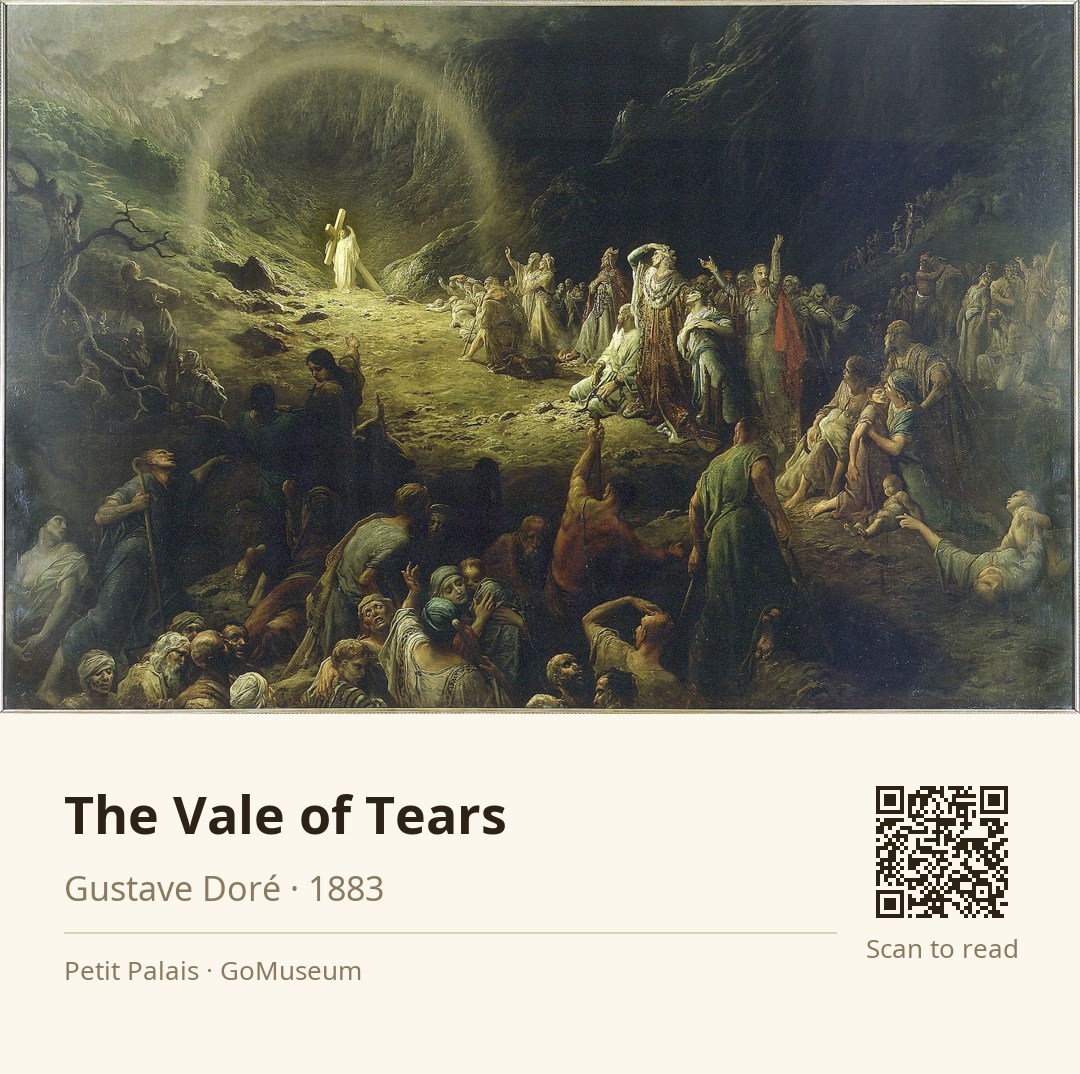
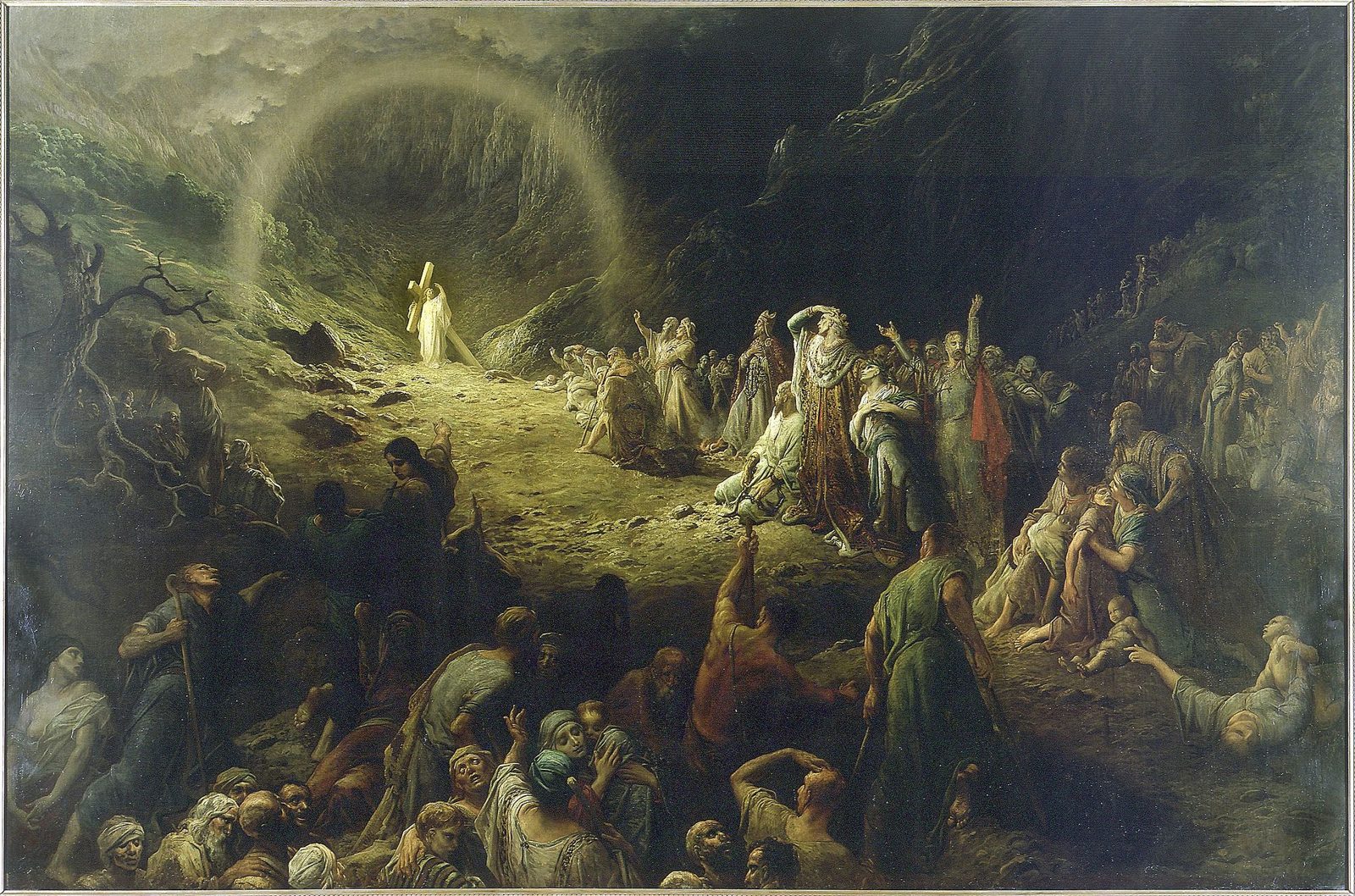
🎧 This work has audio narration — listen in the appA luminous figure in white stands at the entrance of a dark cave, holding a staff and surrounded by a glowing halo. The crowd before him, a mix of men, women, and children, expresses awe and fear, their faces etched with distress as they gaze towards this beacon of hope. The rocky, barren landscape, dominated by dark tones, contrasts sharply with the light emanating from the central figure, emphasizing the gravity of their plight.
This scene, inspired by a verse from the Gospel of Saint Matthew, illustrates the moment when those burdened by suffering turn towards Christ, who beckons them to follow him. The diverse crowd, dressed in Middle Eastern attire, symbolizes humanity’s universal struggle, merging the rich and the poor, the young and the old. Uniquely, Christ occupies the background, allowing the foreground to spotlight the weeping masses, a choice that underscores Doré's humanistic approach, reflecting the emotional weight of their collective sorrow.
Created in 1883, "The Vale of Tears" is one of the monumental works commissioned from Doré following the success of his illustrated Bible. It was exhibited in London for over two decades before being lost to history, only to be rediscovered in a Manhattan warehouse in 1947.
Paul Gustave Doré was a prolific French artist born on January 6, 1832, in Strasbourg. He began his career as a caricaturist at the young age of 15, quickly establishing a reputation for his detailed wood engravings. Doré's illustrations for classic literature, including the Vulgate Bible and Dante's Divine Comedy, garnered international acclaim, leading to the employment of numerous block-cutters to bring his designs to life. His work, while popular among the public, faced mixed reviews from critics during his lifetime.
Doré's artistic journey included notable commissions for works by Cervantes, Rabelais, and Byron, and his illustrations for "Don Quixote" and "The Raven" became iconic. His 1872 publication "London: A Pilgrimage" showcased the city's stark realities, earning both commercial success and critical scrutiny. Despite the challenges he faced, including accusations of exaggeration in his portrayals, his unique vision and talent left a lasting impact on the art world.
Recognized for his contributions, Doré was made a Knight of the Legion of Honour in 1861. His legacy continued to grow posthumously, influencing artists like Vincent van Gogh and earning admiration from literary figures such as H. P. Lovecraft. Doré passed away on January 23, 1883, leaving behind a rich body of work that solidified his place in art history as a master illustrator and visionary.
Gustave Doré's 'The Vale of Tears' was commissioned in 1867, a part of a grand project following the tremendous success of his illustrated Bible. This monumental painting, measuring over 4 meters high and 6 meters wide, was exhibited at the Doré Gallery in London from 1869 until 1892, where it captivated around 2.5 million visitors. After its London run, the painting toured the United States until 1898, but then it faded from public memory. It wasn't until 1947 that it was rediscovered in a Manhattan warehouse, lost among forgotten treasures. The Petit Palais in Paris acquired it in the mid-1980s, ensuring its place in art history.
Doré's technique in 'The Vale of Tears' showcases his mastery of oil painting, particularly in how he captures the emotional intensity of the scene. The brushwork is meticulous, allowing for a vivid portrayal of the crowd's expressions—each face tells a story of suffering and hope. The palette is dominated by dark, earthy tones, which serve to heighten the contrast with the radiant figure of Christ. This luminous figure, painted in bright whites, draws the viewer's eye immediately, creating a focal point that feels almost divine. The composition is dynamic, leading the viewer’s gaze through the rocky landscape towards the figure of Christ, who stands in the background, a deliberate choice by Doré that emphasizes the plight of the masses in the foreground. The scale of the painting enhances its emotional impact, making the viewer feel the weight of the crowd's despair while simultaneously offering a glimmer of hope through the figure of Christ.
Doré started working on 'The Vale of Tears' during the period of his mother's death and finished it just before his own passing.