Sketch for the dining room of the Paris City Hall: Hymn of the Earth to the Sun
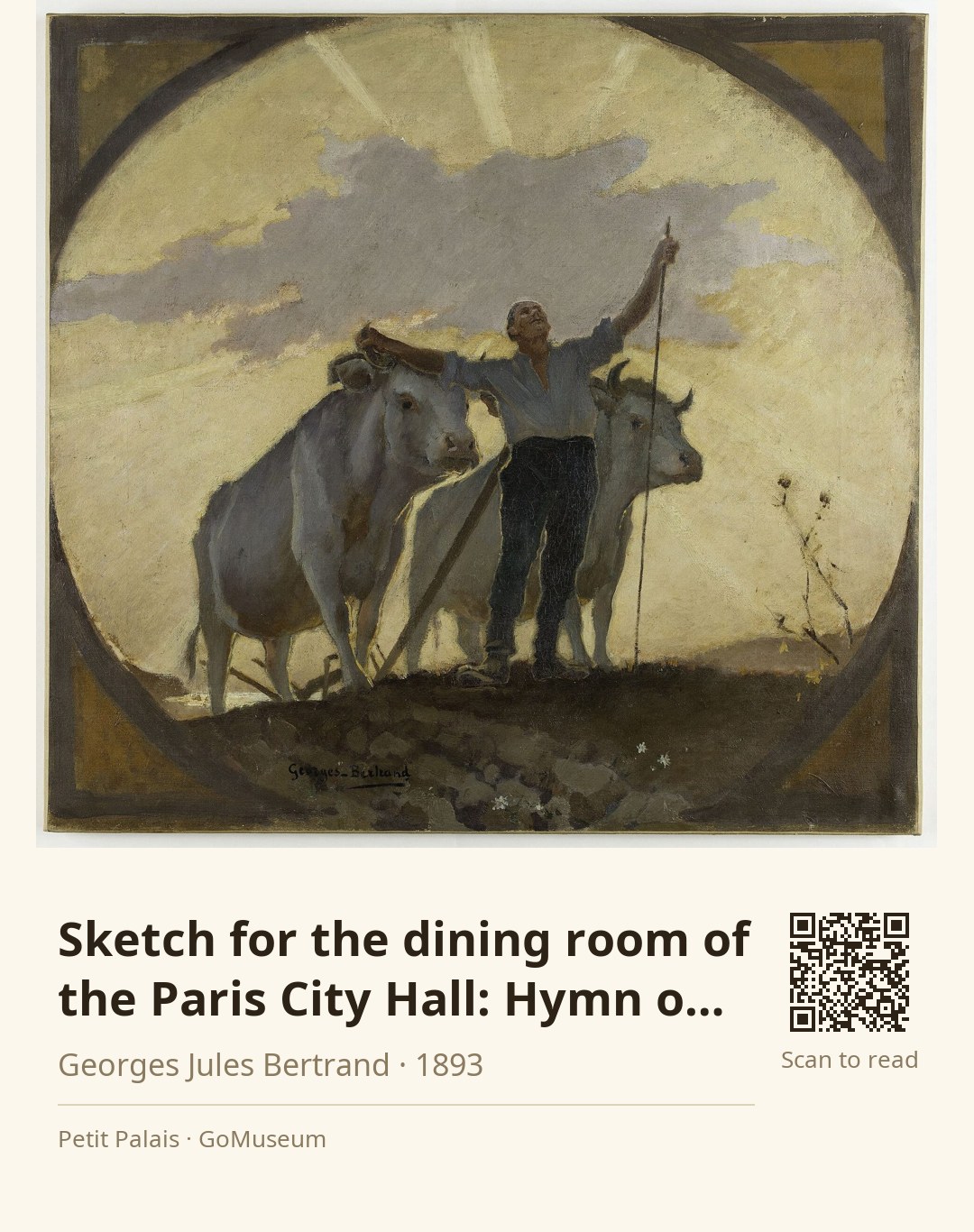
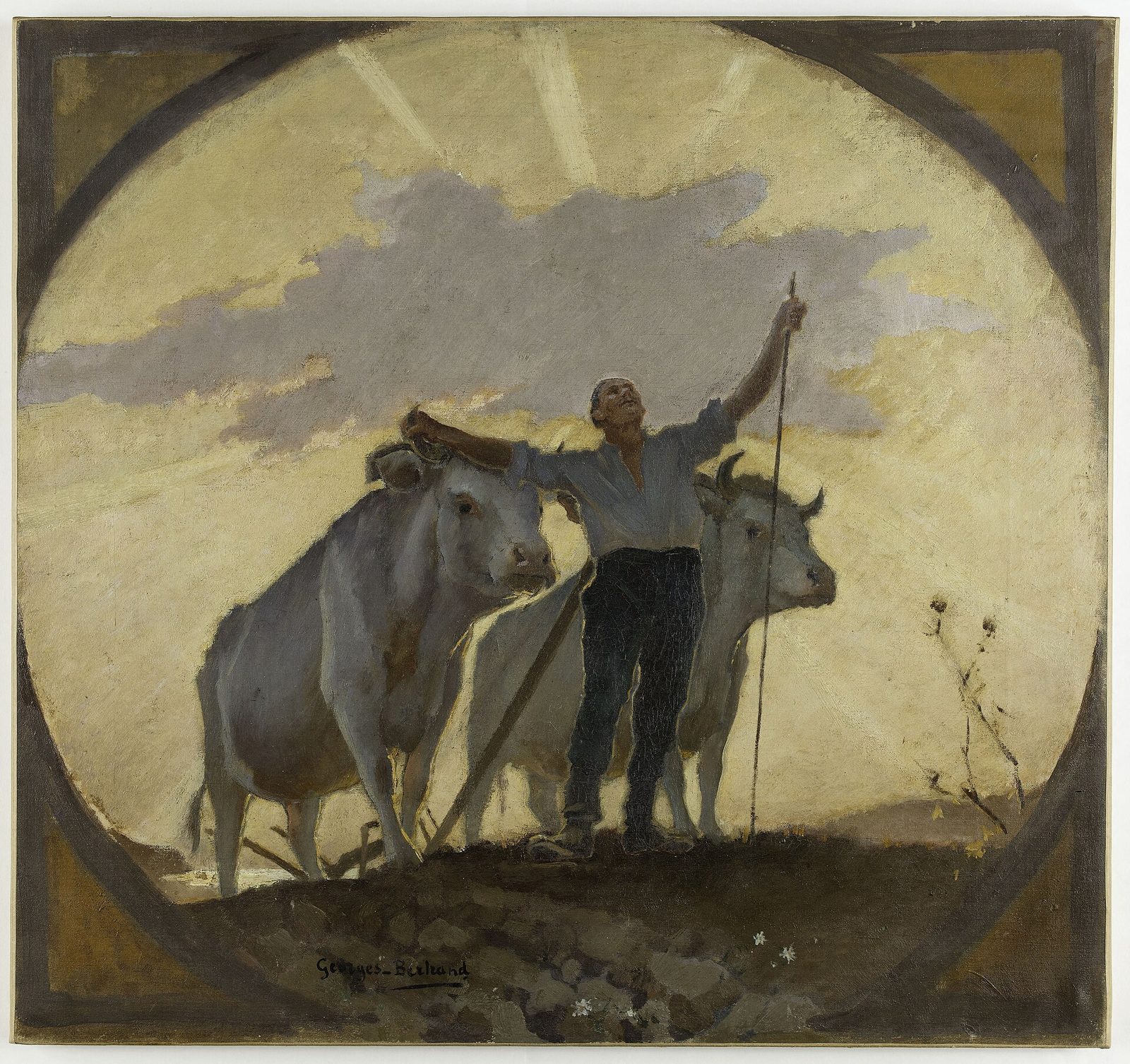
🎧 This work has audio narration — listen in the appA man stands confidently between two large oxen, guiding them with a long stick in his right hand while his left arm is raised, directing their path. Dressed in a light-colored shirt and dark pants, he embodies a sense of authority amidst the earthy tones of the scene, where soft yellows and grays blend seamlessly with the cloudy sky above, suggesting the dawn or dusk of a new day. The circular arch framing this composition draws your eye to the central figures, while delicate flowers and plants in the foreground add a touch of life to the moment.
This portrayal of a humble yet powerful connection between man and nature reflects the artist's intent to celebrate the harmony of earthly labor and the celestial, as indicated by the title "Hymn of the Earth to the Sun." Georges Jules Bertrand, a prominent French painter, was known for his public commissions and significant contributions to the art scene in Paris. His work for the dining room of the Paris City Hall highlights not only his artistic skill but also his role in shaping public spaces through art. In 1893, Bertrand created this sketch, which serves as a testament to his vision of unity between humanity and the natural world.
Georges Jules Bertrand was a French painter born on November 22, 1849, in Paris and passed away on August 11, 1929, in Versailles. He studied under notable artists Félix Barrias and Léon Bonnat, making his debut at the Salon des artistes français in 1876. His significant breakthrough came in 1879 with the painting "La Patrie," which garnered him widespread acclaim. Bertrand became an official artist, receiving numerous public commissions, including the monumental work "Funérailles du président Carnot," displayed at the Panthéon in 1894. He also contributed to the decor of the grand dining hall at the Hôtel de Ville in Paris. In recognition of his contributions to art, he was awarded the Légion d'honneur in 1907. By this time, he had settled in Versailles, where he led the Société Art et Charité. Bertrand's works, characterized by their historical and patriotic themes, secured his place in the annals of 19th-century French art.
Georges Jules Bertrand created this painting, titled 'Hymn of the Earth to the Sun,' in 1893 as a sketch for the dining room of the Paris City Hall. This was a significant commission, reflecting the growing trend of integrating art into public spaces during that era. Bertrand, who was born in Paris in 1849, had already made a name for himself by exhibiting at the Salon des artistes français since 1876. His reputation soared in 1879 with the success of his painting 'La Patrie.' The reception of his works was generally positive, and he became known for his public commissions, including a monumental piece commemorating the funeral of President Carnot at the Panthéon in 1894.
In 'Hymn of the Earth to the Sun,' Bertrand employs a rich palette of earthy tones, primarily soft yellows and grays, which evoke a sense of warmth and connection to the natural world. The brushwork is fluid yet deliberate, allowing the figures of the man and the oxen to emerge with a sense of vitality. The circular arch framing the composition not only directs your attention to the central figures but also creates an inviting space that feels both intimate and expansive. The way light radiates from behind the clouds suggests a divine presence, enhancing the painting's spiritual undertones. The oxen, with their heads slightly lowered, embody a sense of calm obedience, while the man's raised arm signifies authority and guidance. This dynamic interplay between the figures is achieved through careful placement and scale, making the viewer feel the weight of their connection to the earth and the celestial.
Interestingly, Bertrand was not only an artist but also an influential figure in the art community, serving as the president of the Société Art et Charité in Versailles. His commitment to public art and community engagement was recognized when he was awarded the Légion d'honneur in 1907, a testament to his contributions beyond just painting.
The circular arch directs attention to the central figures while creating an inviting space that feels both intimate and expansive.