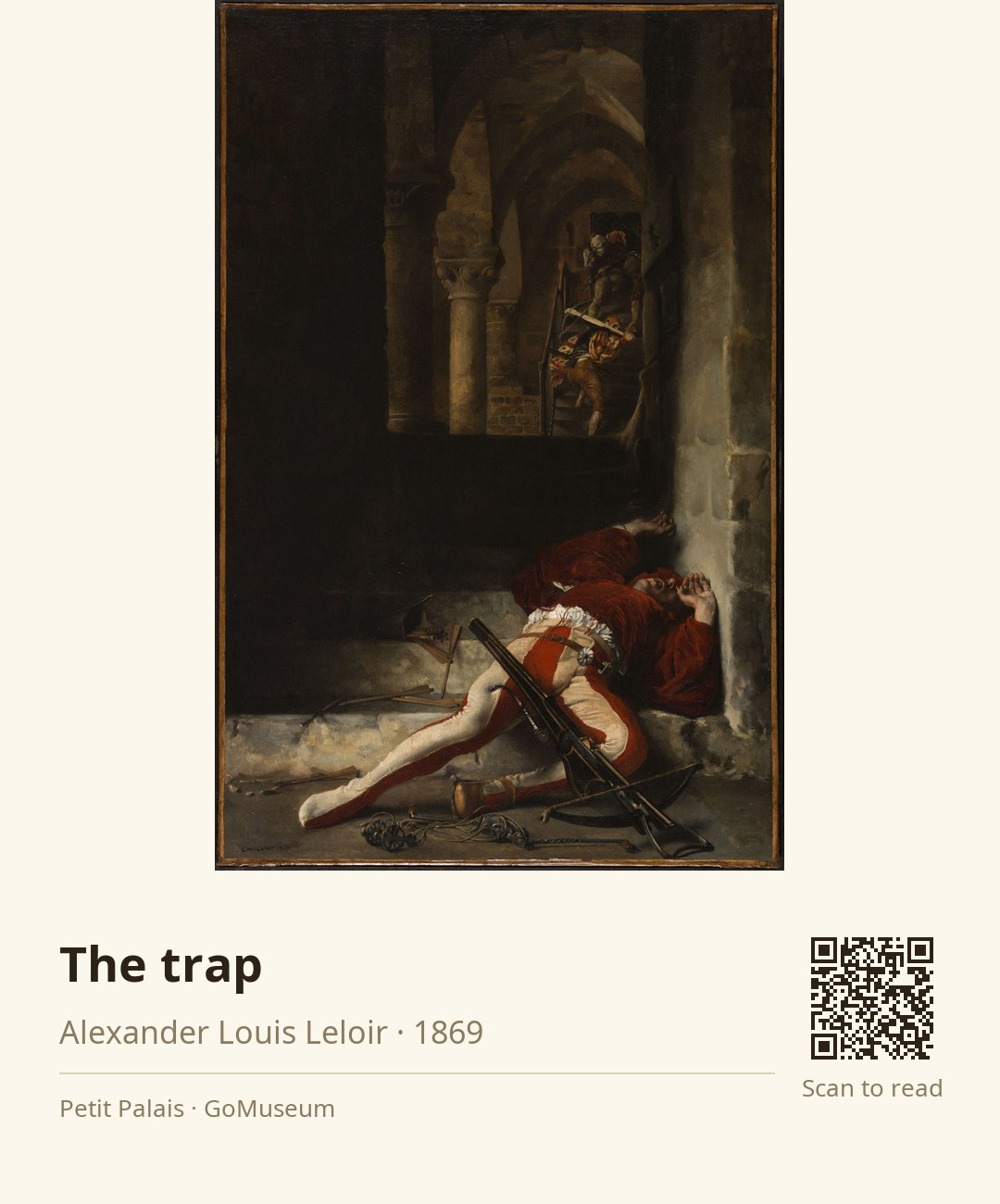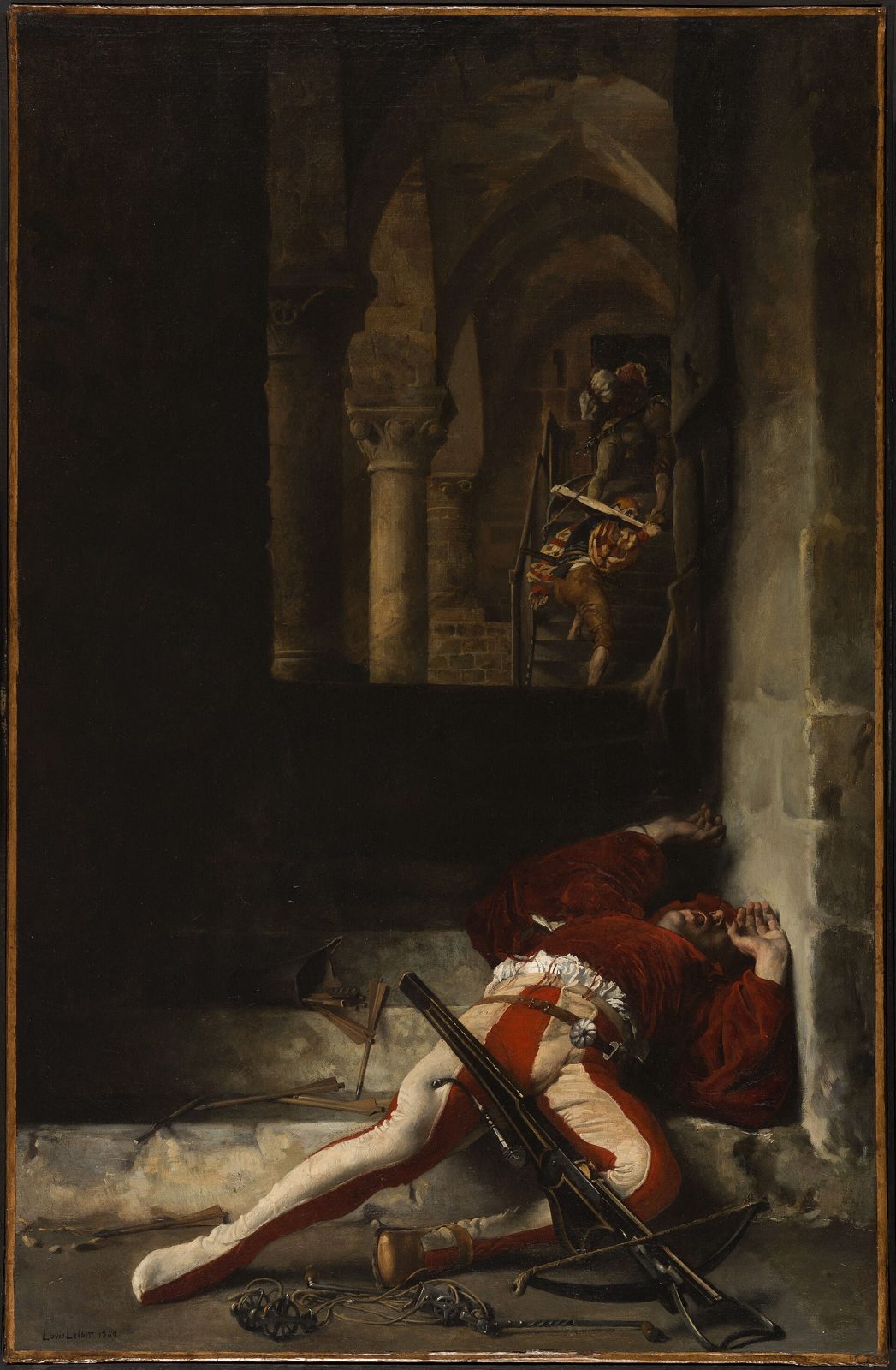
A man in vibrant red and white lies sprawled on the ground, a crossbow and scattered arrows hinting at a violent encounter. Above him, two figures struggle on a staircase, one brandishing a sword while the other appears to retreat, their colorful attire contrasting sharply with the dark, moody palette of the scene.
This dramatic composition, titled "The Trap," immerses you in a moment of tension and conflict, set within a dimly lit, arched interior framed by imposing stone columns. The use of deep shadows and muted tones enhances the sense of confinement and urgency, drawing you into the narrative of ambush and struggle. Leloir's meticulous attention to detail captures not just the physicality of the figures but also the emotional weight of the moment, reflecting the artist's skill in depicting historical and genre scenes.
Created in 1869, "The Trap" showcases Leloir's ability to blend dramatic storytelling with a rich visual language, a hallmark of his work during the second half of the 19th century.
Alexandre-Louis Leloir was a French painter born on March 14, 1843, in Paris, into a family steeped in artistic tradition. His father, Auguste Leloir, and his grandfather, Alexandre-Marie Colin, both contributed to his early artistic education, alongside his mother, a fashion illustrator. Leloir's artistic journey began at the École des Beaux-Arts in 1860, where he sought the prestigious Prix de Rome, achieving notable success with works like "The Death of Priam" and "Homer on the Island of Scyros."
Leloir specialized in historical and genre paintings, showcasing his talent at the Salon from 1863 onwards. His works often depicted scenes from medieval life and the Grand Siècle, infused with a Dutch influence and Orientalist themes. He was also an accomplished illustrator, contributing to notable literary works and co-founding the Society of French Watercolourists in 1879. Recognized for his contributions to art, he was made a Chevalier of the Legion of Honor in 1876. Leloir's legacy endures through his evocative paintings, which continue to resonate in the context of 19th-century French art. He passed away on January 28, 1884.
Leloir's technique in 'The Trap' showcases his mastery of oil painting, particularly in how he handles color and texture. The figures are rendered with a remarkable attention to detail, from the intricate patterns of their clothing to the lifelike expressions on their faces. The brushwork is both precise and fluid, allowing for a dynamic sense of movement amidst the tension of the scene. The dark, moody palette serves to heighten the drama, with deep shadows enveloping the figures and creating a stark contrast against the vibrant reds and whites of the man's attire. The composition draws the eye along the staircase, leading you into the heart of the conflict, while the imposing stone columns frame the action, enhancing the feeling of confinement and urgency.
An interesting tidbit about Leloir is that he was not only a painter but also an illustrator. He contributed illustrations for various literary works, including those of Molière, showcasing his versatility and deep connection to the narrative arts. This duality in his career reflects the broader artistic trends of his time, where literature and visual art often intertwined.