Bicycle at Vésinet
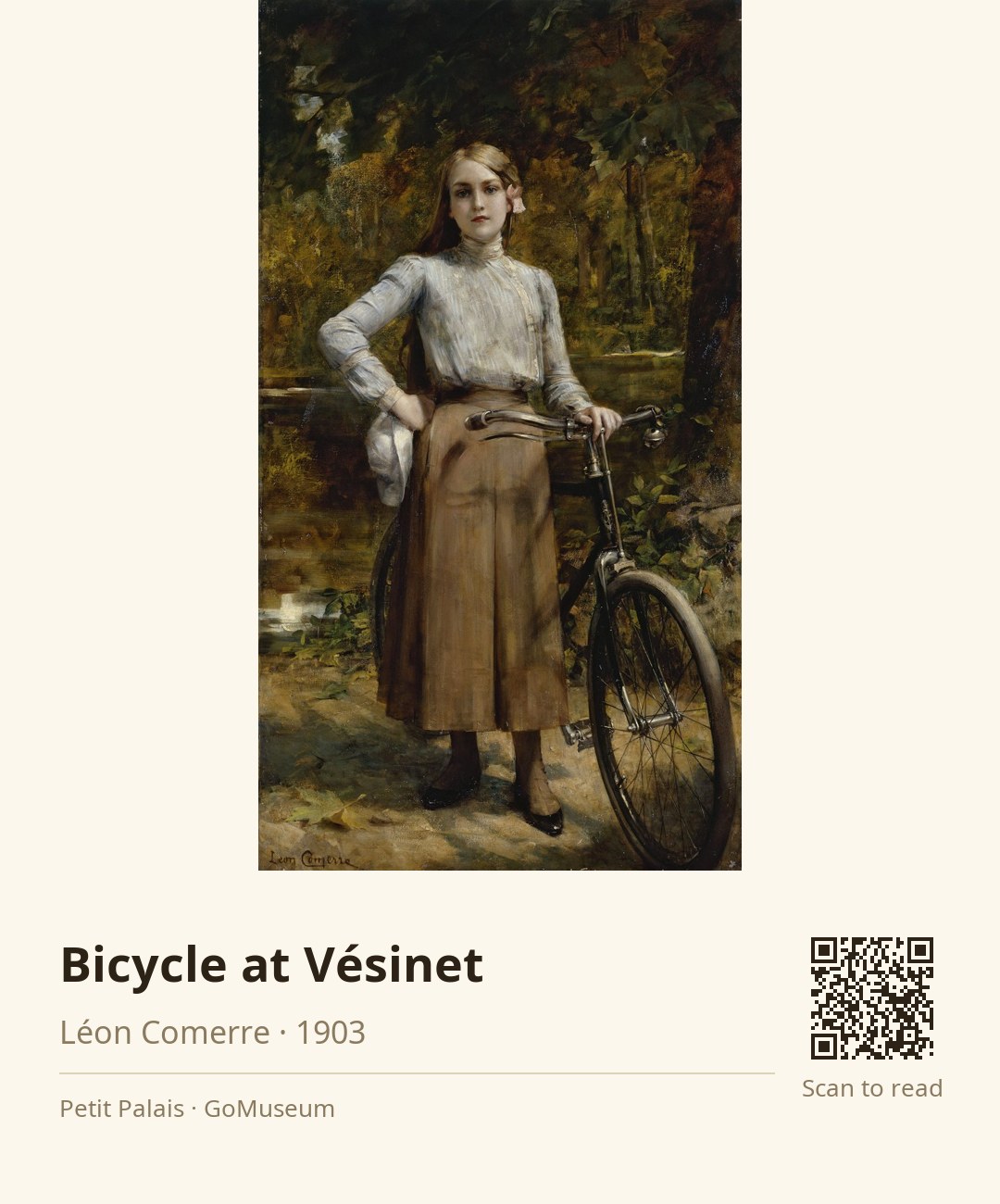
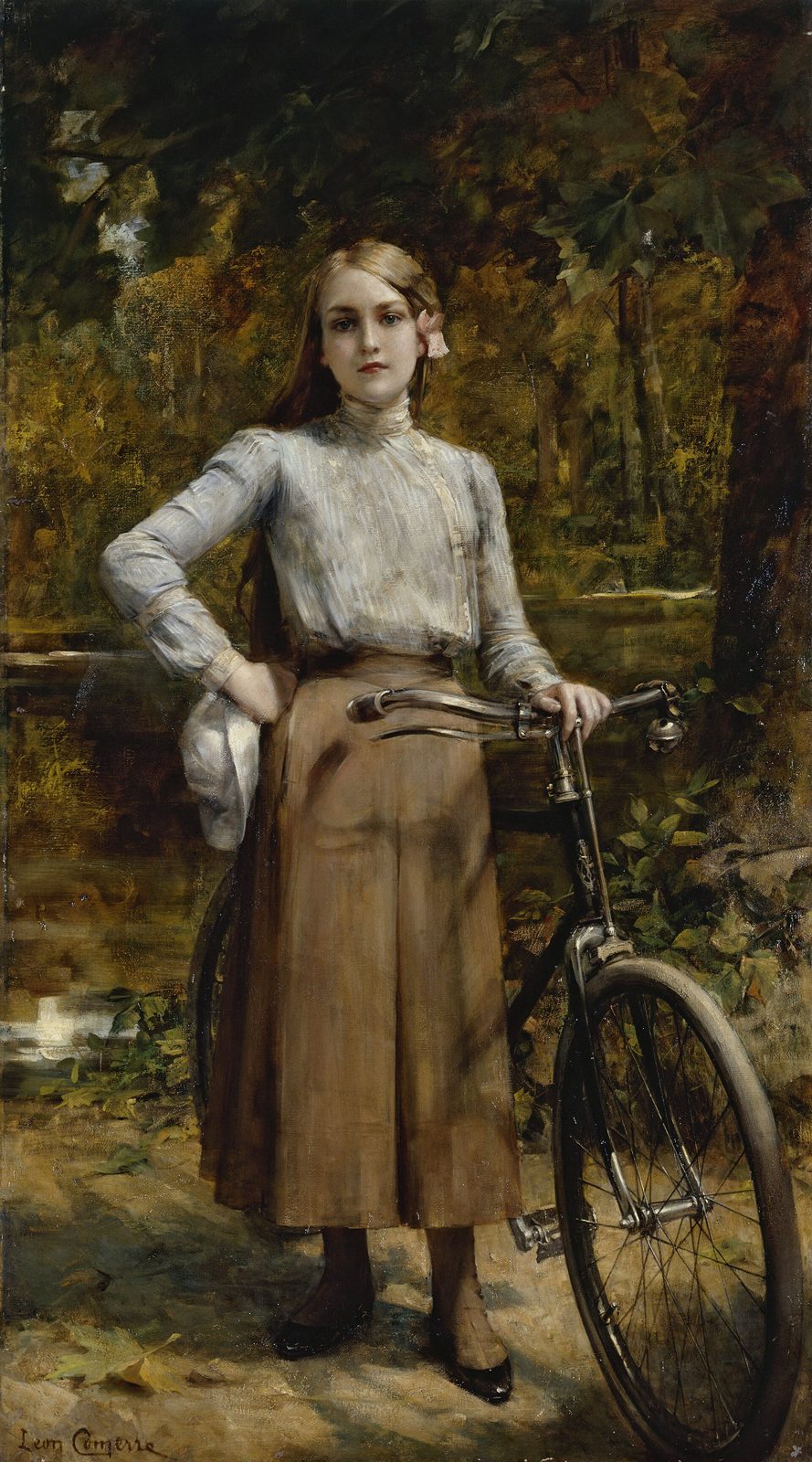
🎧 This work has audio narration — listen in the appA young woman stands confidently beside her bicycle, her right hand resting on her hip, while the other grips the handlebars. Dressed in a long brown skirt and a high-necked white blouse, she embodies the spirit of early 20th-century modernity, accentuated by a pink flower tucked behind her ear. The lush greens and browns of the forest backdrop envelop her, with dappled light filtering through the leaves, creating a vibrant yet serene atmosphere.
This portrayal of Léon Comerre's daughter, George, at the age of fourteen, captures a pivotal moment in women's history. The bicycle, a symbol of newfound freedom, represents a significant shift in societal norms, allowing women greater mobility and independence at a time when such liberties were rare. In this painting, Comerre not only showcases his academic skill through meticulous brushwork and balanced color but also reflects a cultural revolution where cycling became a popular pastime, especially among women of all classes.
Comerre, who lived in Vésinet, painted this work in 1903, encapsulating both personal and societal narratives in a single frame.
Léon François Comerre was a prominent French academic painter born on October 10, 1850, in Trélon. He displayed artistic talent early on, studying under Alphonse Colas in Lille before moving to Paris to further his education at the École nationale supérieure des Beaux-Arts. Influenced by Orientalism, Comerre gained recognition for his exquisite portraits of women and mythological scenes. His career flourished after winning the Grand Prix de Rome in 1875, which allowed him to study in Italy for several years.
Comerre's works, characterized by their vibrant colors and meticulous detail, earned him numerous accolades, including medals at prestigious exhibitions in France and abroad. He became a Knight of the Legion of Honour in 1903 and exhibited widely, including at the Royal Academy in London. His legacy includes a rich body of work that reflects both his academic training and his fascination with the exotic. Comerre passed away on February 20, 1916, leaving behind a significant mark in the realm of academic and Orientalist art.
Comerre's technique in 'Bicycle at Vésinet' is a testament to his academic training, showcasing meticulous brushwork that brings both the figure and the natural surroundings to life. The paint handling is particularly noteworthy; he uses a rich palette of greens and browns to create depth in the forest backdrop, while the dappled light filtering through the leaves adds a dynamic quality to the scene. The composition is carefully balanced, with George's confident stance anchoring the viewer's eye. The long skirt and high-necked blouse are rendered with such precision that you can almost feel the fabric's texture. The bicycle, a modern symbol of freedom, is painted with equal care, its metallic sheen contrasting beautifully with the organic elements of the forest. This attention to detail not only highlights Comerre's skill but also enhances the narrative of a young woman stepping into a new world.
Yes, his wife Jacqueline was also a painter, indicating a shared artistic environment in their household.