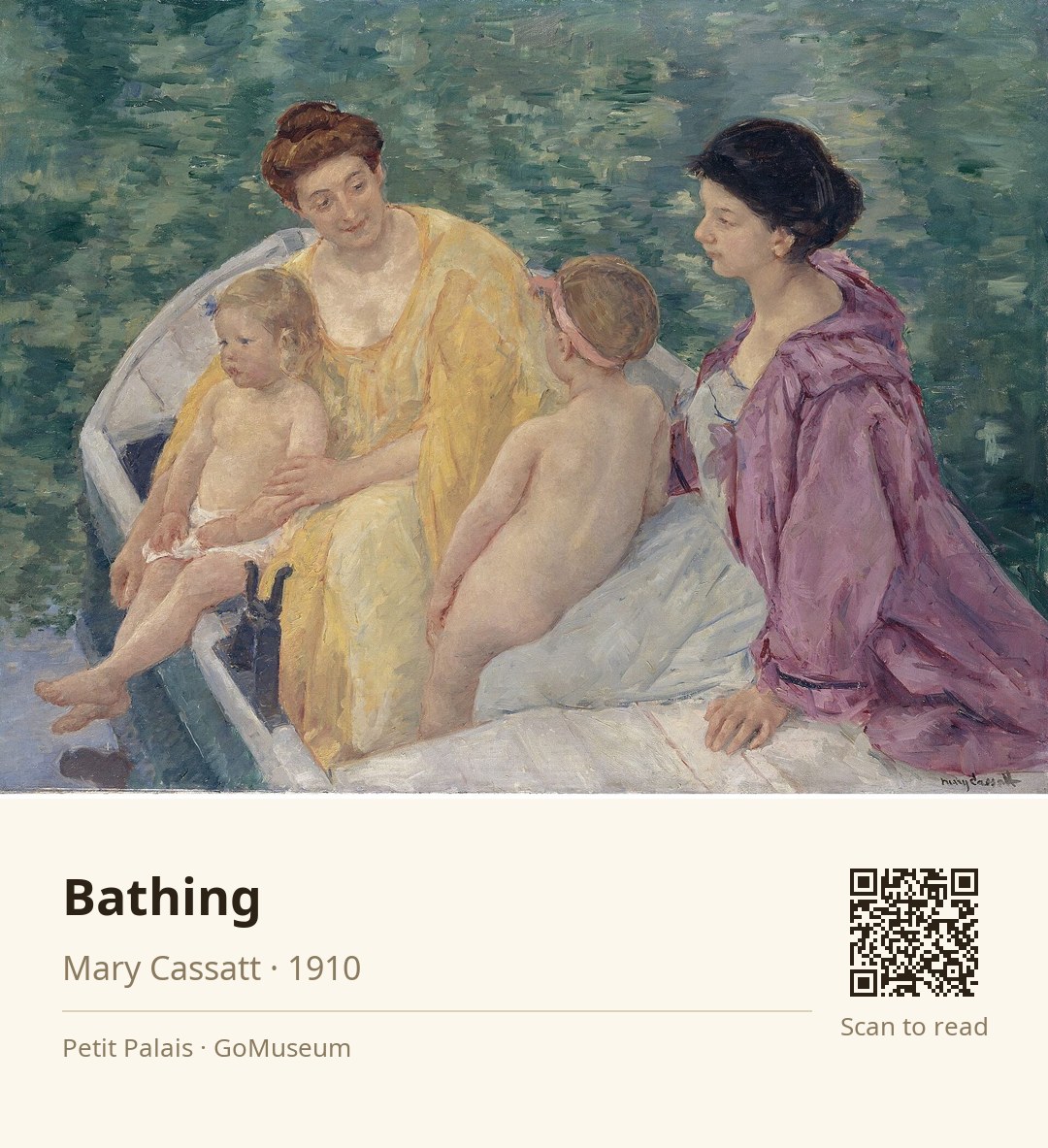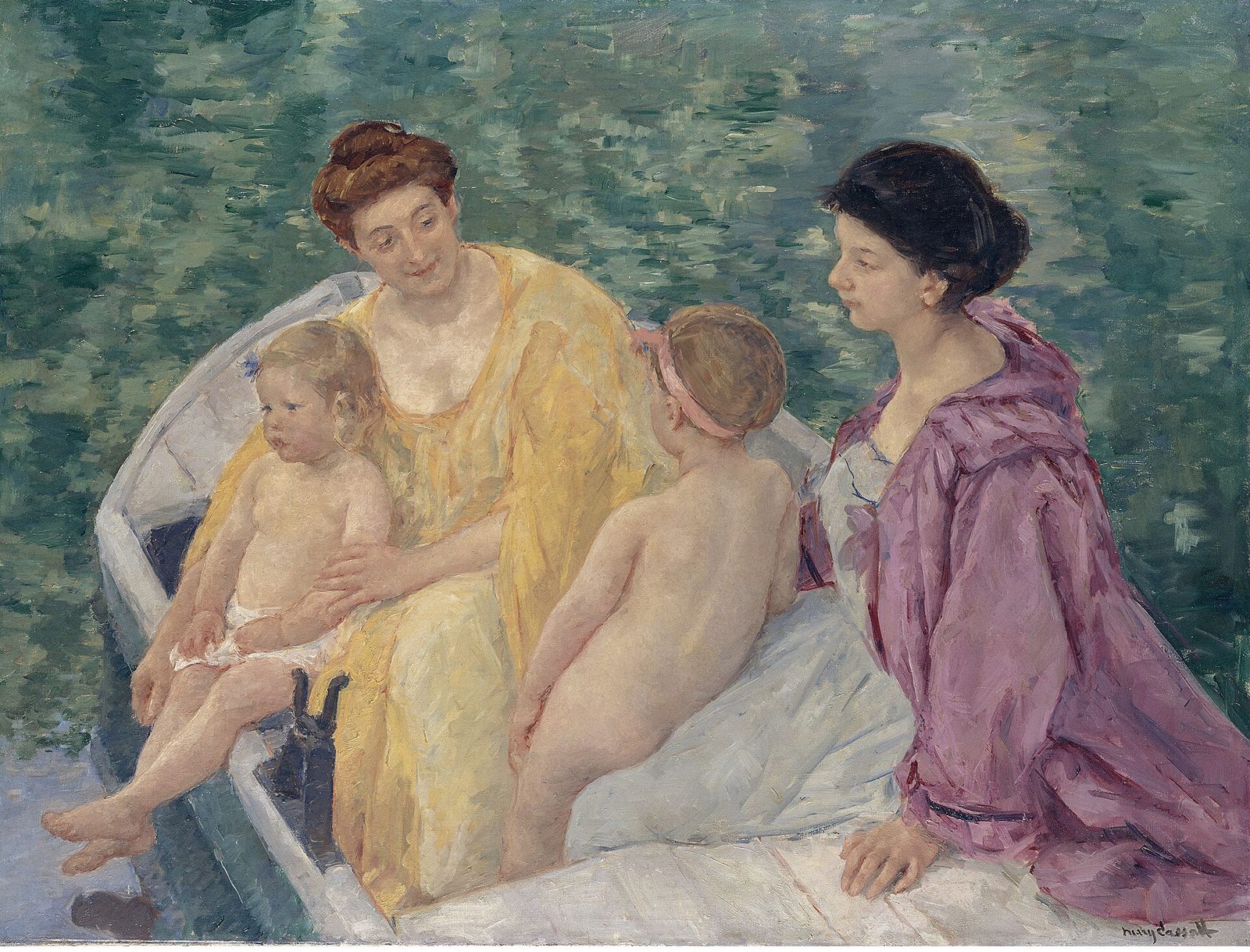
The two women in vibrant dresses, one in yellow and the other in purple, cradle their unclothed children in a small boat, creating an intimate scene of familial connection. The gentle brushstrokes of the water, painted in soothing shades of green and blue, evoke a sense of tranquility that envelops the figures.
This closeness between the mothers and their children reflects Mary Cassatt's lifelong exploration of the bonds shared in women's lives, particularly the nurturing relationship between mothers and their offspring. The choice of a boat as the setting suggests a journey, both literal and metaphorical, emphasizing the shared experiences of motherhood. Cassatt's impressionistic style captures not just the moment but the emotions and interactions that define these relationships, inviting viewers to reflect on their own familial ties.
Mary Stevenson Cassatt was an American painter and printmaker born on May 22, 1844, in Allegheny, Pennsylvania. She spent most of her life in France, where she became a prominent figure in the Impressionist movement, closely associated with Edgar Degas. Cassatt's work primarily focused on the lives of women, particularly the intimate relationships between mothers and children, capturing the nuances of domestic life with sensitivity and depth.
Despite her family's initial objections to her artistic ambitions, Cassatt pursued her passion, studying at the Pennsylvania Academy of the Fine Arts before moving to Paris in 1866. There, she studied under notable artists and developed her unique style, influenced by both the Impressionists and Japanese prints. Her contributions to art were significant, as she played a crucial role in introducing Impressionism to American collectors, notably through her connections with the Havemeyer family.
Cassatt was recognized as one of the three great ladies of Impressionism, alongside Berthe Morisot and Marie Bracquemond. Her work, characterized by its focus on female subjects and domestic scenes, remains celebrated in major museums across Europe and the United States. Cassatt's legacy endures as a pioneering female artist who broke barriers in a male-dominated field, leaving an indelible mark on art history until her death on June 14, 1926.
Mary Cassatt's painting 'Bathing' was created in 1910 and is a significant piece within her body of work, reflecting her focus on the intimate lives of women. Commissioned by Dr. Ernest Goodrich Stillman, the painting was later acquired by the Petit Palais in Paris in 1923, during Cassatt's lifetime. The reception of the work was warm, as it showcased her unique perspective as one of the few female artists associated with the Impressionist movement. Cassatt's ability to capture the essence of motherhood resonated with audiences, and this piece, like many of her others, contributed to her growing reputation in both Europe and America. The painting remains a key part of the museum's collection, highlighting its enduring significance in the art world.
In 'Bathing,' Cassatt employs a loose, fluid brushwork that brings a sense of immediacy and intimacy to the scene. The vibrant colors of the women's dresses—yellow and purple—contrast beautifully with the soothing greens and blues of the water, creating a harmonious balance that draws the viewer in. Cassatt's choice to depict the figures in a slight aerial perspective enhances the feeling of closeness, as if the viewer is privy to a private moment. The textured surface of the water, achieved through visible brushstrokes, adds depth and movement, reinforcing the idea of a shared journey. This technique not only captures the physicality of the scene but also evokes the emotional currents flowing between the mothers and their children.