Portrait of Miss de Lancey
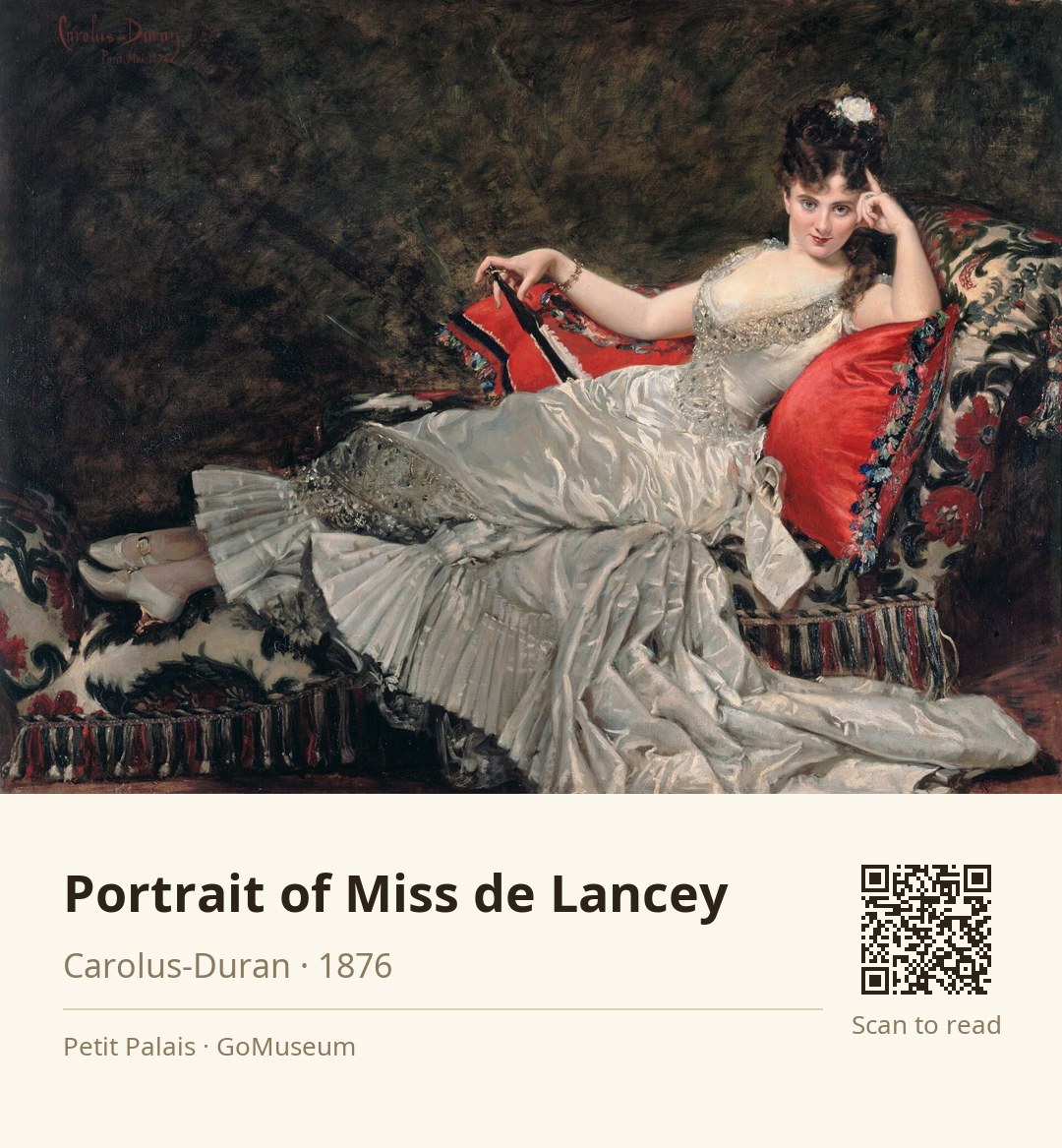
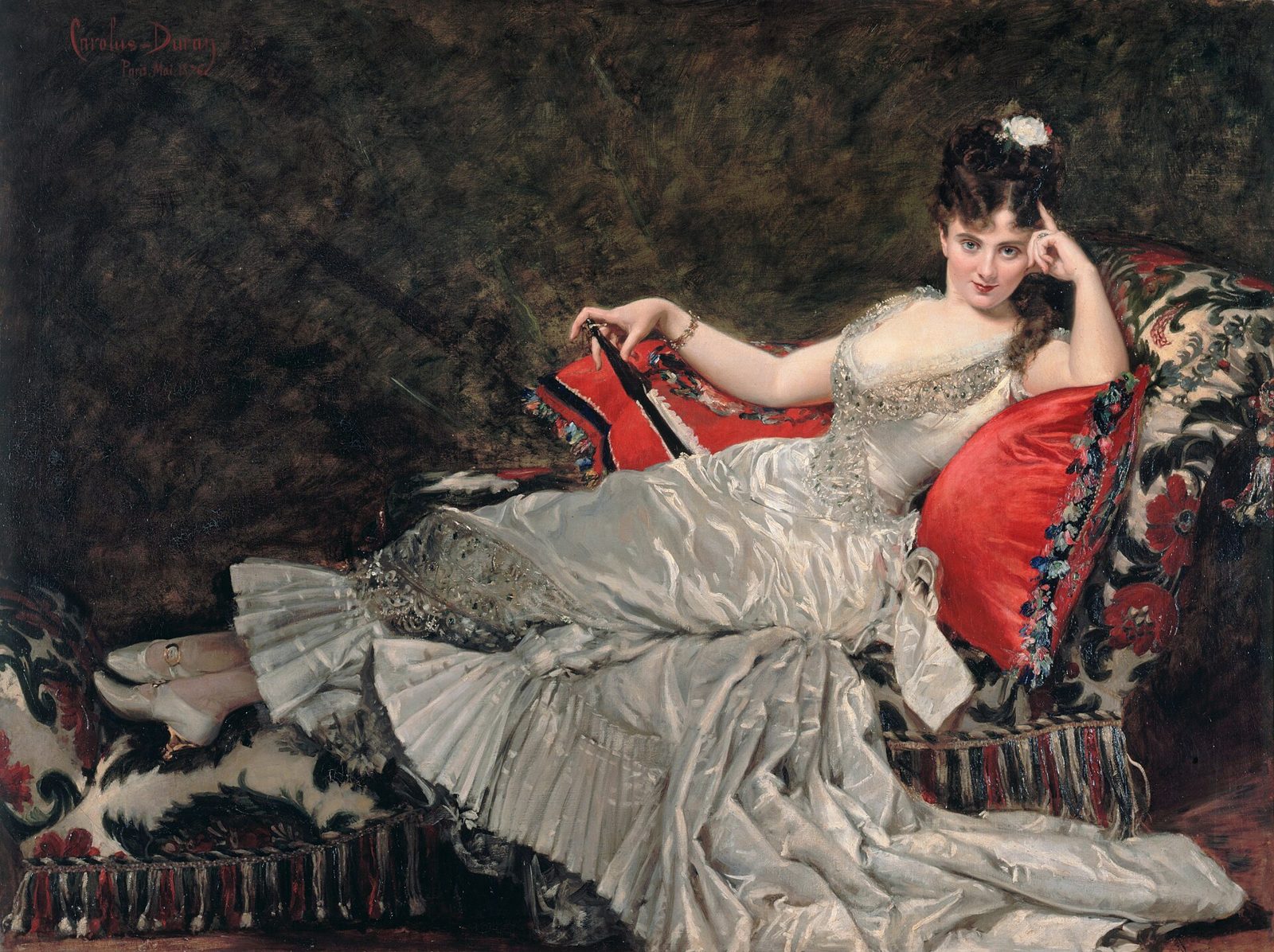
🎧 This work has audio narration — listen in the appAlice de Lancey reclines gracefully on a luxurious sofa, her shimmering white gown adorned with intricate lace and beadwork flowing elegantly around her. The vibrant red and floral cushions provide a striking contrast to her attire, while her contemplative expression and the decorative white flower in her hair add a touch of sophistication to the scene.
This portrayal captures not just a moment of leisure but also the essence of high society in 19th-century France, where elegance and refinement were paramount. Carolus-Duran's choice of a dark, textured background further emphasizes Alice’s presence, drawing the viewer's eye directly to her poised figure. The relaxed yet deliberate positioning of her arms suggests both comfort and confidence, embodying the ideals of femininity and grace of the era.
Created in 1876, this painting was exhibited at the Salon the following year, showcasing Duran's skill in capturing the subtleties of his subjects.
Charles Auguste Émile Durand, known as Carolus-Duran, was a prominent French painter and art instructor born on July 4, 1837, in Lille. He emerged during the Belle Époque, celebrated for his elegant portraits of high society in Third Republic France. His artistic journey began with drawing lessons from a local sculptor, followed by formal studies in painting under François Souchon in Paris, where he adopted his pseudonym.
Durand's early work was influenced by Realism, particularly Gustave Courbet, but he later gravitated towards the style of Diego Velázquez after traveling to Rome and Spain. His breakthrough came with the painting "Murdered," which garnered significant acclaim. He became renowned for his portraiture, capturing the essence of his affluent subjects with a distinctive flair.
As an educator, Durand established a prominent atelier in Paris, mentoring many notable artists, including John Singer Sargent. His contributions to the art world were recognized with numerous honors, including multiple promotions within the Légion d'honneur. He played a crucial role in the art community, co-founding the Société Nationale des Beaux-Arts and serving on juries for major exhibitions.
Durand's legacy is marked by his ability to blend academic techniques with a modern sensibility, making him a key figure in the transition from traditional to contemporary portraiture. He passed away on February 17, 1917, leaving behind a rich artistic heritage that continues to influence artists today.
The 'Portrait of Miss de Lancey' was created in 1876 by the French artist Carolus-Duran, a prominent figure in the art world of the Belle Époque. This painting was commissioned by Alice de Lancey herself, born Julia Tahl in Baltimore, and it was first exhibited at the Salon in 1877, where it garnered attention for its refined portrayal of high society. The reception was mixed; while many praised Duran's technical skill, critics like Émile Zola questioned his adherence to conventional portraiture, suggesting he played it safe rather than pushing artistic boundaries. The painting has been part of the Petit Palais collection since 1915, a testament to its lasting significance and the esteem in which it is held.
The shimmering white gown worn by Alice is rendered with delicate brushwork that mimics the softness of satin, while the intricate lace and beadwork are painted with precision, drawing the viewer's eye to the details. The dark, textured background serves a strategic purpose, enhancing the luminosity of Alice's attire and her skin tone. Duran's use of color is particularly striking; the vibrant red and floral cushions not only contrast with her gown but also create a dynamic visual dialogue that keeps the viewer engaged. The relaxed yet poised positioning of Alice's arms conveys a sense of confidence, embodying the ideals of femininity in 19th-century France. This careful balance of comfort and elegance is what makes the painting so compelling.
An intriguing tidbit about Carolus-Duran is that he was not just a painter but also a significant art instructor. His studio in Paris was a hub for aspiring artists, including many Americans who would go on to become prominent figures in their own right. Notably, John Singer Sargent, who studied under Duran, once exhibited a portrait of his mentor, inscribing it with a heartfelt tribute to the man who shaped his artistic journey. This connection highlights the profound impact Duran had on the next generation of artists.
Carolus-Duran was a prominent art instructor whose studio in Paris became a hub for aspiring artists, influencing many who would later achieve fame.
John Singer Sargent honored Carolus-Duran by exhibiting a portrait of him, which included a heartfelt tribute acknowledging Duran's influence on his artistic development.