The Roe Deer
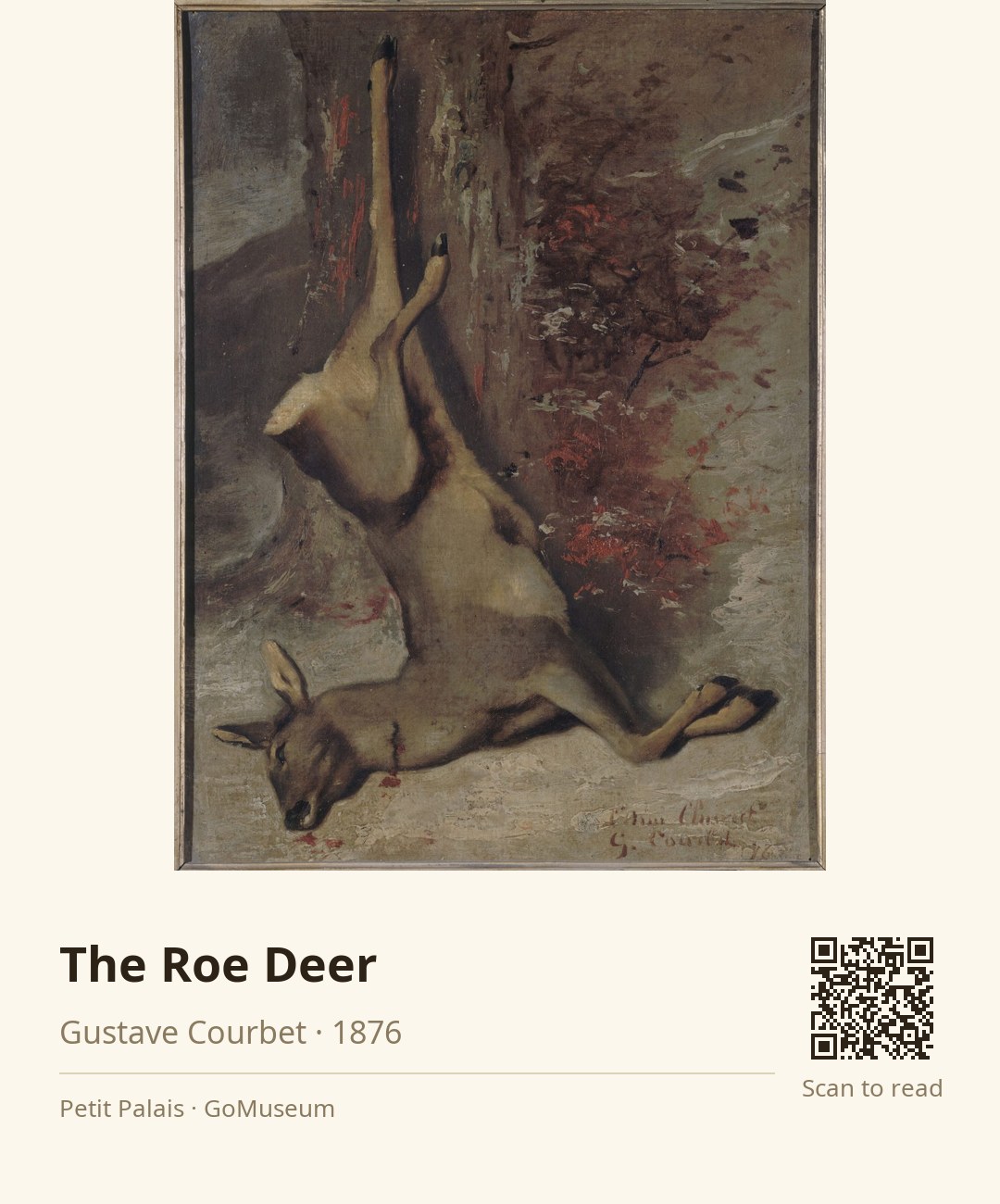
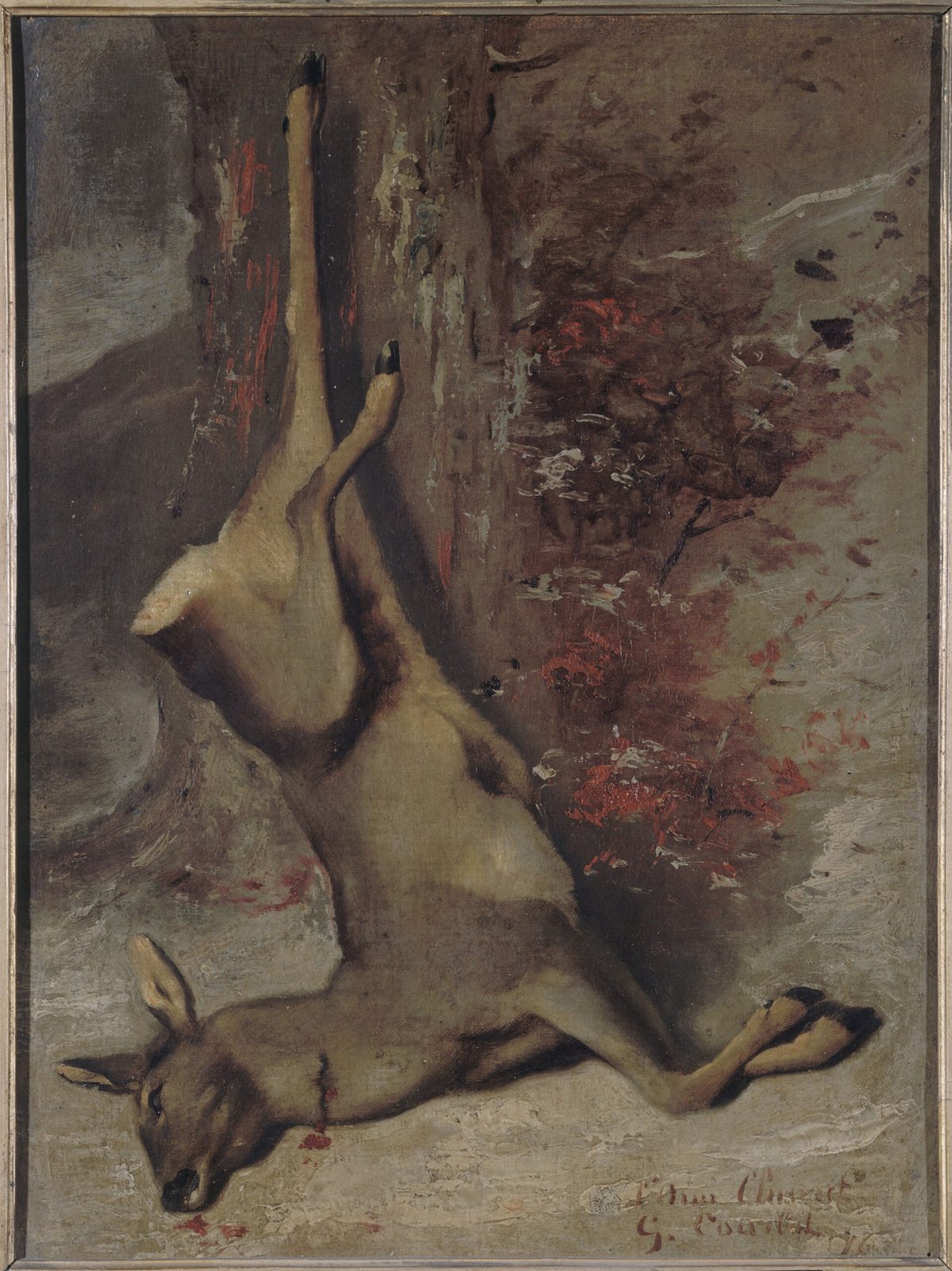
🎧 This work has audio narration — listen in the appThe lifeless roe deer sprawled on its back draws your eye with its stark vulnerability, its legs awkwardly extended towards the sky. Blood-red marks around its neck and head starkly contrast with the earthy browns and grays of the background, creating a haunting image that evokes a sense of loss and mortality.
This raw depiction captures the essence of Gustave Courbet's commitment to realism, where the unvarnished truth of nature is laid bare. The rough brushwork and expressive handling of paint emphasize the visceral reality of the scene, inviting you to confront the harshness of life and death. Courbet's choice to focus solely on the deer, devoid of any surrounding elements, intensifies the emotional weight of the moment, making it a powerful statement on the fragility of existence.
Courbet, a pivotal figure in 19th-century French painting, was known for his rejection of romantic idealism and academic conventions, instead opting to portray the world as he saw it. His work often challenged societal norms and depicted the lives of ordinary people, making bold statements about the human condition. In 1876, he created "The Roe Deer," a work that exemplifies his dedication to capturing the raw essence of life through unflinching realism.
Gustave Courbet, born on June 10, 1819, in Ornans, France, was a pioneering painter who championed the Realism movement in 19th-century art. Rejecting the conventions of academic painting and the idealism of Romanticism, he focused on depicting the world as he observed it, often portraying unidealized peasants and workers in monumental compositions. His early works gained recognition, notably "After Dinner at Ornans," which won him a gold medal at the Salon of 1849, allowing him to exhibit without jury approval.
Courbet's commitment to realism was revolutionary; he believed that art should stem from personal experience rather than historical or mythological themes. His bold approach often sparked controversy, challenging societal norms and addressing social issues, which resonated with later movements like Impressionism and Cubism. Despite facing criticism and imprisonment for his political involvement during the Paris Commune, Courbet continued to create until his death on December 31, 1877, in Switzerland.
His legacy endures as a transformative figure in art history, whose unflinching depictions of everyday life laid the groundwork for modern artistic expression. Today, Courbet is celebrated for his vigorous and uncompromising work, which continues to engage audiences with its raw honesty and depth.
In 1876, Gustave Courbet painted 'The Roe Deer,' a piece that would come to exemplify his commitment to realism. This work was created during a period when Courbet was already a well-established figure in the art world, known for his unflinching depictions of nature and human life. The painting was likely inspired by his own experiences in the French countryside, where he often hunted and found inspiration. Courbet's bold approach to realism was met with mixed reactions; while some praised his raw honesty, others were scandalized by his rejection of traditional ideals. 'The Roe Deer' was part of a larger body of work that challenged the norms of the Paris Salon, which favored idealized subjects. This painting, along with others, helped solidify Courbet's reputation as a pioneer of the Realism movement, influencing countless artists who followed in his footsteps. After Courbet's death in 1877, his works continued to circulate among collectors and were shown in various exhibitions, further cementing his legacy in the art world.
Courbet's technique in 'The Roe Deer' is strikingly visceral, characterized by rough brushwork that conveys a sense of immediacy and raw emotion. He employs a limited yet impactful color palette dominated by earthy browns, grays, and stark reds, which not only enhances the somber mood but also draws attention to the lifeless deer. The brushstrokes are visible and expressive, suggesting a direct engagement with the subject rather than a polished, idealized representation. This choice reflects Courbet's philosophy of painting only what he could see, capturing the unvarnished truth of nature. The composition is tightly focused, with the deer occupying the entire canvas, creating an intense emotional impact. By eliminating any background distractions, Courbet forces the viewer to confront the stark reality of death and vulnerability, making the painting a powerful statement on existence.
Courbet was involved in the Paris Commune of 1871, which led to his imprisonment for six months and subsequent exile in Switzerland.
Courbet gained recognition through his paintings from the late 1840s and early 1850s, which depicted unidealized peasants and workers.
Courbet's technique in 'The Roe Deer' features rough brushwork that emphasizes immediacy and raw emotion, contrasting with the polished styles typical of traditional painting.