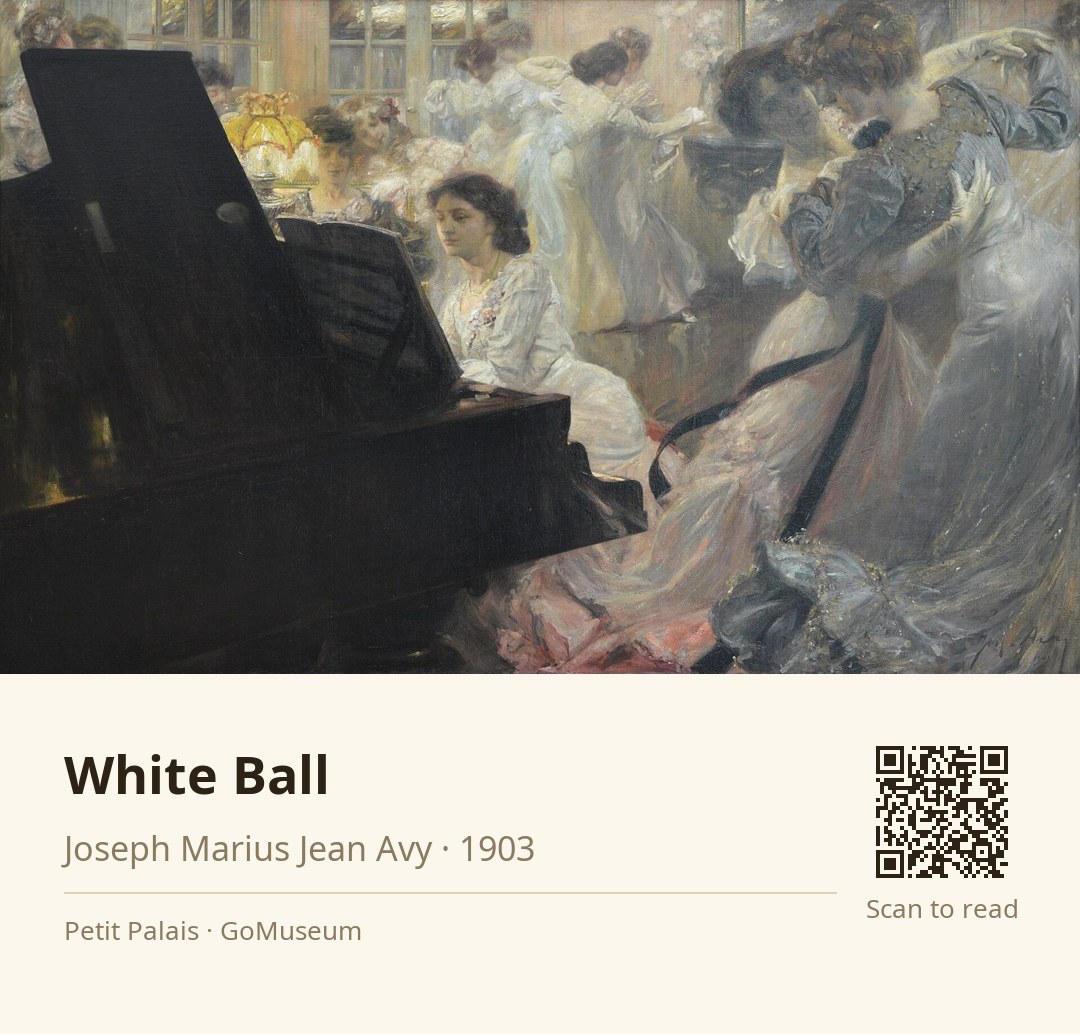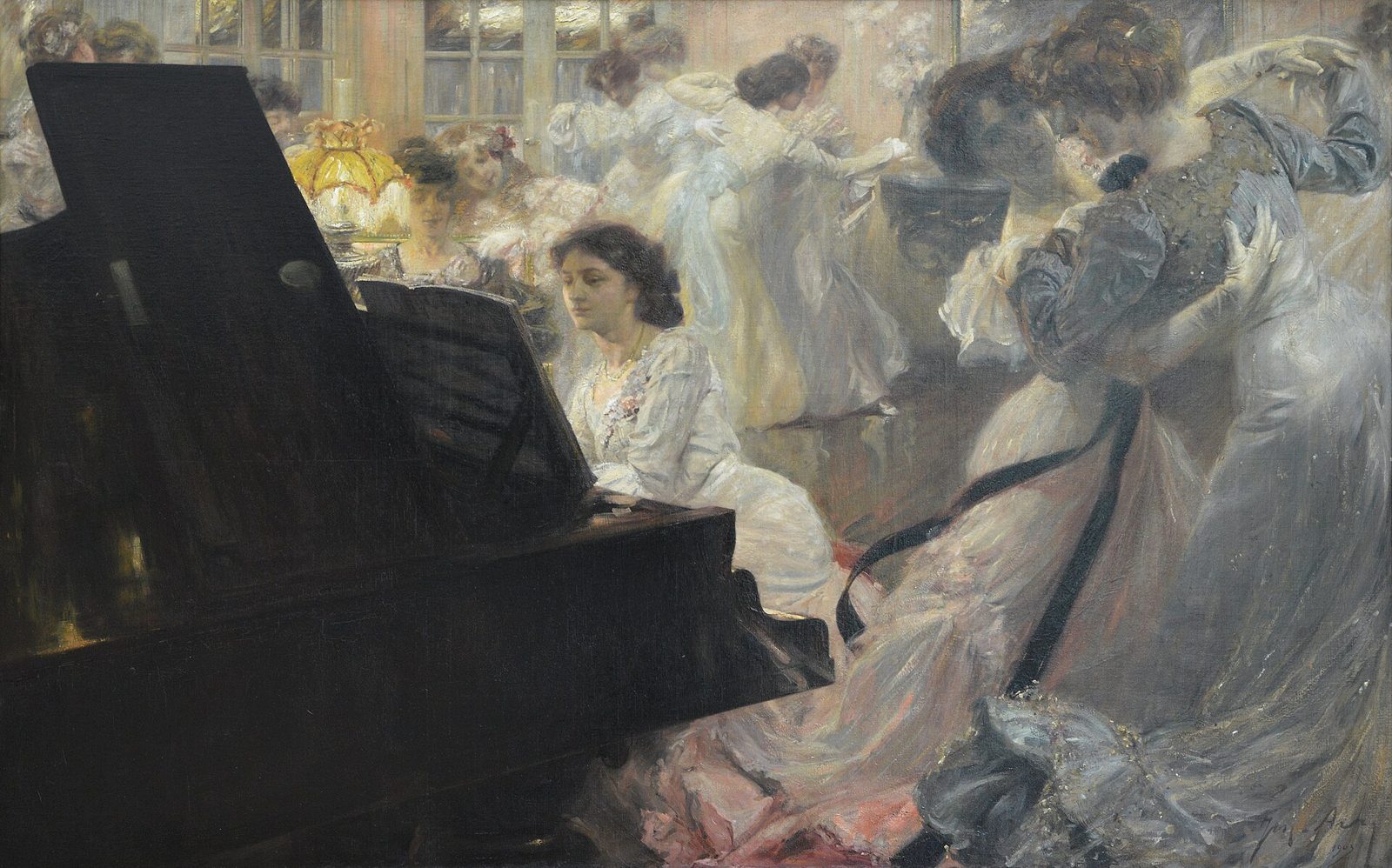
The elegant woman at the piano, dressed in a flowing white gown, captures the essence of a lively soirée in Joseph Marius Jean Avy's "Bal blanc." Her focused expression contrasts with the joyful couple dancing nearby, their attire reflecting the early 20th-century fashion, complete with flowing dresses and formal suits. The soft lighting from the lamp on the piano bathes the scene in a warm glow, enhancing the atmosphere of celebration.
Avy's choice of a muted pastel palette, punctuated by the dark piano, creates a harmonious balance that draws the viewer into this intimate gathering. The fluid brushwork conveys movement, making the figures appear almost alive, as if they are caught in a moment of shared joy. This painting not only showcases Avy’s skill in capturing the dynamics of social life but also reflects the cultural vibrancy of the early 1900s, a time when such gatherings were central to Parisian society.
Created in 1903, "Bal blanc" was exhibited at the Salon de la Société des Artistes Français, where Avy regularly showcased his work.
Joseph-Marius Avy, born in Marseille on September 21, 1871, was a prominent French painter known for his landscapes, genre scenes, and wall decorations. Coming from a wealthy family, he pursued his artistic inclinations in Paris, studying under notable artists Léon Bonnat and Albert Maignan. Avy became a regular exhibitor at the Salon des artistes français from 1900 to 1933 and later at the Salon de la Société nationale des beaux-arts until his death in 1939.
His artistic achievements included winning the Marie Bashkirtseff Prize in 1900 and receiving multiple honors, such as the Knight and later Commander of the Legion of Honor. Avy was also decorated for his service in World War I. His works often featured vibrant Italian landscapes and dynamic scenes of social life, with pieces like "Bal en blanc" showcasing his mastery of color and composition.
In his personal life, Avy married Germaine Besnard in 1909, assisting in the decoration of the Petit Palais, and later wed Clotilde Pregniard shortly before his passing. Avy's legacy endures in the art world, marked by his contributions to early 20th-century French painting and his distinct style that captured the vibrancy of life.
In 1903, Joseph Marius Jean Avy created 'Bal blanc,' a painting that would soon find its place at the prestigious Salon de la Société des Artistes Français. This event was significant for Avy, who was a regular exhibitor there, showcasing his talent among the artistic elite of the time. Over the years, 'Bal blanc' has remained in the collection of the Petit Palais, a testament to its enduring appeal and the artist's legacy.
The fluid brushwork gives life to the figures, conveying a sense of movement that draws you into the scene. The use of a muted pastel palette creates a soft, inviting atmosphere, while the dark piano serves as a striking contrast, grounding the composition. This choice not only highlights the elegance of the woman at the piano but also enhances the overall harmony of the piece. The scale of the painting, with its dimensions of 139 by 219 centimeters, allows for an immersive experience, inviting viewers to feel as if they are part of the soirée. Avy's ability to blend color and form creates a dynamic interplay that captures the essence of celebration and social interaction.
A fascinating tidbit about Avy is that he was awarded the Marie Bashkirtseff Prize in 1900, just a few years before creating 'Bal blanc.' This recognition not only marked a significant milestone in his career but also highlighted his potential as a leading figure in the art world. Interestingly, Avy was also known for his decorations, including the wedding hall of the Rotterdam Town Hall, showcasing his versatility as an artist beyond just painting.
Avy received the Marie Bashkirtseff Prize in 1900, which marked a significant milestone in his career.
Avy was known for his decorative work, including the wedding hall of the Rotterdam Town Hall, highlighting his versatility as an artist.
Avy was awarded the Cross of War for his service during World War I.